
Shanghai AI Lab · 2026-11-15 · major
Sage S2.1 Flash — an open 320B model that reads molecules, spectra and EEG
In short
Sage S2.1 Flash is Shanghai AI Lab's MIT-licensed 320B MoE for science agents. It takes molecules, proteins, spectra and EEG as input and scores 90.3 on MLE-bench Lite, ahead of Claude Opus 5 in the lab's table.
Shanghai AI Lab · 2026-11-15 · 3 sources checked
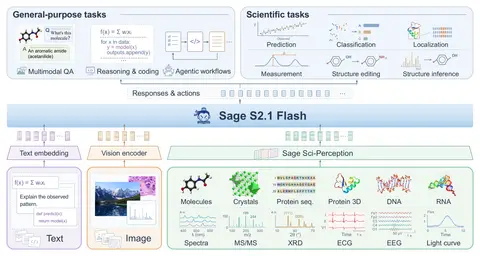
A 320B open-weight model that can take a molecule, a protein or a spectrum as input, then search, code and run experiments.
Key specs
| Mle bench lite | 90.3 |
|---|---|
| Osworld verified | 85.2 |
Quick facts
| Maker | Shanghai Artificial Intelligence Laboratory (InternLM) |
|---|---|
| Size | 320B MoE, 288 experts, 8 active per token |
| License | MIT (code and weights) |
| Scientific inputs | 10+ types: molecules, crystals, proteins, DNA, RNA, spectra, ECG, EEG |
| Position limit | 1,048,576 tokens (config) |
| Availability | BF16 + FP8 weights on Hugging Face and ModelScope |
| Technical report | arXiv 2611.21072 (16 Nov 2026) |
Benchmarks
| Sage S2.1 Flash | 90.3% | |
|---|---|---|
| DeepSeek-V4.1-Flash-1017 | 89.2% | |
| Claude Opus 5 | 88% | |
| GLM-5.3-Flash | 84.3% | |
| Qwen3.8-Max | 82.2% | |
| GPT-5.6 Sol | 80.7% |
| Claude Opus 5 | 86.4% | |
|---|---|---|
| Sage S2.1 Flash | 85.2% | |
| Qwen3.8-Max | 84.3% | |
| GLM-5.3-Flash | 83.5% | |
| GPT-5.6 Sol | 82.2% | |
| DeepSeek-V4.1-Flash-1017 | 78.5% |
| Claude Opus 5 | 76.5% | |
|---|---|---|
| Qwen3.8-Max | 65.3% | |
| DeepSeek-V4.1-Flash-1017 | 61.8% | |
| Sage S2.1 Flash | 60.6% | |
| GLM-5.3-Flash | 60.3% | |
| GPT-5.6 Sol | 59.8% |
What is it?
Sage S2.1 Flash is a new open-weight scientific multimodal model from Shanghai AI Lab, released under the MIT License on 15 November 2026. Besides text and images, it accepts more than ten kinds of scientific data, from molecular graphs and protein 3D structures to spectra, ECG and EEG traces. The lab built it for multi-round research work that mixes reading data, web search, programming and tool use.
How does it work?
Under the hood, Sage S2.1 Flash is a Mixture-of-Experts with 288 experts and 8 active per token. A module called Sage Sci-Perception uses dedicated encoders and projectors to turn each scientific input into embeddings in the same space as text, so one backbone handles everything. Agent skills were trained in verifiable environments, where success is checked against execution results, environment state or submitted files.
Why does it matter?
Research teams get one self-hostable MIT model that reads lab data such as spectra or protein structures directly, instead of only text about them. In the lab's own comparison it leads GPT-5.6 Sol and Claude Opus 5 on MLE-bench Lite and OfficeQA Pro, but it is clearly behind on agentic coding (60.6 vs 76.5 on SWE-bench Pro).
Who is it for?
AI-for-science researchers, ML engineers, teams self-hosting agents
Frequently asked questions
- Is Sage S2.1 Flash open source?
- Sage S2.1 Flash is released under the MIT License, which the model card says covers both the code and the model weights. BF16 and FP8 checkpoints are on Hugging Face under the InternLM organisation and on ModelScope, so teams can download, fine-tune and self-host the model, including for commercial work.
- How do you give Sage S2.1 Flash a molecule or a spectrum?
- For scientific inputs, the Sage S2.1 Flash model card says to download the projector from the model repository and the loading scripts from Sage-SciPerception, serve the model with vLLM with prompt embeddings enabled, then send the combined embeddings to the completions endpoint. Plain coding or office tasks use the normal deployment guide.
- How does Sage S2.1 Flash compare with Claude Opus 5?
- In Shanghai AI Lab's own table, Sage S2.1 Flash beats Claude Opus 5 on MLE-bench Lite (90.3 vs 88.0), OfficeQA Pro (72.2 vs 67.2) and SpreadsheetBench 2 (37.1 vs 33.6). Claude Opus 5 stays ahead on agentic coding, with 76.5 against 60.6 on SWE-bench Pro, and on OSWorld-Verified (86.4 vs 85.2).
- How was Sage S2.1 Flash evaluated?
- The Sage S2.1 Flash technical report evaluates the model on 33 benchmarks across seven domains. The model card's main table compares it with GLM-5.3-Flash, DeepSeek-V4.1-Flash-1017, Qwen3.8-Max, GPT-5.6 Sol and Claude Opus 5, covering agentic coding, office productivity, tool use, ML engineering, deep research, search and vision tasks.
Try it
huggingface.co/internlm/Sage-S2.1-Flash (serve with vLLM; see deployment_guide.md)