
Overview
Sage S2.1 Flash is a scientific multimodal model from the Shanghai Artificial Intelligence Laboratory, published under the InternLM organisation on Hugging Face on 15 November 2026 with an MIT licence for both code and weights. The technical report (arXiv 2611.21072, submitted 16 November 2026) describes it as a 320B-parameter general-purpose Mixture-of-Experts built to reason over scientific evidence and to act in interactive environments: multi-round research that mixes reading data, searching, programming and tool use.
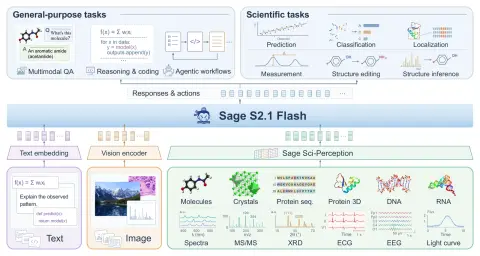
What sets it apart is the input side. Besides a text embedding and a vision encoder, the model has Sage Sci-Perception: dedicated encoders and projectors for more than ten kinds of scientific data, including molecular graphs, crystal structures, protein sequences and 3D structures, DNA and RNA, and measured signals such as spectra, MS/MS, XRD, ECG and EEG traces. The report treats spectra as ordered patches of measurements. All of these land in one shared backbone, so the same model that writes code can also take a molecule or a spectrum as input.
Agent skills were trained in verifiable environments covering tool use, search, coding, machine-learning experiments and scientific software, where success is checked against execution results, environment state or submitted artifacts. The lab evaluates the model on 33 benchmarks across seven domains. In the model card's main comparison against GLM-5.3-Flash, DeepSeek-V4.1-Flash-1017, Qwen3.8-Max, GPT-5.6 Sol and Claude Opus 5, it scores highest on MLE-bench Lite (90.3), OfficeQA Pro (72.2), Harvey LAB (25.0) and SpreadsheetBench 2 (37.1), and 85.2 on OSWorld-Verified against Claude Opus 5's 86.4. On agentic coding it trails: 60.6 on SWE-bench Pro against Claude Opus 5's 76.5.
The published config has 288 routed experts with 8 active per token across 45 layers and a 1,048,576-token position limit. BF16 and FP8 checkpoints are on Hugging Face and ModelScope with deployment guides. For general tasks (coding, office work, computer use) it serves like any large chat model; for scientific inputs you download the projector and the Sage-SciPerception loading scripts, run vLLM with prompt embeddings enabled, and send the combined embeddings to the completions endpoint.
| Released | 2026-11-15 |
|---|---|
| License | MIT |
| Weights | Open weights |
| Parameters | 320B Mixture-of-Experts (321,323,031,390 parameters in the Hugging Face safetensors) — 288 routed experts, 8 active per token, 45 layers |
| Context | 1,048,576 tokens (max_position_embeddings in the published config) |
| Architecture | Multimodal Mixture-of-Experts (Hugging Face architecture Glm5NextForConditionalGeneration, hidden size 4,096) with a vision encoder and the Sage Sci-Perception projectors that map scientific data into the language model's embedding space |
| Modalities | Text, Vision, Molecules, Protein sequences and structures, Spectra, Biosignals |
| Status | Open weights — BF16 and FP8 checkpoints on Hugging Face and ModelScope; technical report on arXiv (2611.21072) |
Benchmarks
Sage S2.1 Flash against named peers, as published on the Sage S2.1 Flash model card (selected rows). A dash in the source is shown as a blank cell.
| Benchmark | Sage S2.1 Flash | GLM-5.3-Flash | DeepSeek-V4.1-Flash-1017 | Qwen3.8-Max | GPT-5.6 Sol | Claude Opus 5 |
|---|---|---|---|---|---|---|
| Terminal-Bench 2.1 | 87.9 | 84.3 | 87.6 | 89.6 | 86.2 | 90.2 |
| SWE-bench Pro | 60.6 | 60.3 | 61.8 | 65.3 | 59.8 | 76.5 |
| SpreadsheetBench 2 | 37.1 | 32.4 | 35.8 | 34.9 | 32.7 | 33.6 |
| GDPval | 78 | 67.7 | 77.6 | 79.6 | 69.6 | 80 |
| OfficeQA Pro | 72.2 | 64.7 | 69.7 | 66.2 | 66.4 | 67.2 |
| Harvey LAB | 25 | 20 | 11.7 | 24.2 | 5 | 22.7 |
| BFCL V4 | 75.5 | 71.7 | 71.4 | 66.8 | 68.8 | 80.6 |
| MLE-bench Lite | 90.3 | 84.3 | 89.2 | 82.2 | 80.7 | 88 |
| PostTrainBench | 39.2 | 36.8 | — | — | 31 | 35.7 |
| PaperBench | 88 | 83 | 88.6 | 95.1 | 94.3 | 86.9 |
| DeepResearch Bench II | 54.2 | 51.9 | 55.1 | 49.2 | 50.7 | 54.1 |
| BrowseComp | 91.2 | 88.3 | 93.8 | — | 92.2 | 90.8 |
| OSWorld-Verified | 85.2 | 83.5 | 78.5 | 84.3 | 82.2 | 86.4 |
| WebArena-Verified | 67.6 | 65 | 60.7 | 64.9 | 66.6 | 69.1 |
This model's scores
- MLE-bench Lite90.3%
- OSWorld-Verified85.2%
- OfficeQA Pro72.2%
- SWE-bench Pro60.6%
Scores on a 0–100 scale (25-point gridlines); higher is better. Each benchmark links to its published source.
Strengths
- MIT licence on code and weights for a 320B MoE, in BF16 and FP8
- Sage Sci-Perception inputs: molecules, crystals, protein sequences and 3D structures, DNA, RNA, spectra, MS/MS, XRD, ECG and EEG
- Highest score in the maker's comparison on MLE-bench Lite (90.3), OfficeQA Pro (72.2), Harvey LAB (25.0) and SpreadsheetBench 2 (37.1)
- Agent skills trained in verifiable environments for tool use, search, coding, ML experiments and scientific software
- 1,048,576-token position limit in the published config
- Served through vLLM, including prompt-embedding input for scientific data
Best for
- Research agents that read a molecule, a protein structure or a spectrum alongside text and then write and run code on it
- Machine-learning engineering agents — the model's strongest area in the maker's comparison
- Spreadsheet, document and office-question work where answers must be checked against the source files
- Self-hosted scientific assistants where an MIT licence on open weights is a requirement
Intern-S (scientific multimodal) — every version
The full lineage of the Intern-S (scientific multimodal) line, newest first. Every version has its own page — click any to compare specs, benchmarks and pricing.
| Version | Released | Context | License |
|---|---|---|---|
| Sage S2.1 Flashcurrent | 2026-11-15 | 1M | MIT |
| Intern-S2-397B | 2026-09-13 | 256K | Apache-2.0 |
FAQ
What scientific data can Sage S2.1 Flash take as input?
Sage S2.1 Flash takes more than ten scientific input types through Sage Sci-Perception, including molecular graphs, crystal structures, protein sequences and 3D structures, DNA, RNA, and measured signals such as spectra, MS/MS, XRD, ECG and EEG. Projectors map each input into the language model's embedding space, next to ordinary text and images.
How do you run Sage S2.1 Flash on scientific inputs?
For scientific inputs, the Sage S2.1 Flash model card says to download the projector from the model repository and the loading scripts from Sage-SciPerception, serve the model with vLLM with prompt embeddings enabled, then send the combined embeddings to the completions endpoint. General coding or office tasks follow the normal deployment guides for the BF16 and FP8 checkpoints.
How does Sage S2.1 Flash compare with Claude Opus 5 and GPT-5.6 Sol?
In the Sage S2.1 Flash model card's own comparison, the model leads on MLE-bench Lite (90.3 vs 88.0 for Claude Opus 5 and 80.7 for GPT-5.6 Sol) and OfficeQA Pro (72.2), but trails on agentic coding: 60.6 on SWE-bench Pro against Claude Opus 5's 76.5. On OSWorld-Verified it scores 85.2 to Claude Opus 5's 86.4.
What licence is Sage S2.1 Flash released under?
Sage S2.1 Flash is released under the MIT License, which the model card says covers both the code and the model weights. BF16 and FP8 checkpoints are published on both Hugging Face and ModelScope. The lab's earlier Intern-S2-397B used Apache-2.0 instead.