Overview
Gortex is a code-intelligence engine built for AI coding agents and IDEs. It parses a codebase with tree-sitter (the README counts 257 languages and grammars), adds compiler-grade resolution for languages such as Python, TypeScript, Go, Java, Rust and C#, and stores the result as a persistent knowledge graph of functions, classes, call chains, HTTP routes and cross-service contracts. Instead of reading whole files, an agent asks the graph for exactly the symbol, caller or blast radius it needs — the project's pitch is up to 50x fewer tokens per response, with the benchmarks published in the repository.
It ships as a single static Go binary for macOS, Linux and Windows with no external dependencies. A long-running daemon serves one shared graph to every editor window, watches files for changes and keeps the graph in an on-disk SQLite store. The same graph is reachable three ways: the `gortex` CLI, an MCP server, and a versioned `/v1/*` HTTP API that also backs a separate Next.js web UI for exploring the graph. Multi-repository workspaces are the default, so references and API contracts can be followed across repo boundaries.
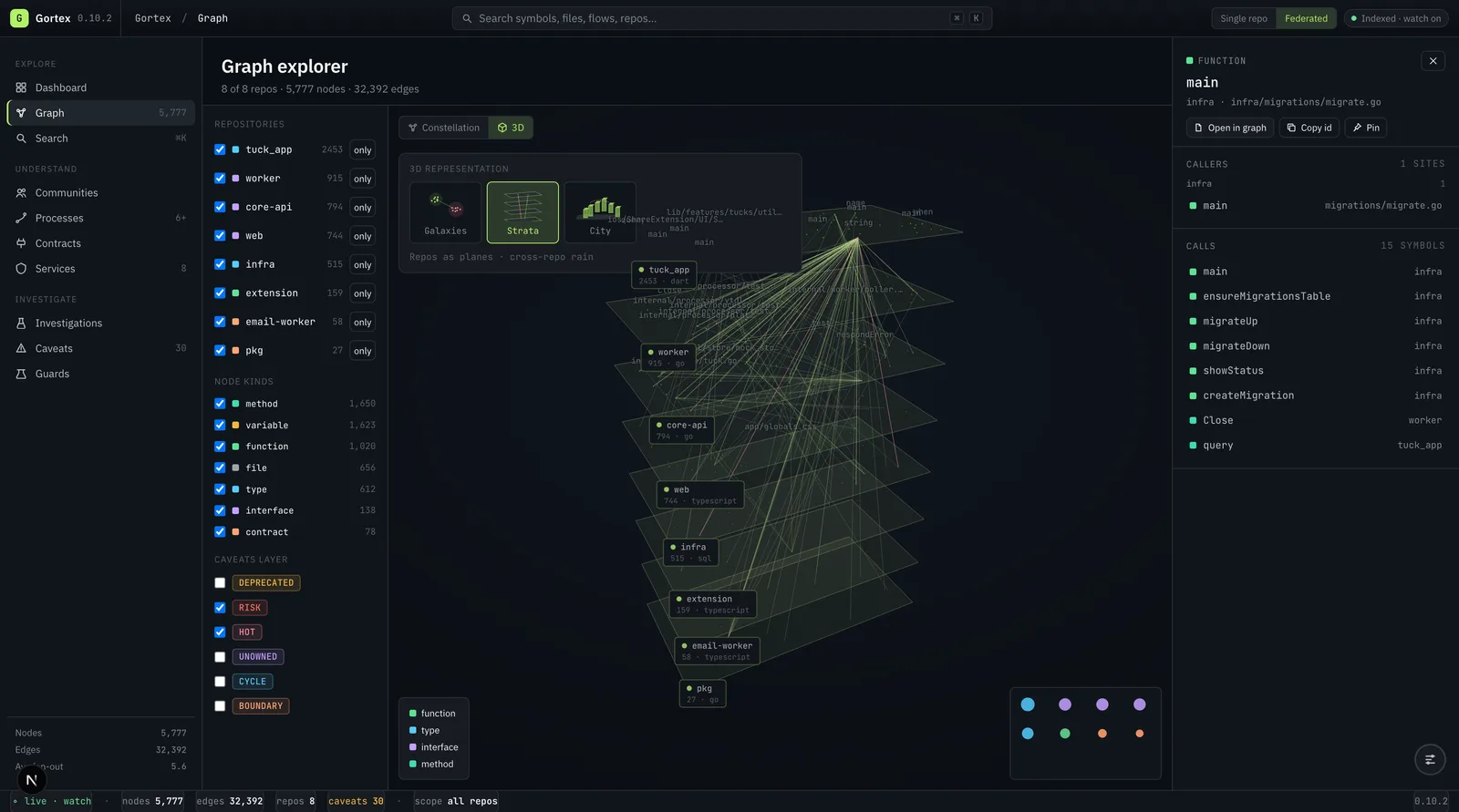
On top of the graph sit higher-level features: default-on semantic search with an embedded GloVe model (MiniLM, Ollama or OpenAI are opt-in), blast-radius and dataflow queries, speculative `preview_edit` checks, PR triage and review commands, and a `gortex savings` report of tokens saved versus naive file reads. `gortex init` configures the coding agents it detects on the machine — the README lists 19, including Claude Code, Cursor, Windsurf, VS Code / Copilot, Codex CLI, Gemini CLI, Zed and Aider. Telemetry is off by default, and Gortex is released under the Apache 2.0 license.
What it does
- Indexes code into a persistent knowledge graph of functions, classes, call chains, HTTP routes and cross-service contracts, parsed with tree-sitter across 257 languages and grammars
- Multi-repo by default: one graph spans many repositories, with cross-repo references, impact analysis and API-contract matching for HTTP, gRPC, GraphQL, message topics, WebSocket, env vars, OpenAPI and Temporal
- Serves the graph over an MCP server, the CLI and a versioned HTTP API with MCP Streamable HTTP transport, plus a standalone web UI with 3D graph views
- Semantic search on by default using an embedded GloVe model with FTS5/BM25 plus vector fusion, and optional MiniLM, Ollama or OpenAI embeddings
- PR workflow commands: `gortex prs` triages open pull requests by blast radius and `gortex review` emits line-anchored findings with a BLOCK / REVIEW / APPROVE verdict
- Single static binary with a background daemon, live file watching and an on-disk SQLite graph store; `gortex savings` reports tokens saved versus reading files
Getting started
Gortex installs as one signed binary. The README's quick start is four commands: set up the machine once, start the daemon, track a repo, and initialise that repo for your agents.
Install the binary
The install script detects your OS and architecture, verifies the SHA256 checksum (and the cosign signature when cosign is installed) and puts `gortex` on your PATH. Re-run it to upgrade. On macOS you can also use Homebrew with `brew install zzet/tap/gortex`.
# macOS / Linux
curl -fsSL https://get.gortex.dev | sh

# Windows (PowerShell)
irm https://get.gortex.dev/install.ps1 | iex
Run the one-time machine setup
`gortex install` writes the user-level MCP config, tool-usage skills and slash commands for your coding assistants.
gortex installStart the daemon and track a repository
The daemon serves one shared graph to every MCP client and watches tracked repos for changes.
gortex daemon start --detach
gortex track ~/projects/myapp
Initialise the repo for your agents
Run this once per repo. It writes `.mcp.json`, agent hooks and a `CLAUDE.md` with the codebase overview and community routing; the docs suggest committing the output so teammates get the same setup.
cd ~/projects/myapp && gortex initOptional: bring up the HTTP API
Give the daemon an HTTP address to expose the `/v1/*` JSON API and the MCP Streamable HTTP endpoint that the web UI and remote clients use. Localhost binds run unauthenticated; any other bind requires `--http-auth-token`.
gortex daemon start --http-addr 127.0.0.1:7411Commands and code are distilled from the project's own documentation — always check the official repo for the latest.
When to use it
- Cut the tokens a coding agent spends on large codebases by answering symbol, caller and blast-radius questions from a graph instead of whole-file reads
- Trace API contracts and call chains across several microservice repositories at once, and spot orphaned providers or consumers
- Check what an edit would break before applying it, with blast-radius, `preview_edit` and `verify_change` queries
- Triage and review open pull requests with graph-grounded risk scores and line-anchored findings
How Gortex compares
Gortex alongside other open-source code indexing & search tools AI/TLDR tracks, ranked by GitHub stars.
| Tool | Stars | What it does |
|---|---|---|
| CodeGraph | ★ 74.3k | Builds a local SQLite knowledge graph of a codebase with a Rust tree-sitter kernel, keeps it in sync through a file watcher, and serves symbols, call paths and blast radius to coding agents over MCP. |
| GitNexus | ★ 47.9k | Indexes a codebase into a knowledge graph of dependencies, call chains and execution flows, then exposes it to Claude Code, Cursor and Codex through MCP tools. |
| codebase-memory-mcp | ★ 46.7k | A native MCP server that indexes a repository into a persistent tree-sitter knowledge graph of functions, call chains and routes, queried by agents through 15 tools. |
| code-review-graph | ★ 32.2k | A local-first code intelligence graph built with Tree-sitter that serves precise, incrementally-updated structural context to AI coding tools over MCP, so they read only the code a task needs. |
| Claude Context | ★ 12.6k | An MCP server that indexes your codebase into a vector database so AI coding agents can find relevant code by meaning instead of loading whole folders. |
| Graft | ★ 10.2k | Builds a persistent knowledge graph of your codebase as linked markdown files, then feeds the matching nodes to coding agents so they stop re-exploring the repo on every task. |
| XERJ | ★ 7k | Single-binary, Elasticsearch-compatible search engine whose autoindex command turns any folder of code, docs, logs or PDFs into typed indices that AI coding agents query via CLI or MCP instead of grepping. |
| Gortex | ★ 1.9k | A local code-intelligence engine that turns your repos into a graph for AI coding agents |