Overview
Heym is a self-hosted runtime and platform for building, orchestrating, running, observing, evaluating and controlling agentic systems on your own infrastructure. In Heym a workflow is a graph that defines how agents, deterministic steps, tools and data work together; the runtime executes that graph, runs independent branches in parallel, records execution history and supports human review checkpoints. The project stresses that the visual canvas is only one interface into the runtime — the same workflows also run through REST and SSE APIs, cron schedules, event triggers, MCP clients and Portal chat pages.
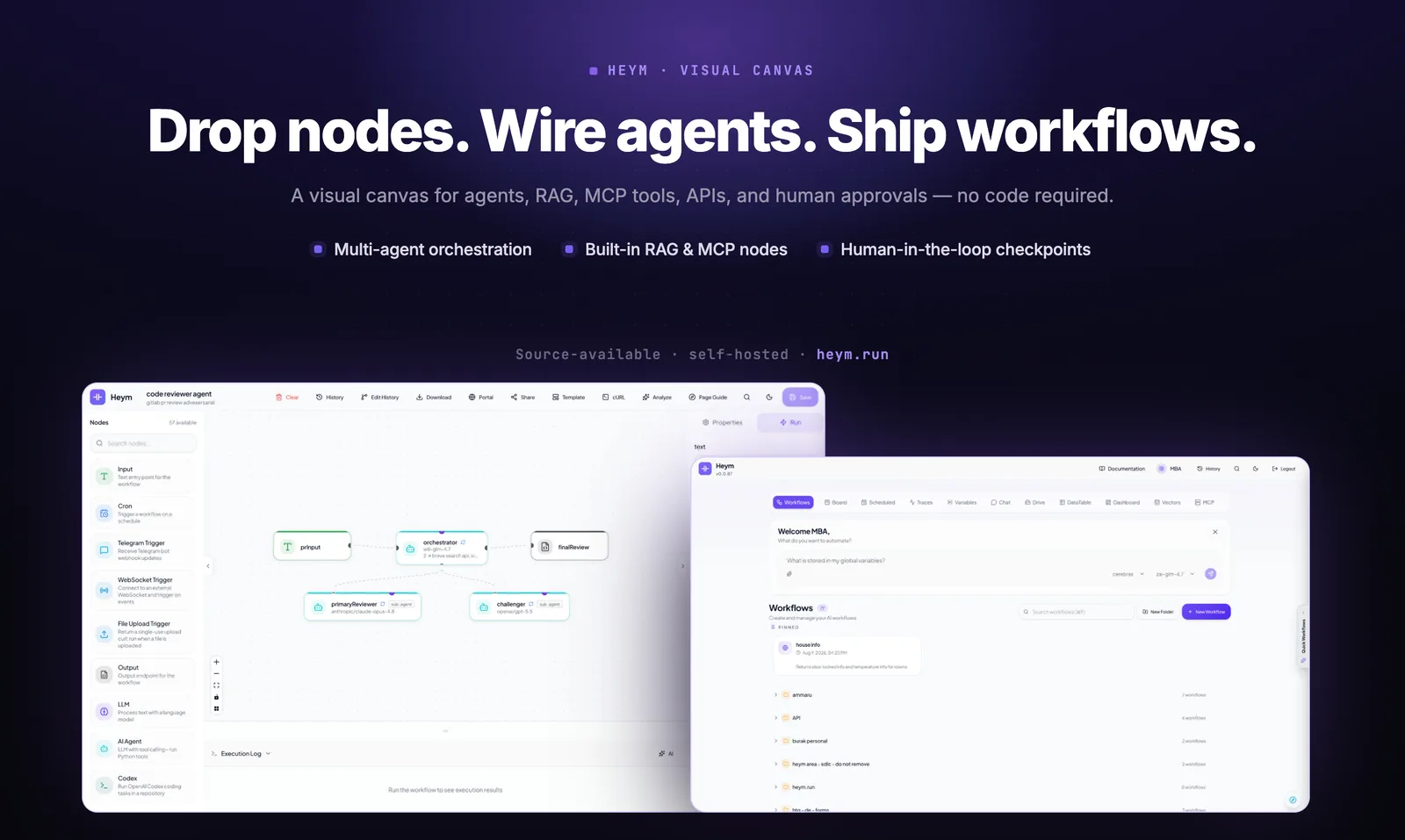
Workflows are composed from a node library that mixes LLM, Agent, RAG, Codex and OpenCode Go nodes with conditions, switches, loops, merges, data transformations and sub-workflow calls, or generated from a plain-text or voice description by the built-in AI Assistant. An orchestrator agent can delegate to named sub-agents and sub-workflows and call independent ones concurrently. Agents can retrieve documents from Qdrant or PostgreSQL with pgvector, keep a per-agent knowledge graph as persistent memory, call MCP servers, and load reusable SKILL.md skills with optional Python tools. Built-in nodes cover Slack, Discord, Telegram, email, GitHub, Jira, Linear, Notion, Google Sheets, BigQuery, Redis, RabbitMQ, S3, Playwright browser automation and more.

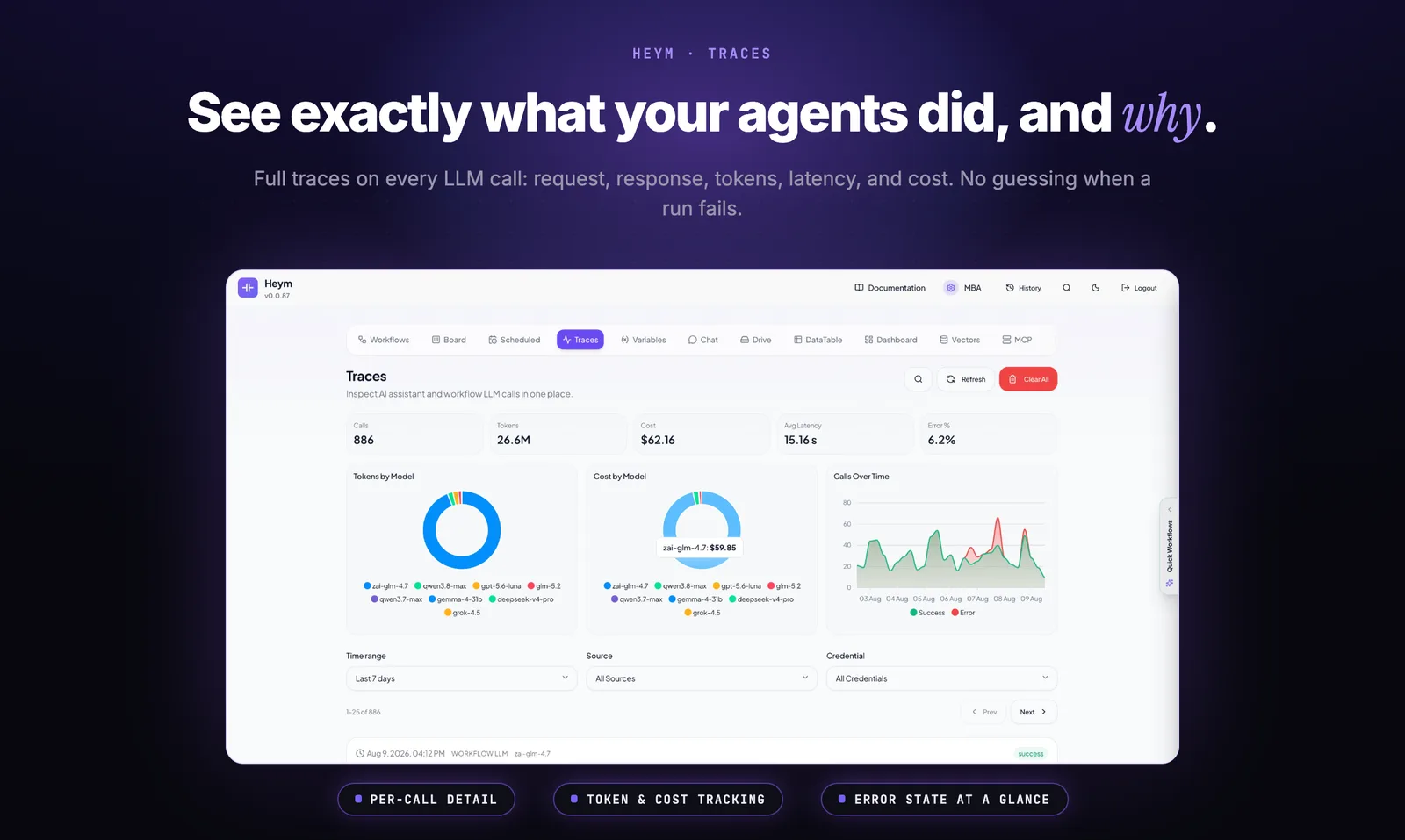
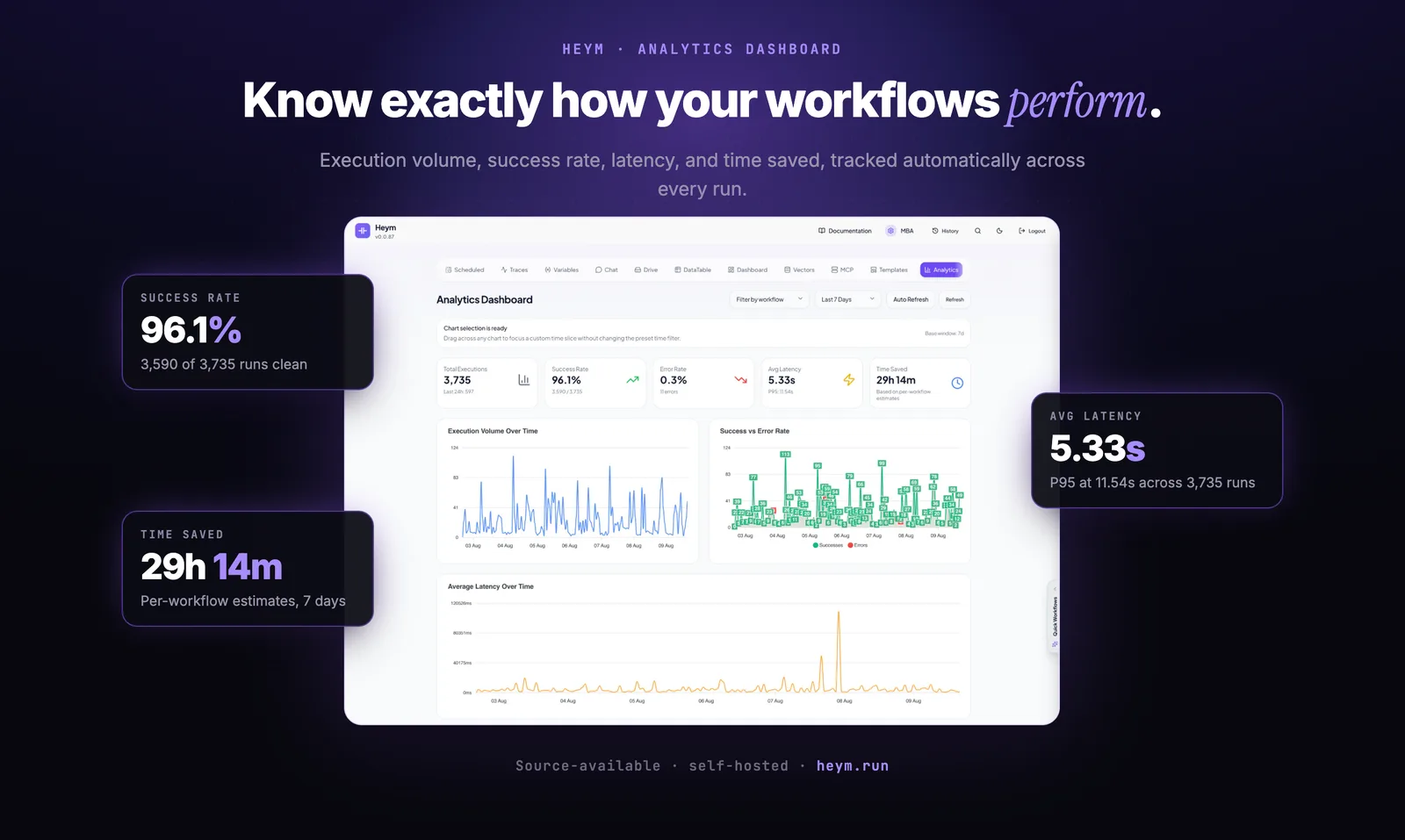
The operations side is where Heym puts its weight: execution history with live attach to running jobs, LLM traces with tokens, latency and USD cost per call, analytics, alerts on errors, duration or spend, prompt evals across models, input guardrails, OIDC single sign-on, team sharing and OpenTelemetry export. The backend is Python with FastAPI and PostgreSQL, the frontend Vue 3 with TypeScript. Heym is source-available under the MIT License with the Commons Clause condition: you may use, modify and self-host it, but selling a product or service whose value derives substantially from Heym requires a commercial licence from the maintainers.
What it does
- Visual canvas plus an AI Assistant that generates nodes and edges from a text or voice description, with reusable templates
- Multi-agent orchestration: an orchestrator agent delegates to named sub-agents and sub-workflows, running independent calls concurrently
- Built-in RAG over Qdrant or PostgreSQL/pgvector, per-agent persistent memory as a knowledge graph, and SKILL.md agent skills with optional Python tools
- MCP both ways — agents call MCP servers over SSE, Streamable HTTP or stdio, and workflows are published as MCP tools at /api/mcp/sse
- Human-in-the-loop checkpoints that pause a run for Accept, Edit & Continue or Refuse and resume from a saved snapshot
- Observability built in: execution history, LLM traces with token and USD cost, analytics, alerts, prompt evals across models and OpenTelemetry export
Getting started
Heym needs PostgreSQL as its core database. Locally, run.sh starts PostgreSQL, the backend and the frontend for you; for servers there is a Docker Compose deployer and a prebuilt image. Prerequisites for the local path are Bun, Python 3.11+, uv and Docker.

Clone and start everything locally
run.sh generates SECRET_KEY and ENCRYPTION_KEY when they are missing. Copy .env.example to .env first if you want to set your own values.
git clone https://github.com/heymrun/heym.git
cd heym
./run.sh
Create your account
Open http://localhost:4017 to register and start building on the canvas. The backend serves its OpenAPI reference at /docs on port 10105 in local development.
Deploy with Docker Compose
For production, deploy.sh builds and runs PostgreSQL, the backend and the frontend (and fills empty keys). Register your admin account, then set ALLOW_REGISTER=false in .env and restart to close registration.
cp .env.example .env
./deploy.sh              # Build and deploy
./deploy.sh --logs       # View logs
./deploy.sh --down       # Stop services
Call a workflow from your app
Every workflow is invocable over REST, streamed over SSE, or published as an MCP tool. The editor's Run with cURL dialog generates the exact request, including authentication.
POST /api/workflows/{workflow_id}/execute         # REST
POST /api/workflows/{workflow_id}/execute/stream  # SSE streaming
/api/mcp/sse                                      # MCP server endpoint
Commands and code are distilled from the project's own documentation — always check the official repo for the latest.
When to use it
- Run multi-agent workflows on your own infrastructure instead of a hosted automation SaaS, with credentials encrypted and access gated by SSO
- Put a human approval step in front of agent actions — a reviewer accepts, edits or refuses, and the run resumes from its saved state
- Expose an internal workflow as an MCP tool for Claude Desktop or Cursor, or as a chat Portal for colleagues, without duplicating the logic
- Track what agent workflows cost and how they fail — per-call traces, USD spend by model, alerts on errors or spend, and OpenTelemetry spans for your existing tracing backend
How Heym compares
Heym alongside other open-source workflow automation tools AI/TLDR tracks, ranked by GitHub stars.
| Tool | Stars | What it does |
|---|---|---|
| n8n | ★ 208k | A self-hostable workflow automation tool with a visual node editor that connects 400+ apps and APIs and adds native AI steps, letting technical teams build automations without writing most of the glue code. |
| Huginn | ★ 50.1k | A self-hosted system of "agents" that watch websites, feeds, and events and take automated actions on your behalf, similar to a private IFTTT. |
| GitHub MCP Server | ★ 33.9k | GitHub's official MCP server, hosted or self-run, that gives an agent scoped toolsets for repositories, issues, pull requests, Actions runs and code-security alerts. |
| gws (Google Workspace CLI) | ★ 31.8k | A command-line tool for every Google Workspace API, built at runtime from Google’s Discovery Service, returning structured JSON and shipping 40+ agent skills. Not an officially supported Google product. |
| Kestra | ★ 30k | An event-driven orchestration platform that defines data, AI, and infrastructure pipelines as declarative YAML and runs them through a web UI. |
| Activepieces | ★ 25.2k | An open-source Zapier alternative where you build automations from reusable TypeScript "pieces", with support for AI agents and self-hosting. |
| n8n-MCP | ★ 23.1k | An MCP server that gives coding assistants structured access to n8n's node catalogue, schemas, docs and workflow templates so they can build and validate n8n workflows. |
| Heym | ★ 1.3k | A self-hosted runtime for agentic workflows — build agents on a visual canvas, run them from APIs, schedules and MCP, and inspect every execution, trace and model cost |