

What is LoopForge?
LoopForge is an open-source, self-hosted workspace from Tencent for shipping software with coding agents. It sits in the AI SDLC Automation category of the AI Coding tools and is open-source, written in Go and licensed MIT. To get started: clone and start the platform.
Overview
LoopForge is an open-source, self-hosted workspace from Tencent for shipping software with coding agents. Instead of driving one agent CLI by hand, you describe a task to Main Bot in a chat, and it works in a Docker sandbox with your repositories, hands parts of the job to project roles, and can open a pull request when it is done.
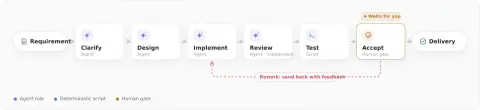
Once a way of working proves itself, LoopForge lets you save it as an SOP: a fixed workflow that mixes agent steps, deterministic scripts and human approval gates. A typical SOP clarifies a requirement, designs, implements, has an independent agent review the change, runs tests as a script, and then waits for a person to accept or send the work back with feedback. A visual designer builds these flows, and runs can be paused, resumed or taken over.
LoopForge orchestrates the coding-agent CLIs a team already uses, including CodeBuddy, Codex, Claude Code, OpenCode, Cursor CLI, Antigravity, Kimi Code, Pi, DeepSeek Harness and ZCode. A separate LoopForge Local mode installs the built-in workflows straight into a coding assistant such as Claude Code, Codex, CodeBuddy or Cursor, without running the platform.
What it does
- Chat workbench where Main Bot works in a Docker sandbox with your repositories, with per-conversation executor, model and permission settings
- SOP workflows that combine agent roles, deterministic scripts, sub-SOPs, previews and human approval gates
- Visual SOP designer, plus pause, resume and take-over controls for running workflows
- Reusable roles with their own prompts, executors, rules, Skills and MCP tools
- Requirement tracking through to pull/merge request status, with live run logs, artifacts and a "Needs review" inbox
- Scheduled AI tasks and token and cost accounting
- Projects, member accounts and an OpenAPI-described HTTP and MCP API
Getting started
The platform runs from Docker with one script; it needs Git, Docker with Compose, Python 3 and curl, and the installer can add missing pieces on Linux and macOS. API keys are only needed for chat and agent steps — the demo SOP runs without one.
Clone and start the platform
Clone the repository and run the start script. It pulls the pinned platform image and brings the workspace up.
git clone https://github.com/Tencent/LoopForge.git
cd LoopForge
./start.sh
Manage the running instance
The same script handles the lifecycle: `./start.sh logs`, `stop`, `restart` and `pull`, or `dev` to build from source. If downloads from ghcr.io stall, point it at a mirror.
MIRROR=ghcr.nju.edu.cn ./start.shOr use LoopForge Local inside your coding assistant
To run the built-in workflows without the platform, install LoopForge Local into a project (Node.js 20+ and Python 3.8+ required), then start a workflow from Claude Code with `/start-devflow "<your request>"`.
npx -y loopforge-cli@latest install claudeCommands and code are distilled from the project's own documentation — always check the official repo for the latest.
When to use it
- Turning a team's proven delivery process into a repeatable SOP that coding agents follow step by step
- Putting a human sign-off gate between an agent's finished change and the merge
- Running Claude Code, Codex or CodeBuddy in sandboxes on your own servers instead of a vendor cloud
- Tracking requirements through to pull request status and seeing which agent runs need review
How LoopForge compares
LoopForge alongside other open-source ai sdlc automation tools AI/TLDR tracks, ranked by GitHub stars.
| Tool | Stars | What it does |
|---|---|---|
| Multica | ★ 56.3k | Self-hostable workspace where coding agents are assigned issues like teammates: 26 agent CLIs, runtimes you own, a replayable execution log per run, and review gates before anything ships. |
| oh-my-codex (OMX) | ★ 33.8k | A workflow layer for the OpenAI Codex CLI that adds agent teams, git-worktree isolation, hooks and HUDs behind a set of canonical plan, code-review and QA commands. |
| GPT-Pilot | ★ 33.6k | Autonomous AI developer that breaks down an app description into tasks, writes and runs code incrementally, and asks clarifying questions to produce a working production application. |
| Beads | ★ 28.8k | A Dolt-backed dependency-graph issue tracker for coding agents: hash IDs avoid multi-agent collisions, `bd ready` surfaces unblocked work, and `bd remember` keeps durable project memory. |
| Vibe Kanban | ★ 28.7k | Vibe Kanban lets you plan tasks on a kanban board, run coding agents like Claude Code and Codex in isolated workspaces, then review their diffs and ship pull requests. |
| Archon | ★ 23.9k | A workflow engine for AI coding agents: describe plan, implement, validate, review and PR phases as YAML, and every run repeats them in its own git worktree. |
| Keploy | ★ 19.8k | An API testing tool that records real traffic with eBPF — including database and queue calls — and replays it as deterministic tests and data mocks, with no SDK to import and no code changes. |
| LoopForge | ★ 1.8k | A self-hosted workspace that runs coding agents through repeatable delivery workflows with human approval gates |