In plain English
You have a language model that almost does what you want. Maybe it's close — but the tone is wrong, or it keeps slipping out of your required format, or it doesn't know your internal terminology. Your first instinct might be to fine-tune it. Most of the time, you don't need to. A better prompt, or a handful of examples in the prompt, will close the gap for free. Fine-tuning earns its place only when prompting genuinely cannot get you there.
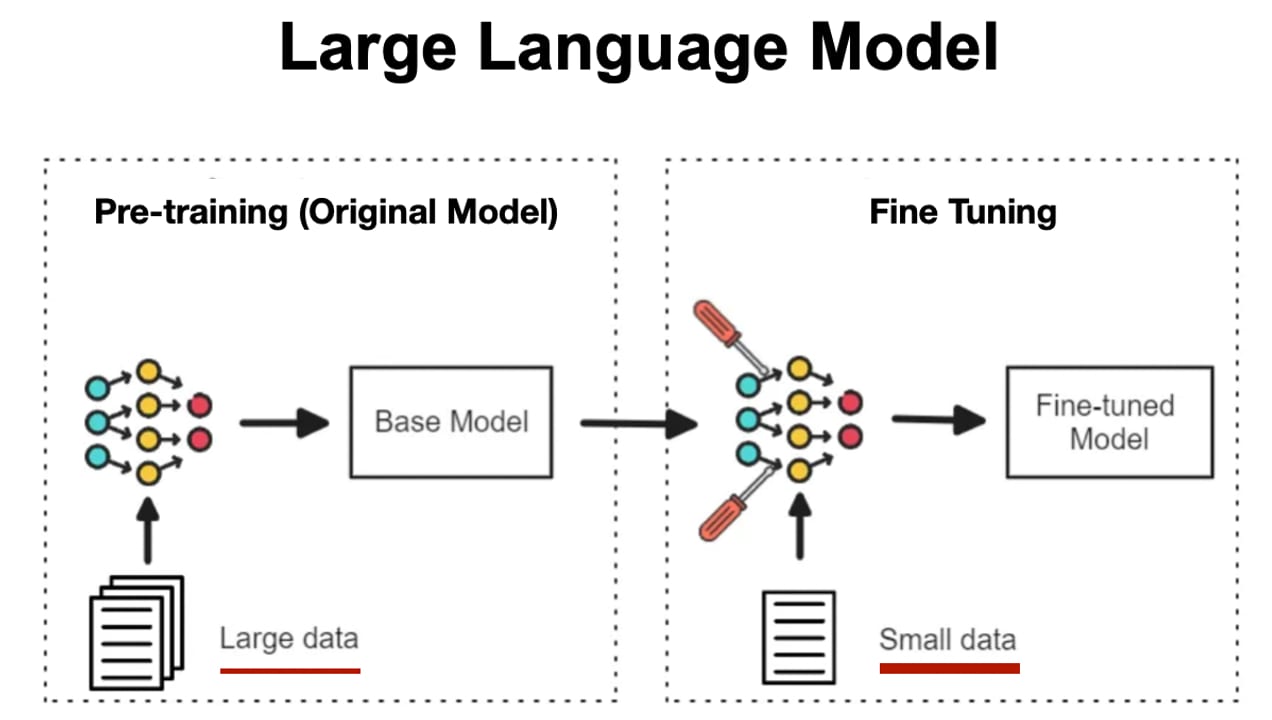
Think of it like teaching a new employee. If they need to know your company's style guide, you hand them the document — that's a system prompt. If they need a few worked examples to understand the format you expect, you show them samples — that's few-shot prompting. If they need to look up your product catalog before answering, you give them a reference binder — that's RAG. You only send them back to school for months of retraining if none of those three approaches sticks. Fine-tuning is that last resort.
Why this decision matters
The decision between prompting and fine-tuning is one of the most consequential calls in applied AI — not because fine-tuning is hard, but because teams routinely do it when they don't need to. Fine-tuning a hosted model like a small GPT-5 or Claude Haiku tier model costs training fees plus higher per-call inference costs — a fine-tuned model typically bills at a premium over the base version. An open model trained with LoRA might cost only a few dollars in GPU time, but it still costs days of engineering effort to prepare data, run training, evaluate the result, and maintain the adapter as the task evolves.
Beyond cost, fine-tuning introduces fragility. A fine-tuned model can suffer from catastrophic forgetting — it gets better at your target task and quietly worse at general reasoning or safety behaviors that you never thought to test. Updates require a new training run. And if the problem turns out to be a knowledge gap rather than a behavioral gap, fine-tuning won't fix it at all, because models don't reliably retain facts through training the way they retain skills.
Getting this decision right at the start of a project can save weeks of wasted effort. Getting it wrong means you either waste money on training you didn't need, or you under-invest and ship a product that keeps breaking in production because the prompt alone isn't reliable enough.
How the decision works: a simple ladder
The right mental model is a ladder of interventions, ordered from cheapest and fastest to most expensive and involved. The rule is simple: start at the bottom rung and stop the moment you hit a solution that works. Most projects never need to climb past the second rung.
Rung 1: better prompt engineering
The majority of "the model doesn't do what I want" problems are solved here. A clear system prompt with explicit instructions — the exact tone, format, constraints, persona, and output structure — eliminates most complaints about style and consistency. If you haven't written a detailed system prompt yet, write one before considering anything else. Prompt engineering is a real skill and most teams underinvest in it.
Rung 2: few-shot examples in the prompt
If a verbal description of the format isn't enough, show the model what you mean. Three to ten worked examples embedded directly in the prompt — showing the exact input/output pairs you want — dramatically improve consistency. This is called few-shot prompting, and it works for most formatting and style problems without any training. The only downside is that examples consume tokens on every call, which raises inference cost at high volume.
Rung 3: RAG for knowledge gaps
If the model's failures are about what it knows rather than how it behaves — it doesn't know your products, your policies, your recent data — that's a knowledge gap, not a behavior gap. Retrieval-augmented generation (RAG) is the right tool: at query time, your system searches a knowledge base and feeds the relevant documents into the prompt. The model's underlying skills stay the same; you're just giving it better information to reason over.
Rung 4: fine-tuning for stubborn behavioral problems
Fine-tuning belongs here — at the top of the ladder, not the bottom. You reach for it when prompting and RAG have genuinely hit their ceiling. The clearest signal: you've written a solid prompt with good examples, and the model still drifts, still breaks format, still uses the wrong tone on edge cases. That's a behavioral consistency problem that fine-tuning is specifically good at solving. You're not teaching it new knowledge; you're internalizing the behavior so it stops needing to be reminded every single time.
When fine-tuning actually wins
There are clear cases where the investment in fine-tuning pays off. They share a common pattern: high volume, stable behavior requirements, and a failure mode that prompting cannot consistently fix.
| Situation | Why fine-tuning wins | The alternative that doesn't work |
|---|---|---|
| Strict, exact output format every time | The behavior is baked in — the model stops drifting on long or complex inputs | Prompts describing the format still fail on edge cases |
| High-volume narrow task (tagging, extraction, rewriting) | No need to re-state instructions on every call — shorter prompts, lower cost | Few-shot examples in every request are expensive at scale |
| Consistent brand voice or persona | The style is internalized, not just described — survives long conversations | System prompts drift as context grows |
| Niche jargon, internal schema, custom query language | Examples teach the pattern better than any description can | The base model rarely saw your internal notation in pretraining |
| Latency-sensitive pipeline with large system prompts | Remove the 2,000-token instruction block — smaller prompt, lower time-to-first-token | Large system prompts slow down every call |
When prompting wins (and fine-tuning wastes money)
Fine-tuning is often reached for in situations where it provides no real advantage over a well-crafted prompt. Recognizing these patterns saves a lot of wasted effort.
- You haven't written a real system prompt yet. If your current approach is a one-sentence instruction, you haven't exhausted prompting. Write a detailed, structured system prompt first.
- The task is general-purpose. Writing, summarizing, answering questions, brainstorming — these are exactly what frontier models are already excellent at. Fine-tuning adds noise, not signal, for tasks the model handles well.
- You need the model to know recent or changing facts. Fine-tuning freezes knowledge at training time. If the information evolves, fine-tuning means perpetual retraining. Use RAG.
- You only have a few hundred examples of mixed quality. A good fine-tune needs at minimum 500-1,000 high-quality, consistent examples for a narrow task. Below that, you're more likely to degrade the model than improve it. You're better off putting a few of your best examples directly in the prompt as few-shot demonstrations.
- You need to iterate quickly. Updating a prompt takes seconds. Rerunning a fine-tuning job, re-evaluating, and re-deploying takes hours or days. In early product development, prompting gives you the speed to find the right behavior before committing to baking it in.
- You're trying to add a fundamentally new capability. If the base model can't do a task even with detailed prompting, fine-tuning on a small dataset won't give it that ability. Fine-tuning amplifies latent skills — it rarely creates new ones from scratch.
Going deeper
Once you've decided that fine-tuning is genuinely warranted, a few more advanced considerations shape whether it succeeds.
Fine-tuning and RAG are not mutually exclusive
The most capable production systems often use both. A fine-tuned model handles the behavioral requirements — output format, tone, domain-specific reasoning patterns, response structure — while a RAG layer handles the knowledge requirements — looking up current data, private documents, or anything that changes. Thinking of it as an either/or choice is a false constraint. The question to ask is: does this failure come from bad behavior, or from missing information? Each tool solves one of those problems; only the hybrid solves both.
Evaluating whether fine-tuning actually helped
Before you fine-tune, you need a baseline measurement of the failure you're trying to fix — the exact metric that proves the prompt isn't good enough. After fine-tuning, you measure the same metric on held-out examples the model never trained on. If the number didn't meaningfully improve, the fine-tune failed and you need to diagnose why: insufficient data, noisy data, the wrong task for fine-tuning, or a base model that simply lacks the underlying capability. Never declare fine-tuning a success by running your eval set through the trained model without a proper hold-out.
Parameter-efficient fine-tuning dramatically lowers the bar
Modern LoRA fine-tuning trains less than 1% of a model's weights by bolting on small adapter matrices instead of updating everything. The practical result is that fine-tuning a 7-billion-parameter open model on a consumer GPU now costs roughly the same as a few hours of cloud compute — sometimes under $10. This changes the economics: for open models, the cost bar for trying a fine-tune is now low enough that "run a quick LoRA experiment" is a reasonable step in a prompt-engineering workflow, as long as you have a clear eval metric to measure against.
The hosted fine-tuning option
If you're using a closed model through an API, providers like OpenAI offer hosted fine-tuning: you upload a JSONL file of training examples, pay a per-token training fee, and get back a private model ID. Hosted fine-tuning charges a per-token training fee, and the resulting fine-tuned model typically has slightly higher inference costs than the base version. The tradeoff is simplicity — no GPU infrastructure — against control: you can't inspect the weights, can't use LoRA to merge adapters, and are bound to that provider's availability and pricing.
The data quality problem
Fine-tuning faithfully copies whatever patterns it sees — including your inconsistencies and mistakes. A dataset where 80% of examples follow one format and 20% follow another will produce a model that inconsistently mixes both. Curate ruthlessly. For a narrow task, 300 clean, consistent, representative examples will outperform 3,000 sloppy ones almost every time. The investment in data quality pays back in training stability, faster convergence, and a model that actually behaves the way you intended. Before spending any time on training code or infrastructure, spend it making sure every example in your dataset is exactly what you want the model to produce.
FAQ
How do I know if I need to fine-tune or if a better prompt will work?
First write a detailed system prompt with explicit format instructions and 3-10 few-shot examples. If the model still fails consistently on real inputs after that, you likely have a behavioral consistency problem that fine-tuning can address. If it fails because it doesn't know certain facts, use RAG instead. Exhaust prompting before committing to training.
Is fine-tuning worth it for a small project?
Usually not. Fine-tuning is expensive in time even when GPU costs are low: you need to prepare and curate a dataset, run training, evaluate the result, and maintain the adapter as the task changes. For small projects with modest query volumes, the economics rarely work out. A few-shot prompt is almost always faster to iterate and cheaper to maintain.
Can fine-tuning teach a model new facts about my business?
Not reliably. Fine-tuning is effective at shaping behavior — tone, format, style, output structure — but models don't retain injected facts the way they retain skills. Facts baked into weights go stale and get stated confidently even when wrong. For private or changing knowledge, use retrieval-augmented generation (RAG), which looks information up at query time.
How many examples do I need before fine-tuning makes sense?
For a narrow, well-defined task, a minimum of around 500-1,000 high-quality, consistent examples is a reasonable starting point. Below that threshold, the model tends to copy inconsistencies rather than learn the underlying pattern. With parameter-efficient methods like LoRA, 200-500 very clean examples can work for simple classification or extraction tasks — but quality always matters more than quantity.
What is the difference between fine-tuning and RAG?
Fine-tuning changes the model's weights so that certain behaviors or patterns become its default — it shapes how the model responds. RAG leaves the model's weights unchanged and feeds it relevant documents at query time so it knows what to respond about. A simple rule: fine-tune for behavior, use RAG for knowledge. High-performing production systems often use both together.
Does fine-tuning make a model worse at other tasks?
It can. When fine-tuned aggressively on a narrow task, models can suffer from catastrophic forgetting — improving on your target behavior while degrading on general reasoning, language quality, or safety properties the lab originally built in. Parameter-efficient methods like LoRA reduce this risk because they freeze the original weights. Always test general ability after training, not just your target task.