In plain English
When you read an essay online or see a photo on the news, you might wonder: did a human create this, or did an AI? Three fundamentally different technologies try to answer that question, and they work in very different ways.
Think of it like authenticating a painting. A statistical detector is the art critic who looks at brushstroke patterns and says "this doesn't feel right." An invisible watermark is a secret signature painted into the canvas with UV-reactive ink — only the gallery with the right lamp can read it. A signed provenance record (the C2PA approach) is a notarized certificate of origin that travels with the painting everywhere, cryptographically proving who made it and when.
None of these methods is foolproof on its own — and understanding why each one fails is just as important as understanding how it works.
Why it matters
AI generation is now cheap and fast enough that a single person can flood a platform with thousands of synthetic images, videos, or essays in hours. Without reliable detection, platforms, journalists, educators, and courts face a growing problem: they cannot easily distinguish authentic human-produced content from AI-produced facsimiles.
Real-world stakes
- Academic integrity — universities use tools like Turnitin to flag AI-written essays, but false positives have caused students who wrote their own work to face misconduct charges.
- News and disinformation — synthetic images of public figures, fabricated news photos, and deepfake video clips can spread before any human reviewer notices.
- Legal evidence — courts are beginning to encounter AI-generated images offered as real photos; provenance standards like C2PA are being examined as a possible safeguard.
- Platform moderation — ad networks and social platforms need to disclose or label AI content under emerging regulations in the EU and US.
For builders, detection matters in a different way: if you are shipping a product that generates content, you may soon be legally required to watermark or label it. The EU AI Act's provisions on AI-generated content and the US Executive Order on AI both reference disclosure requirements.
How each approach works
The three approaches operate at completely different layers of the content pipeline. The diagram below shows where each one lives.
1. Statistical detectors
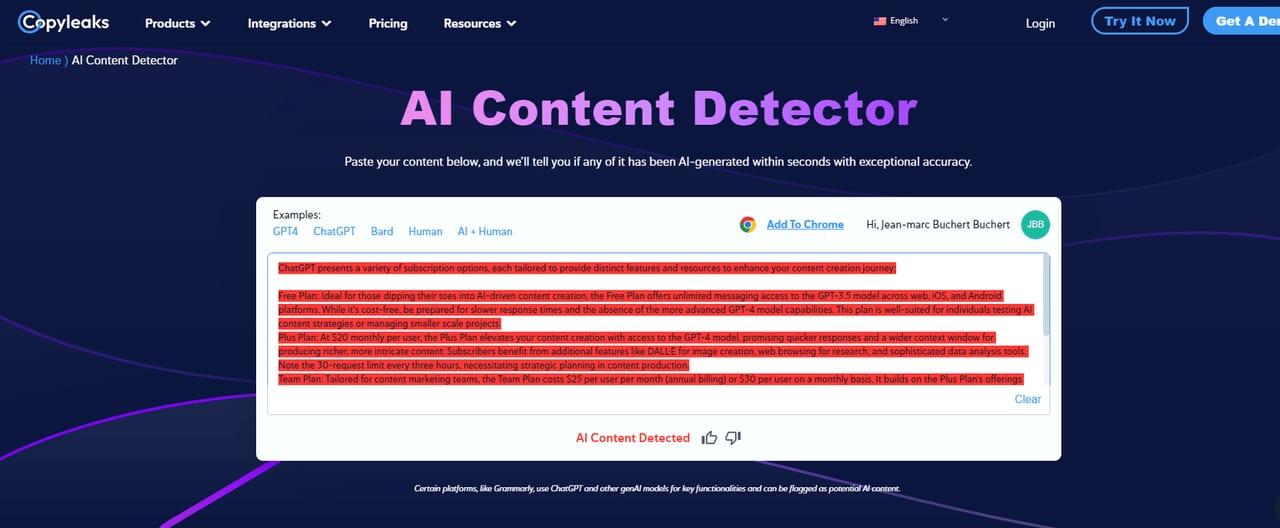
Statistical detectors — tools like GPTZero, Originality.ai, and Turnitin's AI detection — work after the fact, without any cooperation from the model that made the content. They analyze the content itself looking for patterns that differ between human and AI output.
For text, the two most important signals are perplexity and burstiness. Perplexity measures how surprising each word choice is — AI models, trained to produce fluent text, tend to make low-surprise (low-perplexity) word choices consistently. Burstiness measures sentence-length variation — human writing naturally swings between short punchy sentences and long winding ones, while AI prose tends to be more metronomic. A high-perplexity signal combined with low burstiness is the classic AI fingerprint that classifier models like fine-tuned RoBERTa or DeBERTa learn to recognize.
For images, detectors look for artifacts that GANs and diffusion models leave behind: spectral fingerprints from upsampling operations, unnaturally smooth skin, mangled backgrounds, impossible hand anatomy, and lighting inconsistencies. CNN-based classifiers (ResNet50 is a common backbone) are trained on paired datasets of real and synthetic images to learn these patterns.
2. Invisible watermarks (SynthID)
Watermarking is a fundamentally different approach: the model itself encodes a hidden signal into the content during generation. Google DeepMind's SynthID, open-sourced in October 2024 through the Responsible GenAI Toolkit and Hugging Face, is the most widely deployed example. By 2025, over 10 billion pieces of content had been watermarked with SynthID.
For images, SynthID modifies pixel values in a way imperceptible to the human eye but statistically detectable. The signal is designed to survive common transformations: cropping, JPEG compression, brightness adjustments, and format conversion.
For text, SynthID uses a technique called tournament sampling. During generation, at each token step, the model draws two candidate tokens independently from the probability distribution, then uses a pseudorandom function keyed to a secret to decide which one "wins." Repeat this across thousands of tokens, and the winning pattern becomes a statistical signature only the paired detector — which knows the secret key — can find reliably. Individual sentences look completely normal; only the aggregate distribution is unusual.
A unified SynthID Detector portal, launched by Google in May 2025, can scan uploaded images, audio, video, or text and highlight the specific regions most likely to carry a watermark signal.
3. C2PA signed provenance
C2PA (Coalition for Content Provenance and Authenticity) takes the most radical approach: instead of analyzing content, it attaches a cryptographically signed manifest — called a Content Credential — to the media file at creation time. The manifest records who created it, with what tool, at what time, and whether any AI was involved. Every edit appends a new signed entry to the chain.
The signing uses standard X.509 certificates. The entire asset is hashed; if anyone changes even a single pixel after signing, the hash no longer matches the signature, and any C2PA-aware viewer immediately flags the credential as invalid. No central database is needed — verification is purely mathematical and works offline.
C2PA is an open standard originally founded in 2021 by Adobe, Microsoft, BBC, Intel, Arm, and Truepic. As of 2025 it counts hundreds of member organizations. The current stable version is C2PA 2.2 (May 2025), which added video streaming support and expanded file format coverage. Adoption is now widespread: Adobe Firefly, OpenAI DALL-E, Sora, and Google Imagen all embed C2PA credentials by default. On the hardware side, the Leica M11-P was the first consumer camera to sign photos in-body with C2PA; the Google Pixel 10 (September 2025) does the same using a Titan M2 hardware security chip.
Comparing the three approaches
| Approach | Works without model cooperation? | Survives editing? | False positives? | Easy to strip? |
|---|---|---|---|---|
| Statistical detector | Yes | N/A (post-hoc) | High (15–45%) | Yes — paraphrase or restyle |
| Invisible watermark (SynthID) | No — needs model support | Partial — survives compression, fails heavy paraphrase | Low when signal present | Paraphrasing degrades signal ~85% |
| C2PA signed provenance | No — needs tool/camera support | Hash breaks on any edit (re-sign needed) | None — it's binary valid/invalid | Strip the metadata from the file |
The key insight from the table: these approaches are complementary, not competing. Statistical detectors cover legacy content and models that don't watermark. Watermarks provide a robust in-band signal for cooperating generators. C2PA provenance handles the full lifecycle with cryptographic certainty — but only for content where the creation tool participates.
Where detectors fail
Every detection method has a well-documented attack surface, and adversaries are not subtle about exploiting it.
Statistical detector weaknesses
- Paraphrasing and restyling — a 2024 study showed introducing manual burstiness (varying sentence length) reduced AI detection rates by about 40%.
- Non-native English writers — dense, formal phrasing from non-native speakers triggers false AI flags because it matches AI writing patterns in perplexity metrics.
- Short samples — most detectors perform poorly on texts under 150 words because there is not enough data for the statistical signal to emerge.
- Model drift — detectors trained on an earlier generation of model outputs may be blind to patterns from newer models they were not trained on.
Watermark weaknesses
- Heavy paraphrasing — research shows the SynthID-Text signal can be substantially weakened by paraphrasing or back-translation, since the statistical token bias is disrupted when the text is rewritten.
- Screenshot and re-OCR — screenshotting AI text and running OCR strips the original token distribution entirely.
- Cropping to small regions — for images, if only a small portion of the watermarked image is used, the signal degrades.
- Fine-tuning — fine-tuning a watermarked model on new data can disrupt the watermark injection, especially if training data is not watermarked.
- Watermark forgery — theoretical research has shown that an attacker with enough access to the detector API can reverse-engineer the key and forge or remove watermarks with roughly 85% success.
C2PA weaknesses
- Stripping metadata — the manifest lives in the file's metadata layer. Any tool that strips EXIF/XMP data will silently remove it. Absent credentials don't prove forgery — they might just mean the file passed through a platform that discarded metadata.
- Adoption gaps — C2PA only works end-to-end if every tool in the chain — from capture to edit to publish — is C2PA-aware. Many tools still strip credentials silently.
- Legitimate AI disclosure vs. proof of no-AI — a file with a C2PA credential saying it was camera-captured still can't rule out post-capture AI editing done in a tool that doesn't append its own manifest entry.
Going deeper
If you are building a product that generates or processes potentially AI-made content, here is the layer-by-layer engineering picture.
Embedding SynthID in your own LLM
SynthID-Text is available in the open-source Responsible GenAI Toolkit and on Hugging Face. It works as a logit processor you wrap around standard sampling. The core of the tournament mechanism is a pseudorandom function (PRF) keyed to a secret; the detector runs a matched-filter test over the token sequence. A key tradeoff: longer texts produce stronger signals, but very short outputs (under ~200 tokens) may not reach statistical significance for reliable detection.
from synthid_text import logits_processing

# Bayesian detector config (replace with your secret key)
watermark_config = logits_processing.WatermarkingConfig(
    ngram_len=5,
    keys=[12345, 67890],   # secret PRF keys
    context_history_size=1024,
    sampling_table_size=2**16,
    sampling_table_seed=0,
    skip_first_ngram_calls=False,
    score_bias=0.0,
)

# Pass to model.generate() via logits_processor
from transformers import LogitsProcessorList
processor = logits_processing.SynthIDTextWatermarkLogitsProcessor(
    **watermark_config.__dict__
)
output = model.generate(
    input_ids,
    logits_processor=LogitsProcessorList([processor]),
)
Attaching C2PA credentials programmatically
The C2PA organization ships open-source SDKs for Rust (c2pa-rs), JavaScript/TypeScript (c2pa-js), and Python (c2pa-python). The pattern is: create a Manifest, add assertions (including c2pa.ai_generative_training or c2pa.ai.generative.used depending on spec version), sign with your certificate, and embed into the asset.
import c2pa

# Load signing credentials
signer = c2pa.create_signer(
    cert_chain_pem="certs/cert_chain.pem",
    private_key_pem="certs/private_key.pem",
    alg="es256",
)

# Build manifest
manifest = c2pa.ManifestDefinition(
    claim_generator="MyApp/1.0",
    title="Generated image",
    assertions=[
        {"label": "c2pa.ai.generative.used", "data": {"used": True}},
    ],
)

# Sign and embed into output file
output_bytes = c2pa.sign_file(
    input_path="output.jpg",
    manifest=manifest,
    signer=signer,
)
The verification UX problem
Even perfect technical infrastructure fails if users never see the verification result. Today, reading a C2PA credential requires using a dedicated tool like contentcredentials.org/verify or the Google SynthID Detector portal. Social platforms and browsers do not yet surface these signals natively in the main feed. Until provenance becomes ambient — visible in a browser address-bar-style indicator, or embedded in platform UI — most users will never know it exists.
Regulatory trajectory
The EU AI Act (in force from 2024) requires that AI systems producing synthetic audio-visual content apply machine-readable disclosure, pointing toward watermarking as a compliance path. The C2PA specification is on track to be adopted as an ISO international standard. Expect provider APIs to start including watermark or C2PA attachment as a default option — some, like OpenAI's image generation endpoints, already do.
FAQ
Can AI-generated text be detected reliably?
Not reliably enough to use as sole evidence. Most commercial detectors operate at 65–90% accuracy, with false-positive rates that can exceed 20% for non-native English speakers. Heavy paraphrasing can further defeat them. Statistical detection works best as a triage signal, not a verdict.
What is C2PA and how does it prove content authenticity?
C2PA (Coalition for Content Provenance and Authenticity) is an open standard that embeds a cryptographically signed manifest — called a Content Credential — into media files at creation time. The manifest records the creator, tool, timestamp, and any AI involvement. If anyone modifies the file afterward, the hash inside the signature no longer matches, and the credential is flagged as invalid. Adobe Firefly, OpenAI DALL-E, and Sora all embed C2PA credentials today.
How does the SynthID watermark work without being visible?
For images, SynthID modifies pixel values imperceptibly. For text, it uses tournament sampling — at each generation step, the model draws two candidate tokens and uses a secret pseudorandom function to choose between them, biasing the overall token distribution in a statistically detectable way. A matched-filter detector with the same secret key can find the pattern; readers just see normal text.
Can AI watermarks be removed or bypassed?
Yes, partially. Paraphrasing a watermarked text can substantially degrade the SynthID-Text signal. For images, cropping, heavy JPEG compression, or running the image through another generative model can weaken or destroy the watermark. C2PA metadata can be stripped by any tool that discards file metadata. No single watermarking method is unconditionally robust today.
Why do AI detectors produce false positives for human writers?
AI detectors measure statistical properties — low perplexity (predictable word choice) and low burstiness (uniform sentence length) — that overlap with certain human writing styles. Formal academic writing, non-native English prose, and heavily edited content can all score as "AI-like" even when written entirely by a human.
Does a missing C2PA credential mean content is AI-generated?
No. Absent credentials most likely mean the file passed through a platform or editing tool that stripped metadata — which is extremely common. C2PA credentials prove authenticity when present and valid; their absence is not evidence of AI origin.