
Overview
d1-ultra is a hosted multimodal decision model that Liquid AI announced on its blog on October 15, 2026, under the model id d1-ultra. Like the rest of the d1 family it does not write text: it reads a state made of text, images or both, together with typed questions, in one forward pass and returns probabilities without generating any tokens. It answers the same three question types as d1: noul, a yes/no question answered with a probability from 0 to 1; choice, which picks one label from several with a probability for each; and score, a position on an ordered scale. Liquid's launch example shows a camera image of a circuit board, the question "What is the defect?" and the options missing, extra and scratch, answered 0.80, 0.11 and 0.10.
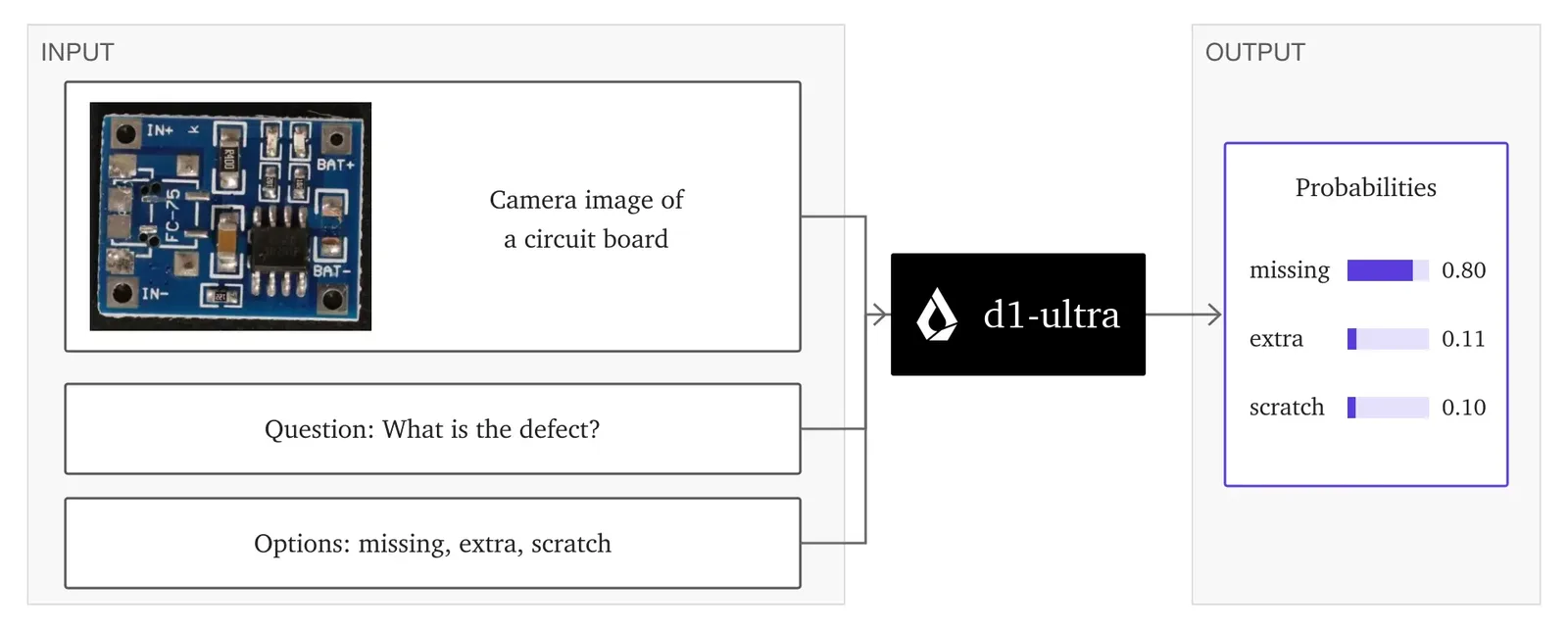
Liquid says it based d1-ultra on a larger open-weight model than d1, with "a series of Liquid-specific heavy customizations", and that the combination with its training pipeline gives the largest gains on knowledge-related tasks. Liquid's docs describe it as the family's most capable decision model, for harder decisions, while the hosted d1 stays the lower-priced option. The weights are not published; the model is served on the Liquid AI API at https://api.liquid.ai/decisions/v1/systemone, and Vercel's AI Gateway lists it as liquid/d1-ultra with a 32,768-token context window.
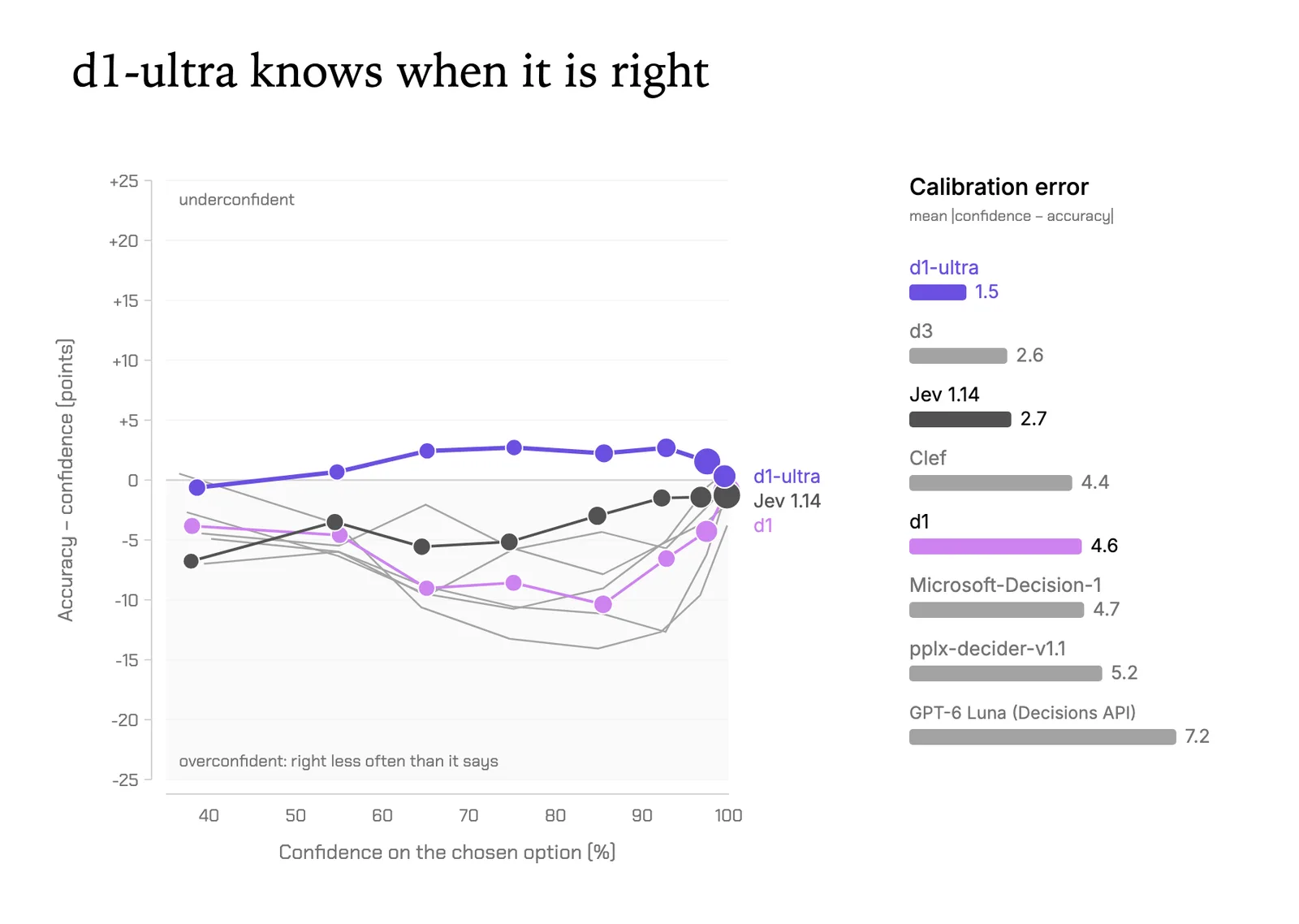
Liquid compared d1-ultra with its earlier hosted d1 and with TypeSafe's Jev 1.14 across 112 unique evaluations grouped into eight categories. It averages 76.7, against 69.4 for Jev 1.14 and 73.5 for the next-best model in Liquid's table, d3, and leads every category: 65.5 on judgment and taste, 56.0 on knowledge and reasoning, 80.2 across 44 languages, 82.8 on tools and agents, 89.3 on robustness, 77.9 on pictures, 77.5 on business and unseen domains, and 85.8 on safety and policy. Liquid also trained it specifically for calibrated probabilities, after finding that most decision models are overconfident: on its calibration chart d1-ultra's mean gap between confidence and accuracy is 1.5 points, against 2.6 for d3, 2.7 for Jev 1.14, 4.6 for d1 and 7.2 for GPT-6 Luna (Decisions API).
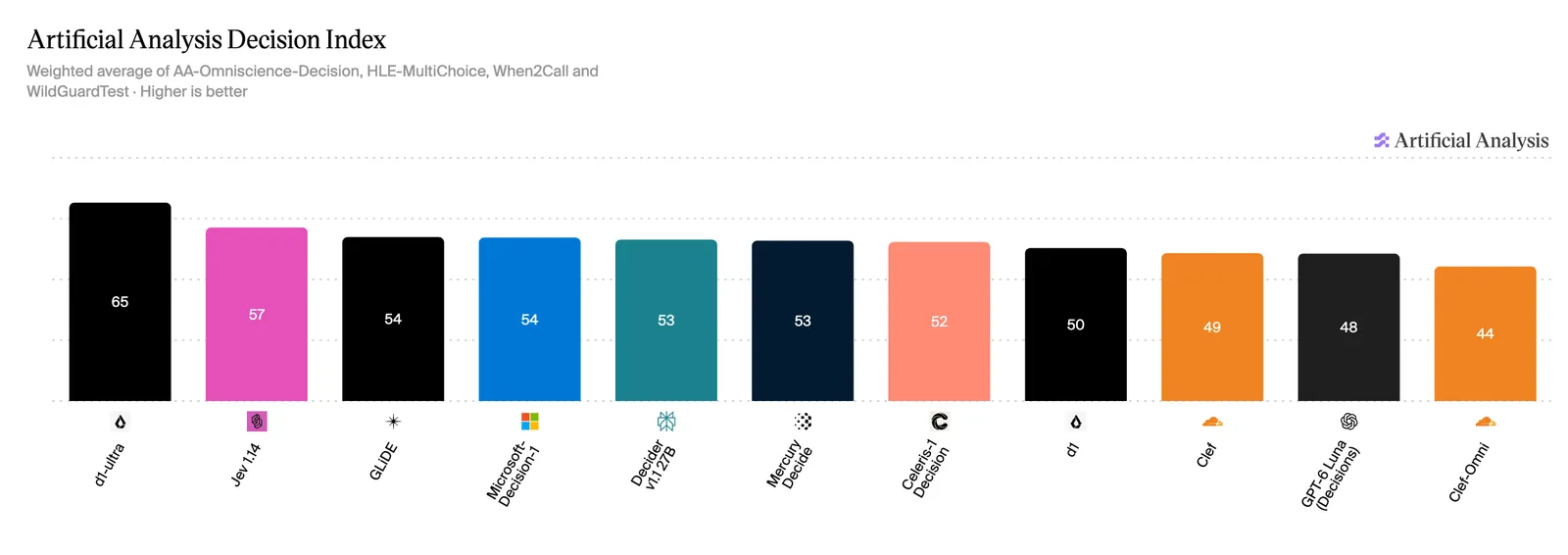
On the Artificial Analysis Decision Index, a weighted average of AA-Omniscience-Decision, HLE-MultiChoice, When2Call and WildGuardTest, Liquid's launch chart shows d1-ultra at 65, ahead of Jev 1.14 at 57, GLiDE and Microsoft-Decision-1 at 54 and Liquid's own d1 at 50; Liquid states it leads every other decision model on the index by at least 8 points. Pricing is $0.042 per million input tokens with no output tokens, the same price as Jev 1.14, against $0.02 for the hosted d1. Images count as input tokens at the text rate, 1.5 tokens per 32×32-pixel patch, so a 1024×1024 image costs 1,536 tokens, and each question is billed as its own prompt including its text and all images.
| Released | 2026-10-15 |
|---|---|
| License | Proprietary |
| Weights | API only |
| Context | 32K |
| Max output | Typed answers with probabilities — no generated tokens |
| Architecture | Built on a larger open-weight model than d1, with Liquid-specific customizations; answers every question in one forward pass with no generation |
| Modalities | Text, Vision |
| Status | Generally available on the Liquid AI API and Vercel AI Gateway |
Benchmarks
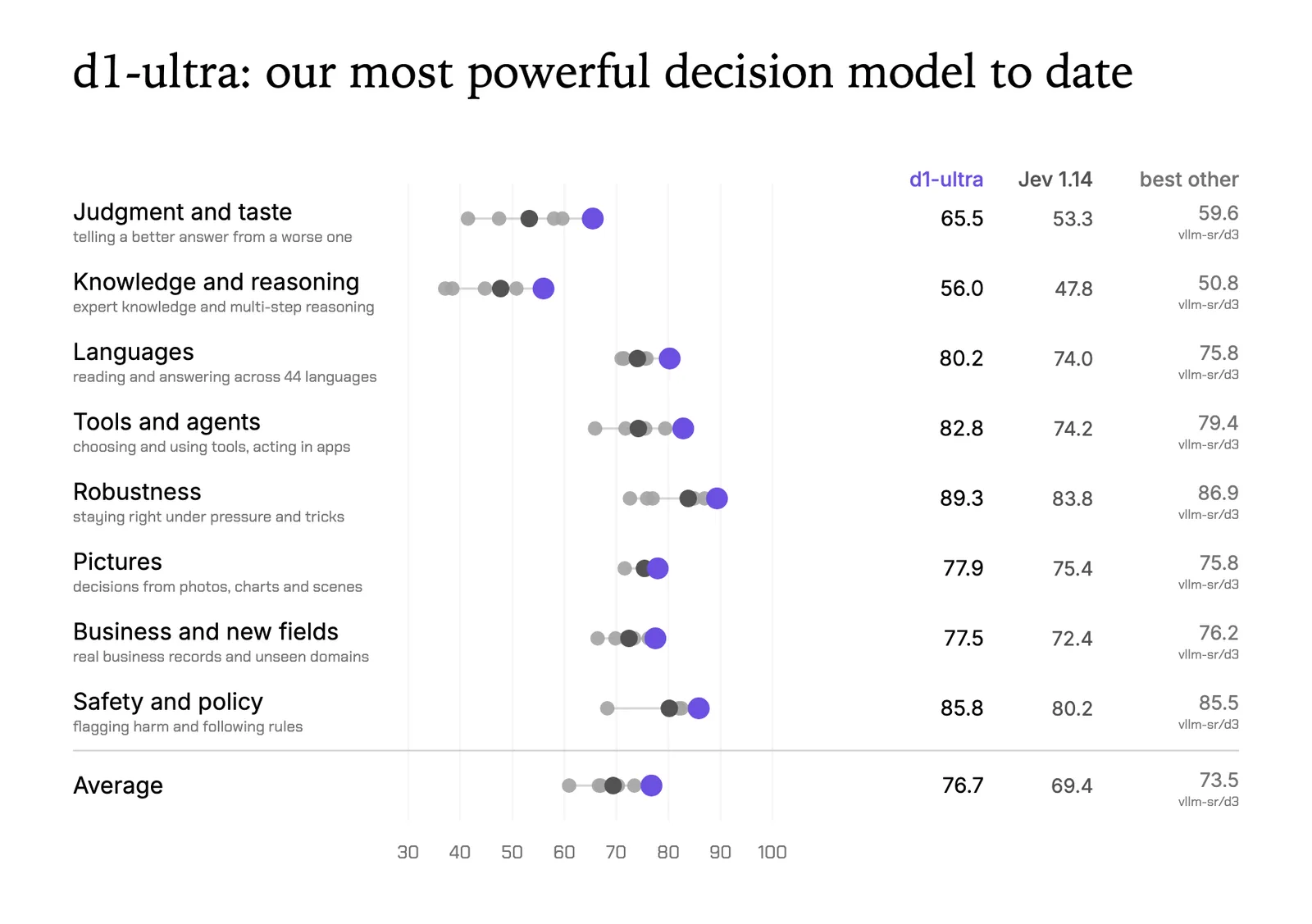
Liquid AI's published decision benchmarks by category (d1-ultra launch post)
| Benchmark | d1-ultra | Jev 1.14 | d3 | pplx-decider v1.1 | Clef | Microsoft-Decision-1 | GPT-6 Luna (Decisions API) |
|---|---|---|---|---|---|---|---|
| Judgment and taste | 65.5 | 53.3 | 59.6 | 58 | 53.1 | 47.5 | 41.5 |
| Knowledge and reasoning | 56 | 47.8 | 50.8 | 47.6 | 44.8 | 38.5 | 37.1 |
| Languages | 80.2 | 74 | 75.8 | 75.4 | 71 | 71.5 | 71.4 |
| Tools and agents | 82.8 | 74.2 | 79.4 | 75.5 | 73.9 | 71.8 | 65.9 |
| Robustness | 89.3 | 83.8 | 86.9 | 77 | 72.6 | 84.9 | 75.9 |
| Pictures | 77.9 | 75.4 | 75.8 | 75.5 | 71.6 | — | — |
| Business and new fields | 77.5 | 72.4 | 76.2 | 73.4 | 71.8 | 69.8 | 66.4 |
| Safety and policy | 85.8 | 80.2 | 85.5 | 85 | 81.9 | 82.5 | 68.3 |
| Average | 76.7 | 69.4 | 73.5 | 70.3 | 67 | 66.6 | 60.9 |
This model's scores
- Liquid decision evals, 112-task average76.7
- Robustness89.3
- Safety and policy85.8
- Tools and agents82.8
- Languages (44 languages)80.2
- Pictures77.9
- Judgment and taste65.5
- Knowledge and reasoning56
Scores on a 0–100 scale (25-point gridlines); higher is better. Each benchmark links to its published source.
Pricing
| Input | $0.042 / 1M tokens |
|---|---|
| Output | $0.00 / 1M tokens |
Billed on input tokens only. Images count at the text rate: 1.5 tokens per 32×32-pixel patch (1,536 tokens for a 1024×1024 image). Each question is billed as its own prompt, including its text and all images.
Strengths
- Highest average (76.7) in Liquid's 112-evaluation comparison, against 69.4 for Jev 1.14 and 73.5 for d3
- Largest margin on knowledge and reasoning: 56.0, against 47.8 for Jev 1.14 and 50.8 for d3
- Calibrated probabilities: a 1.5-point mean confidence-accuracy gap on Liquid's chart, against 2.7 for Jev 1.14 and 4.6 for d1
- 65 on the Artificial Analysis Decision Index in Liquid's launch chart, 8 points ahead of Jev 1.14 at 57
- Text and image questions in one forward pass, with zero output tokens to pay for
- $0.042 per 1M input tokens, the same price as Jev 1.14
Best for
- Reach for d1-ultra for visual inspection, such as naming the defect on a photographed circuit board from a fixed list of options.
- Reach for it to check claims against photos, for example whether a customer's picture shows the damage they report.
- Reach for it for routing, classification and scoring where the answer's probability drives the next step, since Liquid trained it for calibration.
- Reach for it over the hosted d1 for knowledge-heavy decisions, where Liquid reports its largest gains, at roughly twice d1's input price.
- Look elsewhere when you need generated text or open weights to run locally; Liquid's open d1-3B and d1-omni-600M cover on-device use.
How to access
| Provider | Model ID |
|---|---|
| Liquid AI API ↗ | d1-ultra |
| Vercel AI Gateway ↗ | liquid/d1-ultra |
d1 (decision models) — every version
The full lineage of the d1 (decision models) line, newest first. Every version has its own page — click any to compare specs, benchmarks and pricing.
| Version | Released | Context | License |
|---|---|---|---|
| d1-ultracurrent | 2026-10-15 | 32K | Proprietary |
| Open d1 (d1-3B and d1-omni-600M) | 2026-10-07 | 32K | LFM Open License v1.0 |
FAQ
What is d1-ultra?
A hosted multimodal decision model from Liquid AI, announced October 15, 2026. It reads text, images or both and answers typed questions (yes/no, a choice among named options, or a score) with probabilities from one forward pass, without generating any tokens.
How does d1-ultra differ from d1?
Liquid built d1-ultra on a larger open-weight model than d1, with Liquid-specific customizations, and reports the largest gains on knowledge-related tasks. It costs $0.042 per million input tokens against $0.02 for d1. Neither hosted model has published weights; Liquid's open d1-3B and d1-omni-600M are the downloadable members of the family.
How well does it score?
On Liquid's 112-evaluation comparison it averages 76.7, against 69.4 for Jev 1.14 and 73.5 for d3, and leads every category. On the Artificial Analysis Decision Index, Liquid's launch chart shows it at 65 against 57 for Jev 1.14.
How much does it cost?
$0.042 per million input tokens, with no output tokens billed. Images are counted as input tokens at the same rate, 1.5 tokens per 32×32-pixel patch, so a 1024×1024 image costs 1,536 tokens. Each question is billed as its own prompt, including its text and all images.
Where can I call it?
On the Liquid AI API with the model id d1-ultra, and on Vercel AI Gateway as liquid/d1-ultra with a 32,768-token context window. Vercel shows it through the AI SDK, an OpenAI-compatible Decisions API endpoint and a TypeSafe-compatible API. Liquid announced OpenRouter availability as coming.