
Overview
Open d1 is a pair of open-weight decision models that Liquid AI announced on its blog on October 7, 2026: d1-3B, which reads text and images, and d1-omni-600M, which reads text with either images or audio. They follow Liquid's hosted d1 decision model, which launched on the Liquid AI API on October 5, 2026 without open weights. A decision model is not a chat model and does not write text. It takes a state (text, JSON, images or a mix) and a set of typed questions (noul for yes/no, choice for one of several named options, score for an ordered rating) and returns every answer from a single forward pass with zero output tokens: P(yes) for a yes/no question, a probability for each option, and an expected level with a confidence for a score. The model cards list routing and triage, moderation, intent classification, reranking, LLM-as-a-judge scoring, agent guardrails and visual inspection as uses. Both checkpoints are on Hugging Face under the LFM Open License v1.0.
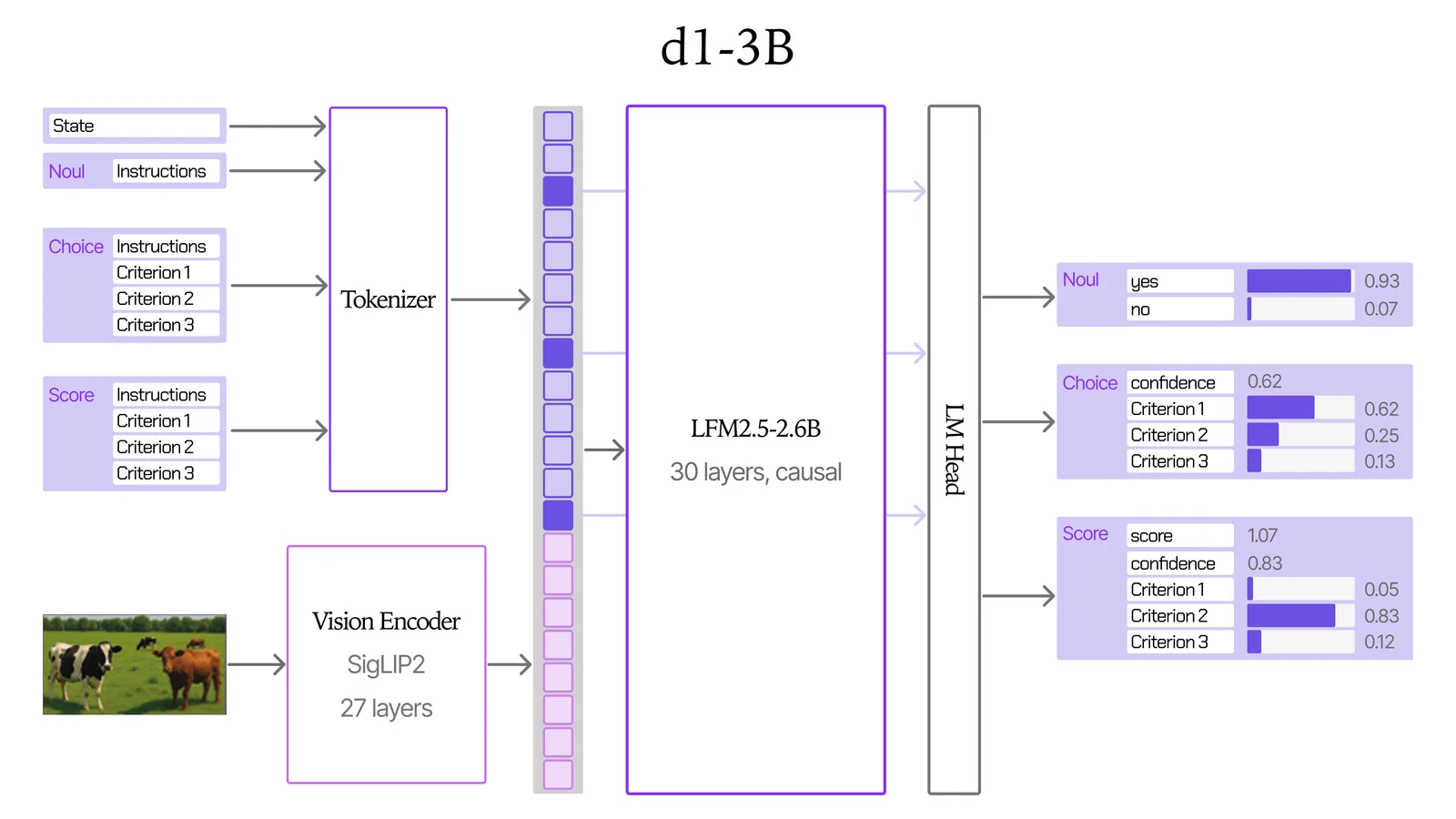
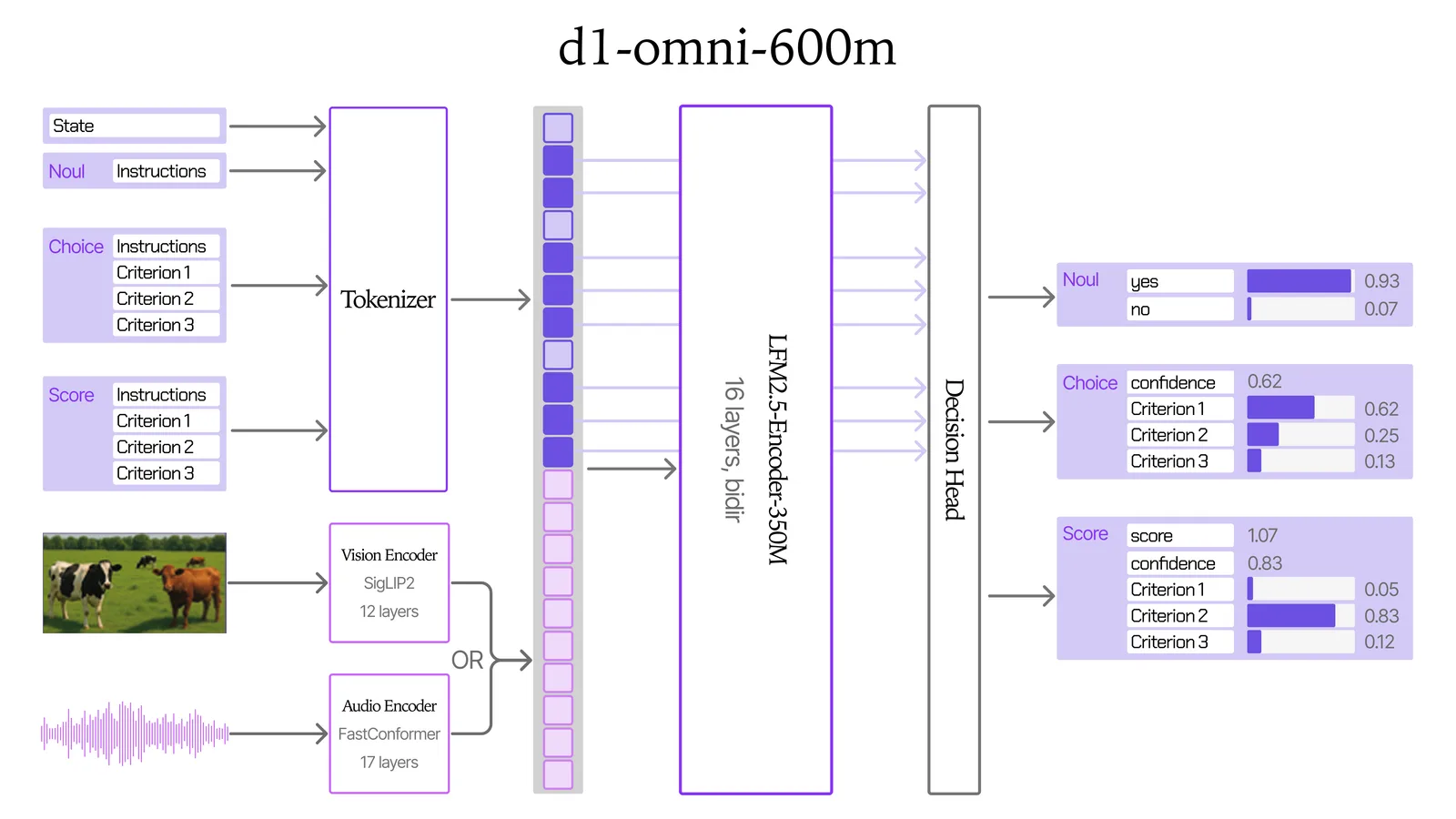
d1-3B has 3.1B parameters and is post-trained from LFM2.5-VL-3B, a decoder-only vision-language model with a SigLIP2 NaFlex vision encoder, with a 32,768-token context. Liquid's blog says its text backbone was first averaged with LFM2.5-2.6B, then fine-tuned, and several checkpoints were merged. d1-omni-600M has 587M parameters: a 381M shared trunk and decision head built on the bidirectional LFM2.5-Encoder-350M, a 94M SigLIP2 vision encoder taken from LFM2.5-VL-450M and a 112M 17-layer FastConformer audio encoder. It has a 16,384-token context, accepts up to 30 seconds of 16 kHz mono speech, and takes images or audio in one request, not both. Liquid calls it "our first experimental checkpoint", and its model card describes it as an early research release under active development with no published inference speeds.
On Decision Index v0.2.1 (public split), scored by Liquid with the official scorer rather than submitted to the leaderboard, d1-3B scores 48.57. Its model card places that behind Winnow-12B (50.02) and ahead of Decider 35B-A3B (47.11), JPT-9B (46.89) and Decider 4B (40.70); d1-omni-600M scores 15.95. On seven public text tasks posed as decisions, d1-3B has the highest mean in Liquid's table at 82.9, against 81.1 for Decider 4B, 77.1 for Decider 2B and 78.4 for d1-omni-600M, which posts the top scores on Civil Comments (95.8) and PAWS-X (79.5). On eleven vision benchmarks d1-3B averages 74.1 against 73.9 for its base LFM2.5-VL-3B, gaining most on VL-RewardBench (65.0 against 50.9) and trailing on CV-Bench (82.1 against 87.6) and VisualWebBench (71.4 against 78.3). Liquid published no vision or audio decision benchmarks for d1-omni-600M and calls audio decision benchmarks an open problem.
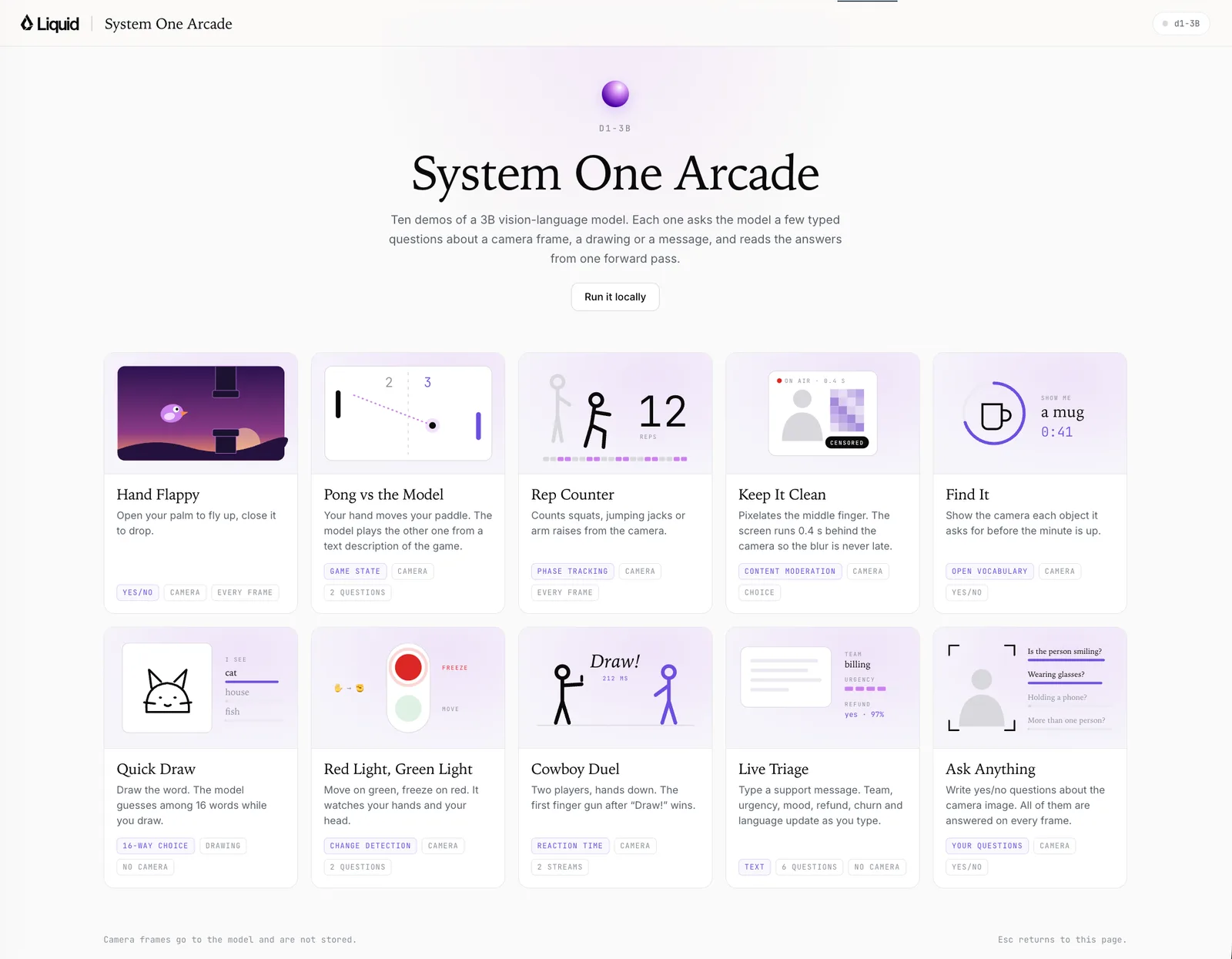
Liquid's latency tables cover d1-3B: one question takes 30 ms on an Apple M5 Pro, 16 ms on a Jetson AGX Thor, 26 ms on a Jetson AGX Orin 64 GB and 50 ms on a Jetson Orin Nano, and 8 ms on an NVIDIA RTX 4090 or 9 ms on an AMD MI325X; packing 64 states reaches 1,106 states per second on the MI325X. Both models load in Transformers with trust_remote_code and are called through system_one() or system_one_batch(), and the blog announces day-one llama.cpp support across Apple, AMD, Qualcomm and NVIDIA hardware. Liquid also published System One Arcade, a Hugging Face Space of ten real-time camera, drawing and text demos that run on d1-3B.
| Released | 2026-10-07 |
|---|---|
| License | LFM Open License v1.0 |
| Weights | Open weights |
| Parameters | d1-3B: 3.1B · d1-omni-600M: 587M |
| Context | 32K (d1-3B) · 16K (d1-omni-600M) |
| Architecture | d1-3B: decoder-only vision-language model post-trained from LFM2.5-VL-3B with a SigLIP2 NaFlex vision encoder. d1-omni-600M: bidirectional LFM2.5-Encoder-350M trunk with a decision head, a SigLIP2 vision encoder and a 17-layer FastConformer audio encoder. Both answer in one forward pass with no generation. |
| Modalities | Text, Vision, Audio (d1-omni-600M only) |
| Status | Open weights on Hugging Face; d1-omni-600M is an early research release under active development |
Benchmarks
Liquid AI's published text benchmarks, each task posed as a decision (Table 1 of the Open d1 launch post)
| Benchmark | d1-omni-600M | d1-3B | Decider 2B | Decider 4B |
|---|---|---|---|---|
| SQuAD 2.0 | 74 | 85.3 | 67.7 | 76 |
| Civil Comments | 95.8 | 93 | 93.6 | 92.8 |
| MASSIVE intent | 86.1 | 87.3 | 81.1 | 88.3 |
| PubMedQA | 61.3 | 66 | 65.7 | 63.3 |
| BoolQ | 77.7 | 86.7 | 87.3 | 89 |
| XNLI | 74.7 | 85 | 85 | 88.6 |
| PAWS-X | 79.5 | 76.9 | 59.5 | 69.8 |
| Mean | 78.4 | 82.9 | 77.1 | 81.1 |
This model's scores
- Decision Index v0.2.1, public split (d1-3B)48.57
- Decision Index v0.2.1, public split (d1-omni-600M)15.95
- Text tasks as decisions, 7-task mean (d1-3B)82.9%
- Text tasks as decisions, 7-task mean (d1-omni-600M)78.4%
- Vision benchmarks, 11-task mean (d1-3B)74.1%
- DecisionBench eng v1 (d1-3B)71.8%
- Fast Decisions, dev split (d1-omni-600M)76.9%
- Fast Decisions, dev split (d1-3B)69.3%
Scores on a 0–100 scale (25-point gridlines); higher is better. Each benchmark links to its published source.
Strengths
- 48.57 on Decision Index v0.2.1 for a 3B model, ahead of Decider 35B-A3B (47.11) and JPT-9B (46.89) on Liquid's scoring
- Highest mean (82.9) on Liquid's seven-task text comparison, against 81.1 for Decider 4B and 77.1 for Decider 2B
- Image questions as well as text: d1-3B averages 74.1 on eleven vision benchmarks, 65.0 on VL-RewardBench against 50.9 for its base model
- Fast at the edge: 30 ms per question on an Apple M5 Pro, 16 ms on a Jetson AGX Thor and 50 ms on a Jetson Orin Nano
- One forward pass with zero output tokens: the state is read once for all questions, and each answer comes with probabilities
- A 587M audio-capable sibling, d1-omni-600M, that leads Liquid's text table on Civil Comments (95.8) and PAWS-X (79.5)
Best for
- Reach for d1-3B to route, triage or moderate requests locally, asking several yes/no, choice and score questions about one text or JSON state in a single call.
- Reach for it as a guardrail or LLM-as-a-judge inside an agent, acting on its probabilities rather than parsing generated text.
- Reach for it for camera and visual-inspection decisions on Apple silicon or Jetson boards, where a question takes tens of milliseconds.
- Try d1-omni-600M for decisions about short English speech clips (up to 30 seconds) or about images on smaller hardware, keeping in mind that it is an early research release.
- Look elsewhere for anything that needs generated text, or for knowledge-heavy questions, where d1-3B scores 23.8 on the Decision Index Knowledge category against 33.8 for Winnow-12B.
How to access
| Provider | Model ID |
|---|---|
| Hugging Face (d1-3B weights) ↗ | LiquidAI/d1-3B |
| Hugging Face (d1-omni-600M weights) ↗ | LiquidAI/d1-omni-600M |
d1 (decision models) — every version
The full lineage of the d1 (decision models) line, newest first. Every version has its own page — click any to compare specs, benchmarks and pricing.
| Version | Released | Context | License |
|---|---|---|---|
| d1-ultracurrent | 2026-10-15 | 32K | Proprietary |
| Open d1 (d1-3B and d1-omni-600M) | 2026-10-07 | 32K | LFM Open License v1.0 |
FAQ
What is Open d1?
Liquid AI's open-weight decision models, announced October 7, 2026: d1-3B (text and images) and d1-omni-600M (text with images or audio). Instead of generating text, they answer typed questions about a state (yes/no, a choice among named options, or a score) with probabilities, in one forward pass and zero output tokens.
How is it related to Liquid's hosted d1?
Liquid launched d1 as a hosted decision model on its API on October 5, 2026, without open weights. Two days later it released d1-3B and d1-omni-600M as open-weight checkpoints on Hugging Face. Liquid's docs list all of them as the d1 family.
What is the difference between d1-3B and d1-omni-600M?
d1-3B is a 3.1B model post-trained from the LFM2.5-VL-3B vision-language model, with a 32,768-token context and text plus image input. d1-omni-600M is a 587M model built on the bidirectional LFM2.5-Encoder-350M with added vision and audio encoders, a 16,384-token context, and either images or up to 30 seconds of speech per request. Liquid describes d1-omni-600M as an early experimental checkpoint.
How well does d1-3B score?
48.57 on Decision Index v0.2.1 (public split), scored by Liquid with the official scorer: behind Winnow-12B at 50.02 and ahead of Decider 35B-A3B at 47.11. On Liquid's seven-task text comparison it has the highest mean, 82.9, against 81.1 for Decider 4B.
How fast is it?
Liquid reports d1-3B answering one question in 30 ms on an Apple M5 Pro, 16 ms on a Jetson AGX Thor, 50 ms on a Jetson Orin Nano, 8 ms on an NVIDIA RTX 4090 and 9 ms on an AMD MI325X. No speed figures are published for d1-omni-600M.
How do I run it?
Load LiquidAI/d1-3B or LiquidAI/d1-omni-600M from Hugging Face with Transformers and trust_remote_code=True, then call model.system_one(state, questions) or system_one_batch() for many states. The response holds the answers and a usage block with zero output tokens. Liquid also announced llama.cpp support at launch.
What license are the weights under?
The LFM Open License v1.0, the license tag on both Hugging Face model cards.