
Overview
MiMo-V2.6 Flash is the efficiency-balanced checkpoint of Xiaomi's MiMo-V2.6 series, published to Hugging Face as MiMo-V2.6-Flash-RL on 21 September 2026 under an MIT licence. It keeps the series' full feature set — text, image, video and audio in one model, and a 1 million-token context — at 309 billion total parameters with 15 billion activated per token, against 1.02T/42B for its Pro sibling.
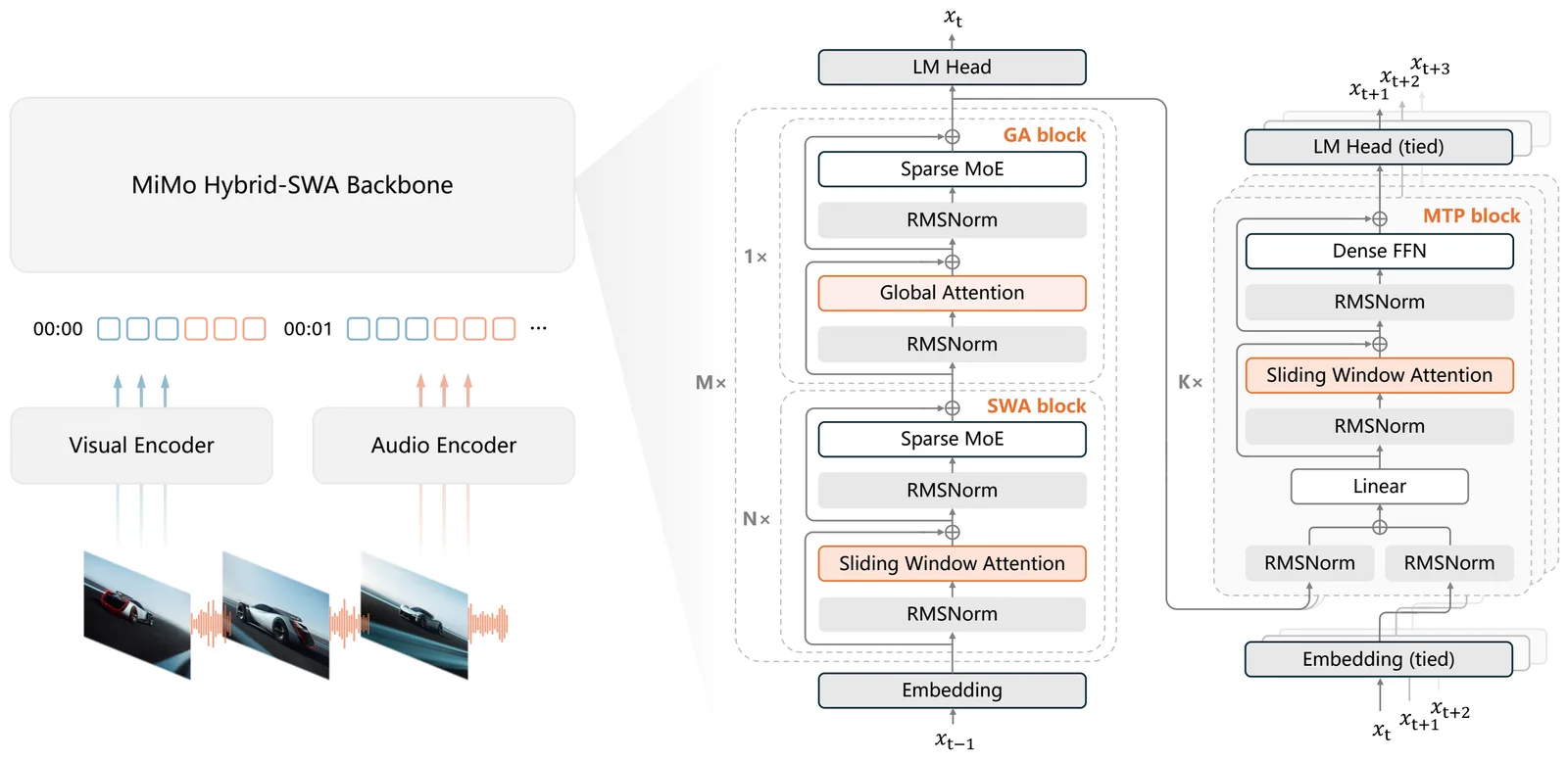
The smaller footprint comes from the backbone rather than from cut capabilities: 48 layers instead of 70, a hidden size of 4096 instead of 6144, 64 attention heads instead of 128, and 256 routed experts instead of 384 — with 8 activated in both cases. The vision encoder, audio stack and five-layer speculative decoder are shared with the Pro checkpoint, so the multimodal pipeline is identical.
Both checkpoints come out of the same training programme, which Xiaomi frames as scaling reinforcement learning toward self-improvement: a single mixed RL run over coding, general-agent, visual and cybersecurity tasks, fully asynchronous GRPO on batches of 1,568 prompts × 16 rollouts, and an agentic grader that ranks rollouts within each group rather than scoring them pass/fail.
On the comparison table Xiaomi published, Flash trails Pro by a few points on most agent and coding rows while actually leading it on CyberGym (95.1 against 94.0). The gap is widest on the harder security benchmarks — ExploitBench 25.3 against 47.9, SEC Bench Pro 47.5 against 66.3. Serving needs a fraction of the hardware: the documented SGLang command runs on a single node with tensor parallelism 8, and the vLLM command with tensor parallelism 4.
| Released | 2026-09-21 |
|---|---|
| License | MIT |
| Weights | Open weights |
| Parameters | 309B total · 15B activated (sparse Mixture-of-Experts) |
| Context | 1M |
| Architecture | Sparse MoE with a hybrid sliding-window/global-attention backbone (48 layers: 39 SWA, 9 GA; 256 routed experts, 8 activated) at a hidden size of 4096, sharing the series' 681M-parameter MiMo ViT, its 308M AudioTokenizer plus 127M audio patch encoder, and a 5-layer multi-token-prediction speculative decoder. |
| Modalities | Text, Image, Video, Audio |
| Status | Open weights — the MiMo-V2.6-Flash-RL checkpoint is published on Hugging Face, with hosted access through the Xiaomi MiMo API platform, AI Studio, MiMo Desktop and OpenRouter |
Benchmarks
MiMo-V2.6 Flash against its Pro sibling and named peers, as published on the MiMo-V2.6 model cards
| Benchmark | MiMo-V2.6 Pro | MiMo-V2.6 Flash | MiMo-V2.5 Pro | Claude Opus 5 | GPT-5.6 Sol | Claude Fable 5 |
|---|---|---|---|---|---|---|
| DeepSWE v1.1 | 71.9 | 67.9 | 19 | 74 | 73 | 70 |
| ProgramBench | 26.5 | 26 | 12.5 | 37 | 25 | 33 |
| MiMo Code Bench | 63.2 | 61.2 | 40.4 | 68.6 | 59.3 | — |
| AutomationBench v1.0.6 | 53.1 | 52.3 | 16 | 50.3 | 45.8 | 46.2 |
| Toolathlon-Verified | 76.9 | 73.6 | 49.1 | 80.6 | 74.9 | 77.9 |
| GDPval-AA 2.1 | 1673 | — | 1107 | 1708 | 1588 | 1595 |
| Agents' Last Exam | 31.6 | 27.6 | 13.2 | 31.6 | 30.8 | 25.7 |
| Terminal Bench 4.0 | 34.9 | 28.8 | 1.5 | 49 | 39.9 | 42.4 |
| Terminal Bench 2.1 | 89.9 | 87.6 | 65.2 | 89.1 | 88.8 | 84.3 |
| OSWorld-Verified | 82 | 80.8 | — | 83.4 | 83 | 86 |
| JobBench | 62 | 61.2 | 25 | 65.7 | 45.4 | 57.4 |
| CyberGym | 94 | 95.1 | 40 | — | — | — |
| MiMo Cyber Bench | 80.2 | 77.2 | 0 | — | — | — |
| ExploitGym | 17.8 | 6 | 0.2 | 22.1 | 30.3 | 28.4 |
| ExploitBench | 47.9 | 25.3 | 16.6 | 70 | 78.5 | 78 |
| SEC Bench Pro | 66.3 | 47.5 | 17.7 | — | 79.1 | — |
| MiMo VisualCoding | 72.3 | 71.5 | — | 70 | 73.4 | 69.1 |
This model's scores
- CyberGym95.1%
- Terminal Bench 2.187.6%
- OSWorld-Verified80.8%
- MiMo Cyber Bench77.2%
- Toolathlon-Verified73.6%
- MiMo VisualCoding71.5%
- DeepSWE v1.167.9%
- MiMo Code Bench61.2%
- JobBench61.2%
- AutomationBench v1.0.652.3%
- SEC Bench Pro47.5%
- Terminal Bench 4.028.8%
- Agents' Last Exam27.6%
- ProgramBench26%
Scores on a 0–100 scale (25-point gridlines); higher is better. Each benchmark links to its published source.
Strengths
- MIT-licensed open weights at 309B total / 15B activated — the series' capabilities on hardware a single node can serve
- Same omnimodal input as the Pro checkpoint (text, image, video, audio) and the same 1M-token context
- Highest score in its own published comparison on CyberGym (95.1), ahead of MiMo-V2.6 Pro
- Single-node deployment documented for both SGLang (tensor parallelism 8) and vLLM (tensor parallelism 4), with EAGLE speculative decoding
- Shares the Pro checkpoint's 681M MiMo ViT and audio encoders, so multimodal behaviour carries over
Best for
- Reach for it when you want the MiMo-V2.6 feature set on hardware that cannot hold a trillion-parameter checkpoint.
- Reach for it for long-context agent runs — repositories, tool traces, multi-session work — where the 1M window matters more than the last few benchmark points.
- Reach for it for multimodal pipelines that read screenshots, video or audio alongside text on self-hosted weights.
- Reach for it for vulnerability-discovery work in authorised environments, where it posts the series' best CyberGym score.
How to access
| Provider | Model ID |
|---|---|
| Xiaomi MiMo Open Platform ↗ | mimo-v2.6-flash |
| Hugging Face (weights) ↗ | XiaomiMiMo/MiMo-V2.6-Flash-RL |
MiMo (open weights) — every version
The full lineage of the MiMo (open weights) line, newest first. Every version has its own page — click any to compare specs, benchmarks and pricing.
| Version | Released | Context | License |
|---|---|---|---|
| MiMo-V2.6 Procurrent | 2026-09-21 | 1M | MIT |
| MiMo-V2.6 Flash | 2026-09-21 | 1M | MIT |
FAQ
How does MiMo-V2.6 Flash differ from MiMo-V2.6 Pro?
Size, not features. Flash is 309B total with 15B activated against Pro's 1.02T/42B, and its backbone has 48 layers at hidden size 4096 with 256 routed experts, against 70 layers at 6144 with 384 experts. Context (1M), modalities, vision encoder, audio encoders and speculative decoder are identical.
Is MiMo-V2.6 Flash ever better than the Pro checkpoint?
On one row of Xiaomi's published comparison, yes: CyberGym, where Flash scores 95.1 against Pro's 94.0. Everywhere else in that table Pro leads, by a little on the agent rows and by a lot on the hard security ones (ExploitBench 47.9 against 25.3).
What hardware does MiMo-V2.6 Flash need?
The model card's SGLang command is single-node with tensor parallelism 8 and data parallelism 2; the vLLM command uses tensor parallelism 4 with `--trust-remote-code`. Pro, by contrast, is documented across two nodes at tensor parallelism 16. Recommended sampling for both is temperature 1.0, top_p 0.95.
What licence are the weights under?
MIT. MiMo-V2.6-Flash-RL is published on Hugging Face under the MIT licence together with its tokenizer, model card and the shared MiMo-V2.6 technical report, with a ModelScope mirror listed on the card.
Which modalities does it accept?
Text, image, video and audio. Vision runs through the same 681M-parameter MiMo ViT as the Pro checkpoint; audio runs through a 308M AudioTokenizer encoder with 20 RVQ codebooks plus a 127M audio patch encoder.