
Overview
MiMo-V2.6 Pro is the flagship checkpoint of Xiaomi's MiMo-V2.6 series, published to Hugging Face as MiMo-V2.6-Pro-RL on 21 September 2026 under an MIT licence. The model card describes a sparse Mixture-of-Experts model with 1.02 trillion total parameters and 42 billion activated per token, a 1 million-token context, and native handling of text, image, video and audio in a single model.
The series' stated goal is to "scale reinforcement learning toward self-improvement" — scaling RL compute, environment diversity and grader compute together. Xiaomi describes a single mixed RL run ("You Only RL Once") that trains coding, general-agent, visual and cybersecurity tasks in the same batch across multiple harnesses, using fully asynchronous GRPO on batches of 1,568 prompts × 16 rollouts per step.
The reward signal is itself scaled through what the card calls Groupwise Agentic Grading. Groupwise Reward Synthesis builds task-specific rubrics offline from contrasting rollouts and fuses rubric quality with test outcomes; Groupwise Advantage Redistribution ranks passing trajectories online and shifts advantage toward higher-quality solutions. A later stage, Multi-Prefix Multi-Teacher On-Policy Distillation, reuses teacher and SFT histories so decision points can be trained without regenerating the preceding turns.
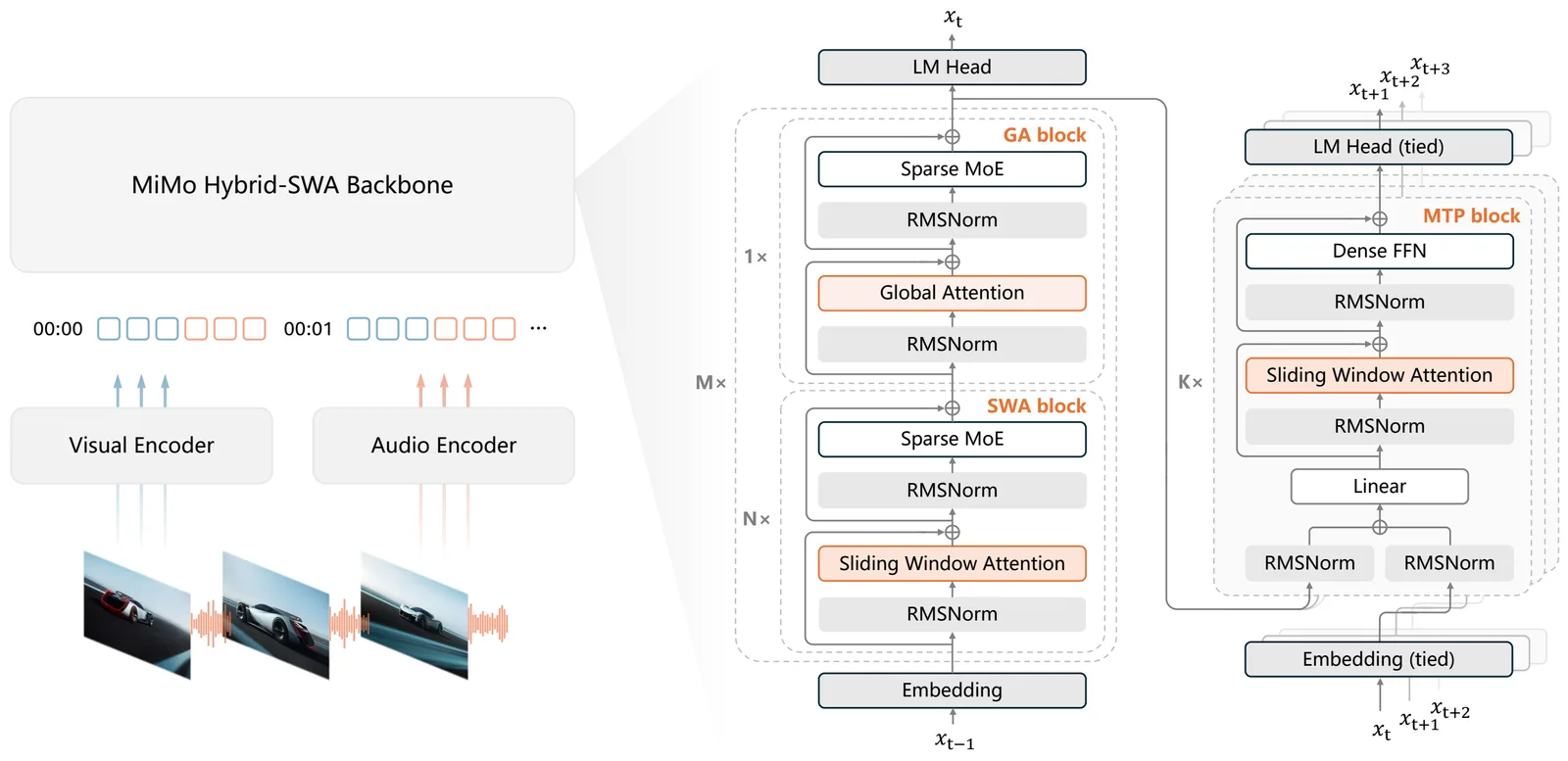
Architecturally the backbone interleaves local sliding-window attention with global attention and uses sparse MoE feed-forward blocks with no shared experts. Omnimodal input arrives through a 681M-parameter MiMo ViT and a two-part audio stack, and a five-layer speculative decoder predicts seven subsequent tokens per forward pass. Weights, tokenizer, model card and a technical report are all published; deployment recipes are given for SGLang and vLLM.
| Released | 2026-09-21 |
|---|---|
| License | MIT |
| Weights | Open weights |
| Parameters | 1.02T total · 42B activated (sparse Mixture-of-Experts) |
| Context | 1M |
| Architecture | Sparse MoE with a hybrid sliding-window/global-attention backbone (70 layers: 60 SWA, 10 GA; 384 routed experts, 8 activated), a 681M-parameter MiMo ViT vision encoder, a 308M AudioTokenizer plus a 127M audio patch encoder, and a 5-layer multi-token-prediction speculative decoder. |
| Modalities | Text, Image, Video, Audio |
| Status | Open weights — the MiMo-V2.6-Pro-RL checkpoint is published on Hugging Face, with hosted access through the Xiaomi MiMo API platform, AI Studio, MiMo Desktop and OpenRouter |
Benchmarks
MiMo-V2.6 Pro against named peers, as published on the MiMo-V2.6-Pro-RL model card
| Benchmark | MiMo-V2.6 Pro | MiMo-V2.6 Flash | MiMo-V2.5 Pro | Claude Opus 5 | GPT-5.6 Sol | Claude Fable 5 |
|---|---|---|---|---|---|---|
| DeepSWE v1.1 | 71.9 | 67.9 | 19 | 74 | 73 | 70 |
| ProgramBench | 26.5 | 26 | 12.5 | 37 | 25 | 33 |
| MiMo Code Bench | 63.2 | 61.2 | 40.4 | 68.6 | 59.3 | — |
| AutomationBench v1.0.6 | 53.1 | 52.3 | 16 | 50.3 | 45.8 | 46.2 |
| Toolathlon-Verified | 76.9 | 73.6 | 49.1 | 80.6 | 74.9 | 77.9 |
| GDPval-AA 2.1 | 1673 | — | 1107 | 1708 | 1588 | 1595 |
| Agents' Last Exam | 31.6 | 27.6 | 13.2 | 31.6 | 30.8 | 25.7 |
| Terminal Bench 4.0 | 34.9 | 28.8 | 1.5 | 49 | 39.9 | 42.4 |
| Terminal Bench 2.1 | 89.9 | 87.6 | 65.2 | 89.1 | 88.8 | 84.3 |
| OSWorld-Verified | 82 | 80.8 | — | 83.4 | 83 | 86 |
| JobBench | 62 | 61.2 | 25 | 65.7 | 45.4 | 57.4 |
| CyberGym | 94 | 95.1 | 40 | — | — | — |
| MiMo Cyber Bench | 80.2 | 77.2 | 0 | — | — | — |
| ExploitGym | 17.8 | 6 | 0.2 | 22.1 | 30.3 | 28.4 |
| ExploitBench | 47.9 | 25.3 | 16.6 | 70 | 78.5 | 78 |
| SEC Bench Pro | 66.3 | 47.5 | 17.7 | — | 79.1 | — |
| MiMo VisualCoding | 72.3 | 71.5 | — | 70 | 73.4 | 69.1 |
This model's scores
- CyberGym94%
- Terminal Bench 2.189.9%
- OSWorld-Verified82%
- MiMo Cyber Bench80.2%
- Toolathlon-Verified76.9%
- MiMo VisualCoding72.3%
- DeepSWE v1.171.9%
- SEC Bench Pro66.3%
- MiMo Code Bench63.2%
- JobBench62%
- AutomationBench v1.0.653.1%
- ExploitBench47.9%
- Terminal Bench 4.034.9%
- Agents' Last Exam31.6%
Scores on a 0–100 scale (25-point gridlines); higher is better. Each benchmark links to its published source.
Strengths
- MIT licence on a 1.02T-parameter frontier-class MoE — weights, tokenizer and technical report are all downloadable
- Native omnimodal input (text, image, video and audio) in one model, with a 1M-token context for long repositories and multi-session agent runs
- Leads its own published comparison on AutomationBench v1.0.6 (53.1), Terminal Bench 2.1 (89.9) and CyberGym (94.0)
- A single mixed reinforcement-learning run across coding, agent, visual and cybersecurity tasks rather than separate per-domain runs
- Documented SGLang and vLLM serving paths, including EAGLE speculative decoding and MiMo-specific reasoning and tool-call parsers
Best for
- Reach for it when an agent stack needs frontier-class coding and tool use on weights you can host yourself under a permissive licence.
- Reach for it for long-horizon work — large repositories, long tool traces, multi-session runs — that needs the full 1M-token context.
- Reach for it when a workflow mixes modalities: reading screenshots or video alongside code and text in the same conversation.
- Reach for it for authorised security work, where the card reports its strongest margins over the previous generation.
How to access
| Provider | Model ID |
|---|---|
| Xiaomi MiMo Open Platform ↗ | mimo-v2.6-pro |
| Hugging Face (weights) ↗ | XiaomiMiMo/MiMo-V2.6-Pro-RL |
MiMo (open weights) — every version
The full lineage of the MiMo (open weights) line, newest first. Every version has its own page — click any to compare specs, benchmarks and pricing.
| Version | Released | Context | License |
|---|---|---|---|
| MiMo-V2.6 Procurrent | 2026-09-21 | 1M | MIT |
| MiMo-V2.6 Flash | 2026-09-21 | 1M | MIT |
FAQ
How big is MiMo-V2.6 Pro?
The model card gives 1.02 trillion total parameters with 42 billion activated per token, in a sparse Mixture-of-Experts layout of 384 routed experts with 8 activated. The backbone has 70 layers — 60 sliding-window attention, 10 global attention — at a hidden size of 6144.
What licence are the MiMo-V2.6 weights under?
MIT. Xiaomi publishes the MiMo-V2.6-Pro-RL and MiMo-V2.6-Flash-RL checkpoints on Hugging Face under the MIT licence, with ModelScope mirrors listed on the card.
Which modalities does MiMo-V2.6 Pro accept?
Text, image, video and audio in one model. Vision runs through a 681M-parameter MiMo ViT with a 2 × 16 × 16 patch size; audio runs through a 308M AudioTokenizer encoder with 20 RVQ codebooks plus a 127M audio patch encoder.
How do I serve MiMo-V2.6 Pro locally?
The model card documents both SGLang and vLLM. The SGLang command runs across two nodes with tensor parallelism 16, expert parallelism 16, the EAGLE speculative algorithm and the MiMo reasoning and tool-call parsers; the vLLM command uses tensor parallelism 8 with `--trust-remote-code`. Recommended sampling is temperature 1.0, top_p 0.95.
What does "You Only RL Once" mean?
It is Xiaomi's description of running one mixed reinforcement-learning pass instead of separate per-domain runs: coding, general-agent, visual and cybersecurity tasks — plus multiple harnesses — are mixed into the same batch, so capabilities reinforce each other and strategies transfer to harnesses never seen during training.
How does MiMo-V2.6 Pro compare to Claude Opus 5?
On the comparison Xiaomi published, Opus 5 leads on most coding and agent rows (DeepSWE v1.1 74.0 vs 71.9, Toolathlon-Verified 80.6 vs 76.9, Terminal Bench 4.0 49.0 vs 34.9), while MiMo-V2.6 Pro leads on AutomationBench v1.0.6 (53.1 vs 50.3), Terminal Bench 2.1 (89.9 vs 89.1) and MiMo VisualCoding (72.3 vs 70.0). Opus 5 has no published figure in the CyberGym row.