
Overview
Raon-1 mini is a language model designed and trained from scratch by KRAFTON AI, the research unit of the Seoul-based game developer KRAFTON. Its weights were published on Hugging Face on November 24, 2026 under the Apache 2.0 license, a month after the October 21 Raon-1 mini preview; unlike the preview, the repository is not gated. KRAFTON describes it as strong at Korean conversation and agentic tasks, and lists training languages of Korean, English, Japanese, Chinese, Spanish, French and Thai.
The architecture matches the preview: a sparse mixture-of-experts model of 28.8B total parameters with 4.3B active per token (6 of 128 routed experts plus a shared expert), labelled 30B-A4B. Eighteen of its 25 layers use Raon Delta Attention, a linear-attention variant that decouples the erase and write gates of Kimi Delta Attention and keeps a fixed-size state, so only the 7 gated MLA layers hold a KV cache, about 8 KiB per token in BF16. It uses no positional encoding and supports 262,144 tokens of context natively. New in this release are six selectable reasoning-effort levels — none, low, medium, high (the default), xhigh and max — applied through steering vectors that ship with the checkpoint, so thinking can be shortened or switched off per request without changing the prompt.
KRAFTON's published table compares it with four MoE models of similar active size — Qwen3.6-35B-A3B, Gemma 4 26B-A4B, Flint (40B-A2.5B) and Inkling 2 Mini (26.4B-A5.4B) — with the dense Qwen3.8-27B and Muse Glimmer 30B as references. It scores 96.7 on AIME 2026, 86.0 on GPQA Diamond, 71.0 on SWE-Verified (mini-SWE-agent) and 84.9 on IFBench, and leads the MoE group on MultiChallenge (64.9), BrowseComp Plus (55.9), GDPVal (72.3) and KRAFTON's internal Korean chatbot benchmark (92.7). It trails on Terminal-Bench Lite (52.0 against 77.0 for Inkling 2 Mini), sits behind three of the four MoE peers on MMLU Pro (82.7), and Flint and Inkling 2 Mini beat it on SWE-Verified. Against the preview, 16 of the 18 rows in the shared table rose, including MMLU Pro from 76.5 to 82.7 and AutomationBench from 29.7 to 39.9; AA-Omniscience slipped from 3.5 to 1.0 and Chatbot Korean from 92.9 to 92.7.
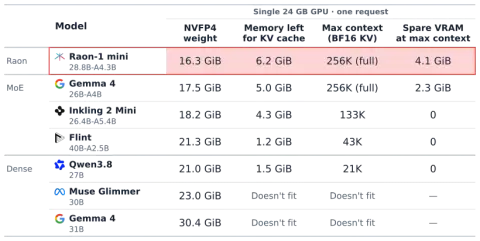
The release includes MXFP8 weights and NVFP4, GGUF and MLX builds, plus a DFlash2 draft model for speculative decoding. KRAFTON says a full 256K-token request fits in 24 GB of VRAM with NVFP4 weights and a BF16 KV cache, leaving 4.1 GiB spare; in its comparison only Gemma 4 26B-A4B also reaches its full context on that card. It runs with Hugging Face Transformers (with trust_remote_code), KRAFTON's forks of vLLM and llama.cpp and MLX, and connects to Hermes Agent, Pi and OpenCode through an OpenAI-compatible endpoint. The Apache 2.0 license covers the weights; KRAFTON's hosted API and playground run under separate terms.
| Released | 2026-11-24 |
|---|---|
| License | Apache 2.0 |
| Weights | Open weights |
| Parameters | 28.8B total · 4.3B active |
| Context | 262K |
| Architecture | Hybrid mixture-of-experts Transformer: 25 layers, 18 Raon Delta Attention (linear attention, fixed-size state) and 7 gated MLA full-attention layers, no positional encoding, 128 routed experts with 6 selected per token plus 1 shared expert, Raon-mHC residual connections with 4 streams |
| Modalities | Text |
| Status | Generally available — open weights on Hugging Face (not gated), plus a free-for-a-limited-time playground |
Benchmarks
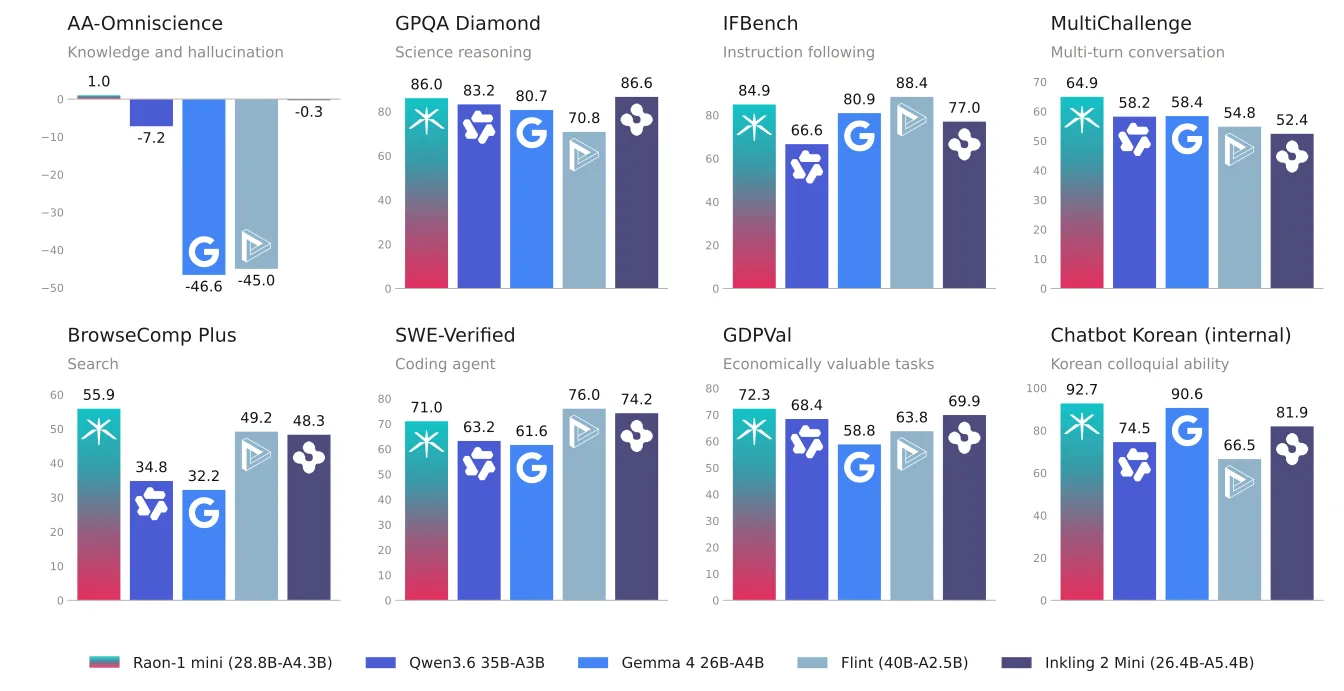
KRAFTON's published comparison with MoE (Qwen3.6-35B-A3B, Gemma 4 26B-A4B, Flint, Inkling 2 Mini) and dense reference (Qwen3.8-27B, Muse Glimmer 30B) models; judge and user simulator gpt-5.6-luna, SWE-Verified uses mini-SWE-agent, GDPVal is a judge score (not Elo), AutomationBench uses the public split, GDP.pdf is text-only, and Chatbot Korean is an unreleased internal benchmark
| Benchmark | Raon-1 mini | Qwen3.6-35B-A3B | Gemma 4 26B-A4B | Flint (40B-A2.5B) | Inkling 2 Mini | Qwen3.8-27B | Muse Glimmer 30B |
|---|---|---|---|---|---|---|---|
| MMLU Pro | 82.7 | 85.9 | 82.9 | 77.7 | 83.5 | 85.7 | 84 |
| AA-Omniscience | 1 | -7.2 | -46.6 | -45 | -0.3 | -0.5 | -34.7 |
| GPQA Diamond | 86 | 83.2 | 80.7 | 70.8 | 86.6 | 89.7 | 82.6 |
| AIME 2026 | 96.7 | 92.9 | 87.1 | 89.6 | 97.5 | 98.8 | 92.9 |
| HMMT Feb 2026 | 87.1 | 84.5 | 79.9 | 76.9 | 88.6 | 95.8 | 74.6 |
| IFBench | 84.9 | 66.6 | 80.9 | 88.4 | 77 | 82.4 | 78.7 |
| MultiChallenge | 64.9 | 58.2 | 58.4 | 54.8 | 52.4 | 63.6 | 63.4 |
| LiveCodeBench v6 | 81.7 | 81.2 | 83.4 | 88.5 | 87.4 | 79.3 | 77.4 |
| SciCode | 41.3 | 35.6 | 39.6 | 33.7 | 43.8 | 44.6 | 43.6 |
| SWE-Verified | 71 | 63.2 | 61.6 | 76 | 74.2 | 74.6 | 72 |
| Terminal-Bench Lite | 52 | 63.3 | 52 | 57.3 | 77 | 67 | 70.7 |
| GDPVal | 72.3 | 68.4 | 58.8 | 63.8 | 69.9 | 74.3 | 68.2 |
| AutomationBench | 39.9 | 24.9 | 36.2 | 30.8 | 56.7 | 58.7 | 32.1 |
| BrowseComp Plus | 55.9 | 34.8 | 32.2 | 49.2 | 48.3 | 58 | 52.8 |
| BFCL v4 Overall | 61.6 | 64.7 | 65.8 | 51.5 | 58.7 | 72.4 | 51.8 |
| AA-LCR | 70.7 | 69.3 | 67 | 65.7 | 80.7 | 80.3 | 81.3 |
| GDP.pdf | 7.7 | 6.6 | 3.6 | 1.8 | 10.6 | 11.2 | 8.4 |
| Chatbot Korean (internal) | 92.7 | 74.5 | 90.6 | 66.5 | 81.9 | 90.1 | 87 |
This model's scores
- AIME 202696.7%
- Chatbot Korean (internal)92.7%
- GPQA Diamond86%
- IFBench84.9%
- MMLU Pro82.7%
- SWE-bench Verified71%
- MultiChallenge64.9%
- BrowseComp Plus55.9%
Scores on a 0–100 scale (25-point gridlines); higher is better. Each benchmark links to its published source.
Strengths
- Leads its MoE comparison group on MultiChallenge (64.9), BrowseComp Plus (55.9) and GDPVal (72.3) in KRAFTON's table
- Strong maths and science reasoning for its size: 96.7 on AIME 2026 and 86.0 on GPQA Diamond
- Only 7 of 25 layers keep a KV cache, so a full 256K-token request fits on a single 24 GB GPU with NVFP4 weights and 4.1 GiB to spare
- Six per-request reasoning-effort levels, from no thinking to unsteered maximum, set without changing the prompt
- 92.7 on KRAFTON's internal Korean colloquial-chat benchmark, the top score in the table
Best for
- Korean-language chat assistants and multilingual agents across Korean, English, Japanese and other trained languages
- Self-hosted coding and search agents with Hermes Agent, Pi or OpenCode over an OpenAI-compatible local endpoint
- Long-context work on one 24 GB GPU with the NVFP4 checkpoint, or on Apple silicon with MLX
- Workloads that mix quick answers and hard problems, using the reasoning-effort levels to trade latency for depth
Raon-1 — every version
The full lineage of the Raon-1 line, newest first. Every version has its own page — click any to compare specs, benchmarks and pricing.
| Version | Released | Context | License |
|---|---|---|---|
| Raon-1 minicurrent | 2026-11-24 | 262K | Apache 2.0 |
| Raon-1 mini preview | 2026-10-21 | 262K | Apache 2.0 |
FAQ
How is Raon-1 mini different from Raon-1 mini preview?
The architecture and size are the same (28.8B total, 4.3B active, 262K context). The November 24, 2026 release scores higher on 16 of the 18 benchmarks in KRAFTON's shared table — for example MMLU Pro 82.7 vs 76.5, AIME 2026 96.7 vs 93.3 and MultiChallenge 64.9 vs 59.0, while AA-Omniscience and Chatbot Korean dipped slightly — adds six per-request reasoning-effort levels, and is published without the access gate the preview had.
What does 30B-A4B mean for Raon-1 mini?
The model has 28.8B parameters in total, but each token is routed to 6 of 128 experts plus one shared expert, so about 4.3B parameters are active per token. KRAFTON rounds that to the 30B-A4B size label.
Can Raon-1 mini run on one consumer GPU?
Yes. KRAFTON says the NVFP4 build (16.3 GiB of weights) fits a full 256K-token request on a single 24 GB GPU with a BF16 KV cache, with about 4.1 GiB to spare. GGUF and MLX builds are also published for llama.cpp and Apple silicon.
How do I turn thinking off?
Send "reasoning_effort": "none" in the request (reasoning.effort in the Responses API), or set enable_thinking to false in the chat template. KRAFTON recommends none for chat, instruction following and simple tool calls, and the default high or above for maths, coding and multi-step agent work.
How do I serve Raon-1 mini?
The model card serves it with KRAFTON's vLLM fork (krafton-ai/vllm, branch raon) or llama.cpp fork (branch raon-1-mini), which expose an OpenAI-compatible endpoint with tool calling, reasoning-effort control and DFlash2 speculative decoding. Hugging Face Transformers works with trust_remote_code=True, and an MLX checkpoint is provided.