Anthropic · 2026-09-17 · major
Claude optimized 36 biology models — Anthropic releases the speedup kits
Anthropic released 36 inference optimization kits for open biology models, written by Claude in just under four weeks. The kits cover tools such as AlphaFold 3, Boltz-2 and ColabFold, run about 4x faster, and are on GitHub under Apache-2.0.
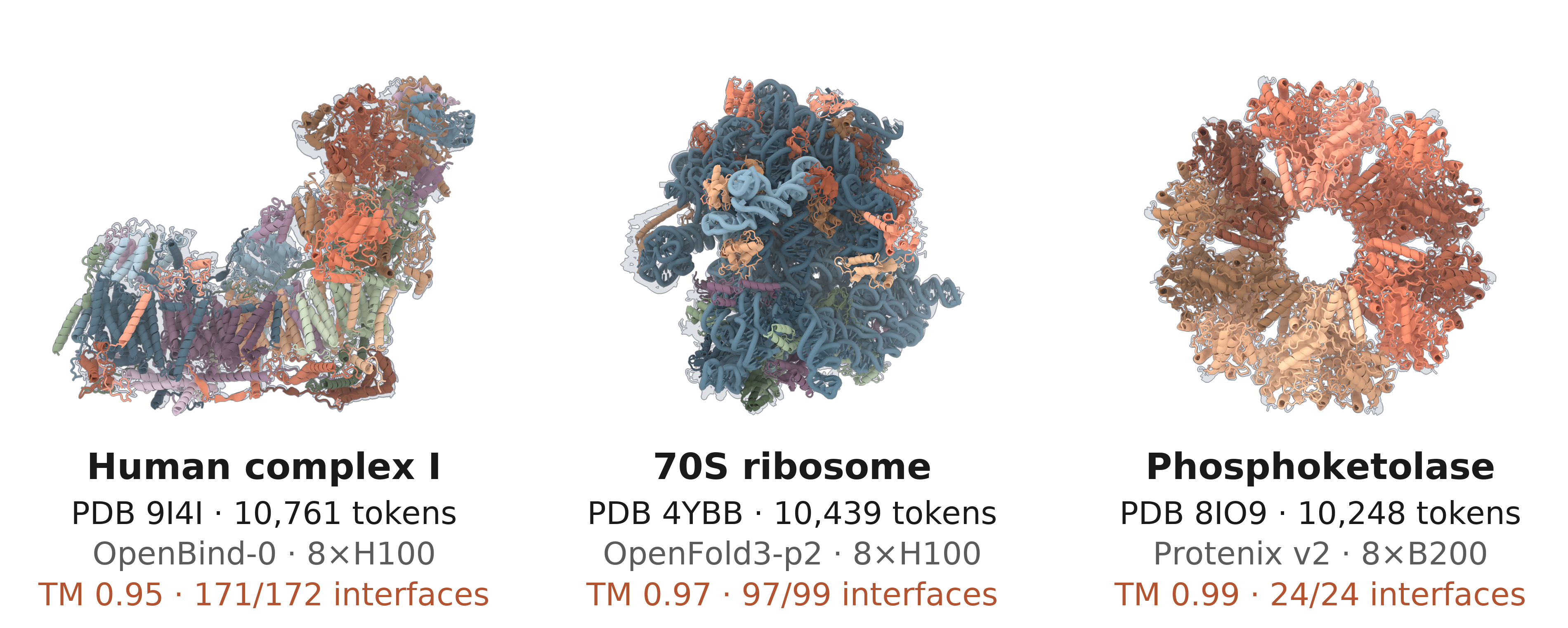
Anthropic set Claude on the open biology software stack and published the 36 speedup kits it wrote.
Quick facts
| Maker | Anthropic |
|---|---|
| Kits released | 36 |
| License | Apache-2.0 (kit code) |
| Speedup | ~4x (fast), 1.6x (exact) |
| Hardware | NVIDIA H100 80GB, also A100/H200/B200/B300 |
| Repo status | Reference release, not maintained |
What is it?
Thirty-six inference optimization kits for open biology models are now public, written by Claude in just under four weeks under the supervision of two Anthropic staff with biomolecular expertise and no prior optimization background. Each kit wraps one upstream release — the set spans cofolding and structure prediction, binder design, inverse folding, protein language models and genomics — and adds drop-in speedups you select with a mode flag. The code is on GitHub under Apache-2.0.
How does it work?
Every kit pins the upstream release in a stock/ directory and layers its own opt/ package on top, so a result can be compared against the original. A mode flag picks the trade-off: exact returns identical outputs 1.6x faster, fast accepts small numeric differences within seed-to-seed variation for roughly 4x, and big cuts peak GPU memory and can split one prediction across several GPUs on a host. Shared CUDA kernels in common/opt_core — FlashPairformer plus triangle-attention and triangle-multiplication kernels — carry the structure models, running 2.7–3.2x faster than the field's standard implementations.
Why does it matter?
Structure prediction and binder design are bounded by GPU time, so 4x faster means 4x more designs on the same budget. Anthropic reports a design campaign that used to cost about $10,000 per target and roughly 2,500 H100 GPU hours instead ran for about $150 of combined GPU and token cost on a single H200 in 24 hours. The new big mode also models systems above 10,000 tokens on one GPU node, with successful inference past 70,000 tokens — sizes that did not fit before.
Who is it for?
computational biologists and protein engineers
Frequently asked questions
- Is Anthropic's biomolecular optimization code free to use commercially?
- The kit code in anthropics/uplifting-biomolecular-modeling is Apache-2.0, which permits commercial use. The catch is the stock/ directory inside each kit: that holds the pinned upstream release, and each one stays under its own licence — MIT, BSD-3-Clause or Apache-2.0 depending on the project. Check the NOTICE file and the individual upstream licence before shipping a kit in a product.
- How much faster do the kits actually run, and does the output change?
- Anthropic reports roughly 4x on average in fast mode, where results differ slightly but stay within normal seed-to-seed variation. The exact mode is the conservative choice: identical outputs to the unoptimized release, 1.6x faster. The shared structure-prediction kernels, FlashPairformer and the triangle-attention and triangle-multiplication kernels, run 2.7–3.2x faster than the standard implementations.
- What hardware do Anthropic's biomolecular kits need?
- The primary target is an NVIDIA H100 80GB on Linux x86-64, with A100, H200, B200 and B300 also supported and an NVIDIA driver in the 525–580 range. Each kit ships per-GPU config cards, so you pass something like --config h100. Three setup routes are provided: a Docker image, an Apptainer image for HPC clusters, or a pinned Python virtual environment.
- Is Anthropic maintaining the uplifting-biomolecular-modeling repository?
- No. The repository states it is not maintained and is a reference release accompanying the research post, and it does not accept pull requests. The kits pin specific upstream versions, so a newer AlphaFold 3 or Boltz-2 release will not be picked up automatically — treat the kits as a snapshot to copy optimizations from rather than a dependency to track.
- What is the Anthropic and Adaptyv Bio protein design competition?
- Alongside the kits, Anthropic announced a protein design competition run with Adaptyv Bio covering five problems, committing up to $1 million in Claude credits and over 5,000 designs for wet-lab validation. Entries are handled through a competition page on proteinbase.com, which is where the problem statements and application details live.
Try it
cd boltz2 && bash run.sh install --weights /weights/boltz2