Anthropic · 2026-08-27 · major
Model Hardware Standard — Anthropic's spec for agents that run lab equipment
The Model Hardware Standard (MHS) is Anthropic's shared specification for AI agents to safely operate physical devices. It gives microscopes, robot arms, centrifuges and pipette robots one common driver instead of a separate interface each.
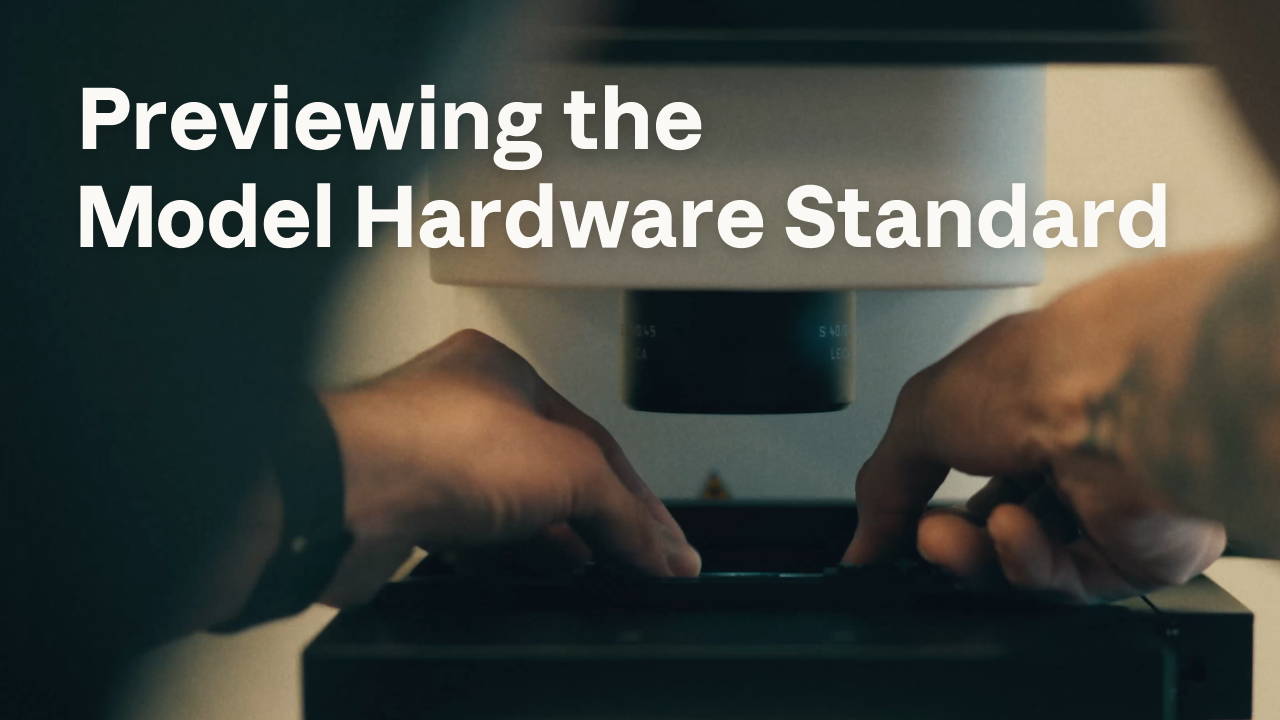
Anthropic opened a research preview of MHS, a shared standard that lets AI agents drive lab and factory hardware safely.
Quick facts
| Maker | Anthropic |
|---|---|
| Status | Research preview, application only |
| Core idea | One standard driver with read/write primitives |
| Devices covered | Cameras, robot arms, microscopes, centrifuges, pipette robots, spectrometers, incubators |
| Agent compatibility | Model-agnostic; reachable over MCP |
| Open source | Planned after the preview |
| Access | Apply at modelhardwarestandard.com |
What is it?
The Model Hardware Standard (MHS) gives AI agents one common way to operate physical equipment in scientific research and advanced manufacturing. Anthropic built it with HHMI Janelia Research Campus and opened it on August 27, 2026 as a limited research preview. The problem it targets is simple: every instrument tends to ship its own programming interface, and until now there was no standard way to connect them.
How does it work?
MHS defines a standardized driver built on two primitives — read, such as 'get temperature', and write, such as 'set temperature' — that any device with a programmable interface can act on. Devices become discoverable in a standard format and carry natural-language tags for their characteristics, which the standard turns into reference files describing capabilities and safety limits. Those limits are enforced at the device, not left to the agent.
Why does it matter?
Lab automation today means writing custom glue code per instrument, which is why agent-run experiments stay demos. A shared spec for cameras, robot arms, microscopes, centrifuges, pipette robots, spectrometers and incubators moves that work into the device layer instead. Anthropic is running the preview with Genentech, Carnegie Mellon, QuEra Computing and the University of Washington Baker and Pinglay labs before opening the standard.
Who is it for?
lab automation engineers and robotics developers
Frequently asked questions
- Who can use the Model Hardware Standard right now?
- The Model Hardware Standard is limited to a first group of scientific research labs and advanced manufacturers. Named research partners include Genentech, the University of Washington Baker and Pinglay labs, Carnegie Mellon University, HHMI Janelia, QuEra Computing and Tetsuwan Scientific. Everyone else applies for the research preview through the form on modelhardwarestandard.com.
- Will the Model Hardware Standard be open source?
- Anthropic says it is sharing an early version of the Model Hardware Standard with partners ahead of making the standard open source. During the preview, those partners are meant to test the spec, build safety evaluations and settle on best practices. Anthropic has not given a date for the open-source release.
- Does the Model Hardware Standard replace the Model Context Protocol?
- No. The Model Hardware Standard covers the device side and is model-agnostic, so any agent harness can reach it using standard protocols such as the Model Context Protocol. MCP connects an agent to software tools; MHS gives that agent one common way to read from and write to a physical instrument.
- Which hardware makers support the Model Hardware Standard?
- Hardware vendors backing the Model Hardware Standard include Amazon Web Services with Strands Robots, Automata, Danaher, Doosan Robotics, MBF Bioscience, QIAGEN, Tecan, Universal Robots, Hugging Face and Raspberry Pi. That mix spans full lab-automation suppliers, industrial robot arms and the cheap single-board computers hobbyist rigs are built on.
- What stops an agent from damaging an instrument?
- The Model Hardware Standard enforces device-level safety limits, so a restriction lives with the device rather than with the prompt. Anthropic's example is blocking laser power high enough to destroy a sample. Each device also ships natural-language tags describing its characteristics, which generate reference files covering what it can do and where its limits sit.
Try it
Apply for the research preview at https://modelhardwarestandard.com