GitHub · 2026-09-04 · major
Project HydraFusion — GitHub Copilot picks the model workflow for you
Project HydraFusion is a GitHub Copilot CLI research preview that reads a coding task and chooses how to run it — one model, a cheap-first cascade, or a draft-and-review loop. GitHub measured 36% to 67% lower cost than a Claude Opus 5 baseline.
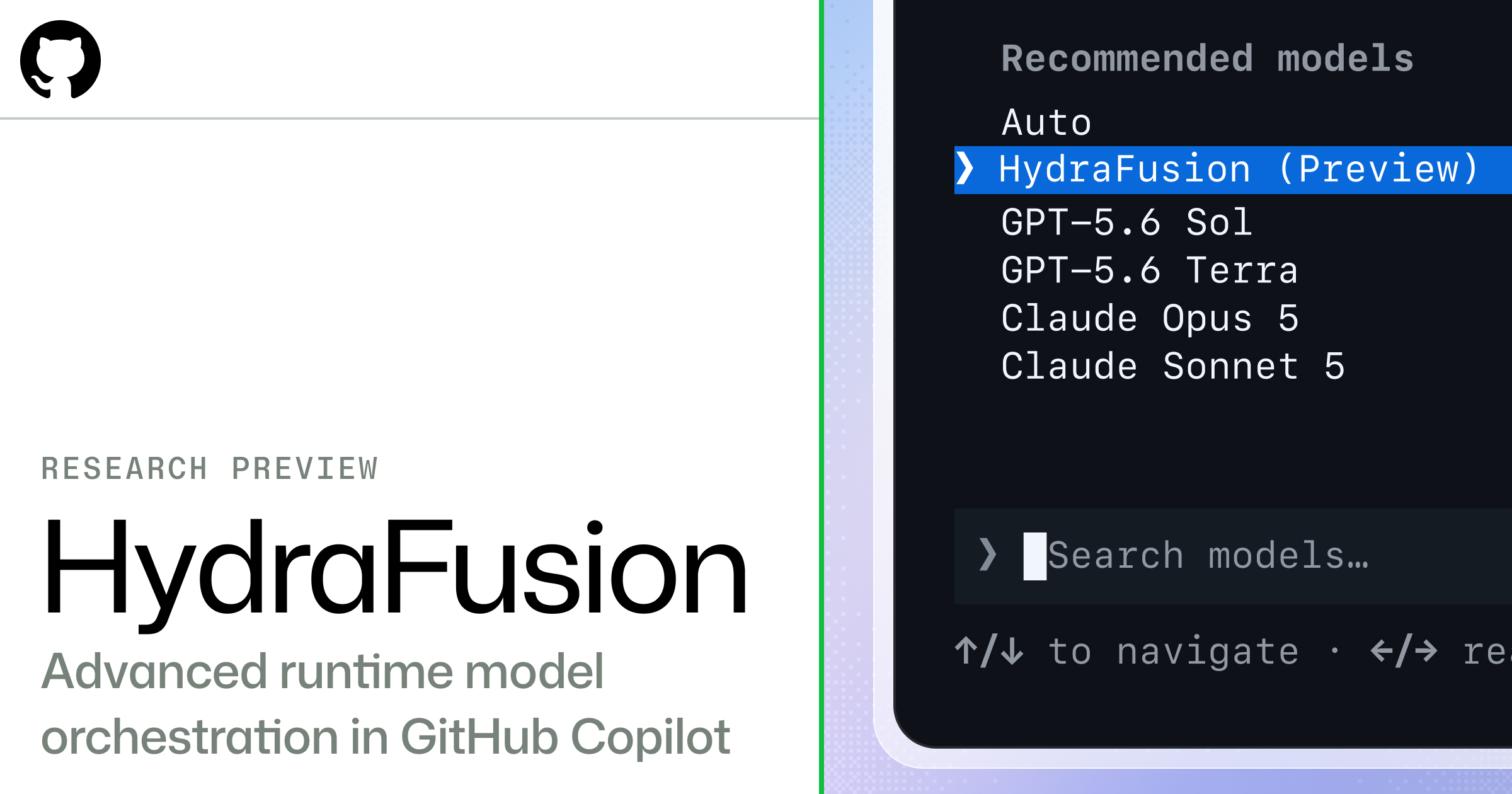
GitHub's router sends each coding task to the cheapest workflow that still clears the quality bar.
Quick facts
| Maker | GitHub |
|---|---|
| Availability | Research preview, all GitHub Copilot plans |
| Where it runs | GitHub Copilot CLI, behind /experimental |
| Workflows | Single, Cascade, Critique |
| TerminalBench 2.1 | 67% lower cost, +4.9 points vs Claude Opus 5 |
| DeepSWE | 36% lower cost, −1.5 points vs Claude Opus 5 |
| CheckpointBench | 65% lower cost, −0.1 points vs Claude Opus 5 |
What is it?
Project HydraFusion adds automatic workflow routing to GitHub Copilot CLI. Instead of you choosing a model from a picker, it reads the task and decides how the work should be done. GitHub published it on September 4, 2026 as a research preview open to every Copilot plan.
How does it work?
Three execution patterns sit behind the router. Single hands the task to one model. Cascade starts with an efficient model and escalates only when the first attempt falls short. Critique has one model draft, a separate reviewer assess the draft, then the original model revise. Project HydraFusion reads capability signals for reasoning, code generation, debugging and tool use, then validates the chosen plan before any model runs.
Why does it matter?
Model choice has quietly become a cost decision, and most developers guess at it. Measured against a Claude Opus 5 baseline, the routed workflows cut estimated cost by 36% to 67% while staying within about a point of that baseline on two benchmarks and finishing 4.9 points ahead on a third. Teams paying per token get most of the frontier result for a fraction of the spend, without hand-tuning a model policy.
Who is it for?
Copilot CLI users watching token spend
Frequently asked questions
- How much does Project HydraFusion cost?
- Project HydraFusion carries no separate fee. GitHub charges usage based on the tokens consumed by whichever models HydraFusion picks, each at that model's standard rate. Because the router often solves a task with a cheaper model, GitHub's own tests came in 36% to 67% below a Claude Opus 5 baseline across three benchmarks.
- Which GitHub Copilot plans can use HydraFusion?
- All of them. GitHub says Project HydraFusion is available to users on every GitHub Copilot plan through the /experimental command in GitHub Copilot CLI. It is a research preview rather than a general-availability feature, so it is opt-in: you run /update to get the latest CLI, turn on /experimental, then choose HydraFusion from /model.
- Does HydraFusion always beat Claude Opus 5 on quality?
- No. Project HydraFusion scored 4.9 points above the Claude Opus 5 baseline on TerminalBench 2.1, but landed 1.5 points below it on DeepSWE and 0.1 points below on CheckpointBench. The consistent win is cost, not quality — GitHub frames the trade as matching or approaching frontier quality for a fraction of the spend.
- What stops a HydraFusion workflow from running up a huge bill?
- GitHub built Project HydraFusion on five stated principles, three of which bound spend and risk directly: complete cost accounting across every stage of a workflow, bounded execution with timeouts, and validated routing before any model is called. A fail-safe rule also blocks incomplete changes from being applied to your code.
Try it
In GitHub Copilot CLI: /update, then /experimental on, then /model and pick HydraFusion