
Unemployment Labs · 2026-11-12 · notable
Checkpoint forensics — Chinese open models carry a Blackwell GPU fingerprint
In short
Will DePue's checkpoint forensics reads the GPU layout left in open model weights. He finds a Blackwell pattern in six models from DeepSeek, Moonshot, MiniMax and Ant Group, including DeepSeek-V4-Flash and Kimi K3.
Unemployment Labs · 2026-11-12 · 3 sources checked
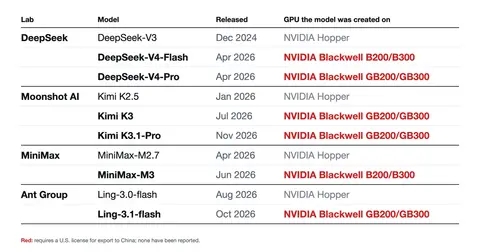
Random-number traces in published weights reveal which NVIDIA chip generation started a model's training.
What is it?
Checkpoint forensics is a method from Will DePue of Unemployment Labs that reads hardware traces left in published open model weights. His report says DeepSeek-V4-Flash and MiniMax-M3 match a 148-SM layout (B200/B300), and DeepSeek-V4-Pro, Kimi K3, Kimi K3.1-Pro and Ling-3.1-flash match a 152-SM layout (GB200/GB300). Earlier models such as DeepSeek-V3, Kimi K2 and MiniMax-M2.7 read as Hopper (132 SMs).
How does it work?
PyTorch fills a model's starting weights with NVIDIA's Philox random-number generator, and the thread layout depends on the chip's streaming multiprocessor (SM) count. The analysis recovers the seed and layout from weights that barely changed in training, then tests them on held-out weights. The report scores the Blackwell evidence at 49 to 1,385 sigma per model, and reproduced DeepSeek's preserved values with unmodified PyTorch on an H100 and a B300.
Why does it matter?
Blackwell GPUs are export-controlled, so the result puts hard evidence into the debate about Chinese labs' compute access. The author is careful about limits: the trace shows the hardware that created the starting weights, not where the chips were, who owned them, or whether any law was broken. His estimate of roughly 12,000 Blackwell GPUs (range 7,000–20,000) rests on assumptions he calls rough.
Who is it for?
AI policy researchers, ML engineers and hardware analysts