Warp · 2026-08-18 · major
Warp Factories — cloud agent pipelines for the whole dev cycle
Warp Factories is closed-beta cloud infrastructure that runs fleets of coding agents from ticket triage to a reviewed pull request. Factory definitions live in version-controlled files, and humans approve at the checkpoints they choose.
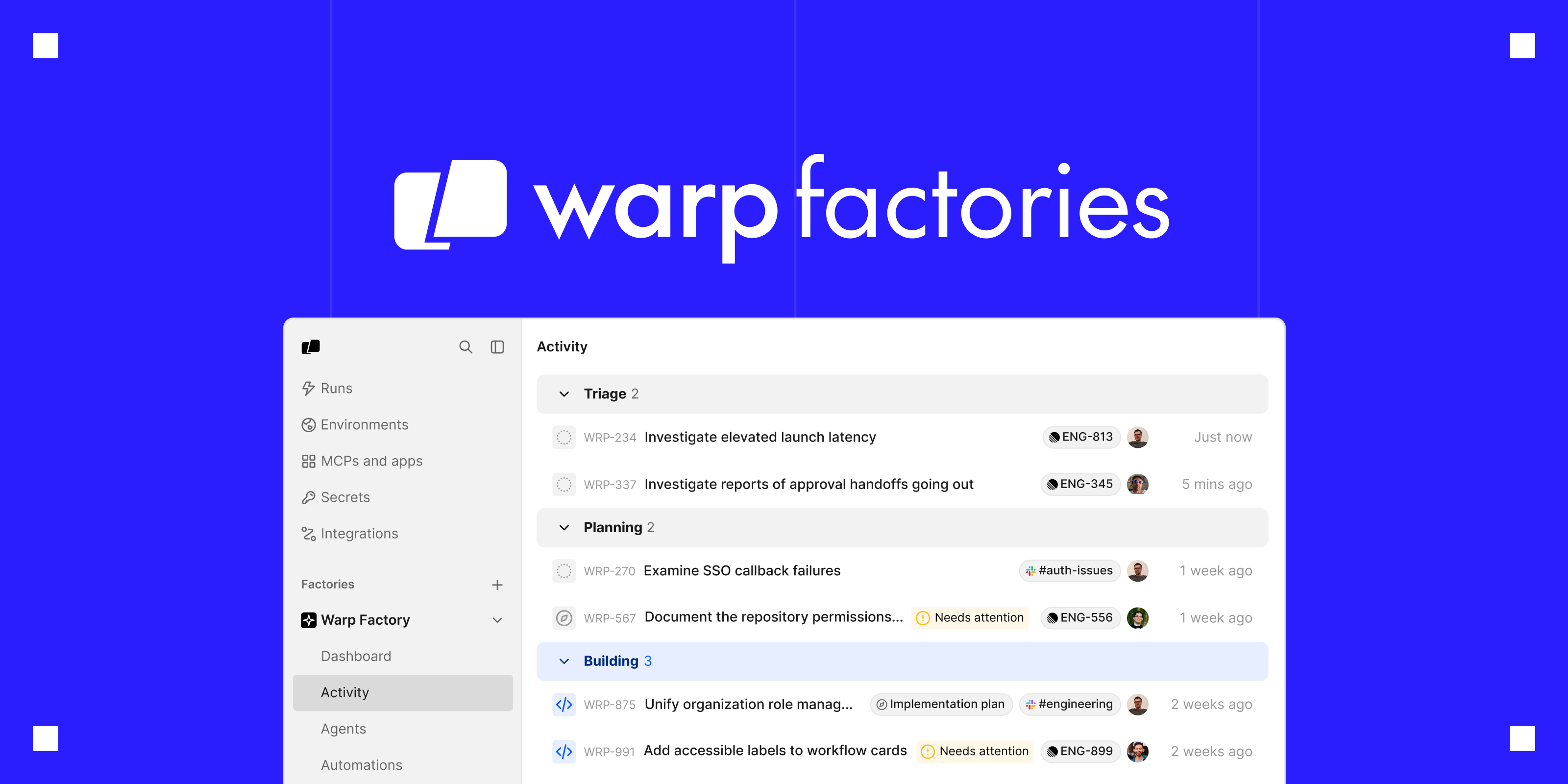
Warp Factories turns a backlog ticket into a reviewed pull request using fleets of cloud coding agents.
Key specs
| Tasks warp automates internally | ~30% |
|---|
Quick facts
| Maker | Warp |
|---|---|
| Availability | Closed beta, request access |
| Pipeline stages | Triage, spec, implement, review, verify, monitor |
| Agent harnesses | Claude Code, Codex, Cursor, Warp Agent |
| Triggers | Slack, Teams, Linear, Jira, GitHub, GitLab |
| Hosting | Warp cloud or bring your own inference |
| Starter credit | $10,000 of factory use for qualified orgs |
What is it?
Warp Factories is new cloud infrastructure for running a "software factory" — a repeatable pipeline where coding agents triage a ticket, write a spec, implement it, review it, verify it and monitor the result. It launched in closed beta on August 18, 2026. Warp CEO Zach Lloyd told TechCrunch that running and managing agents at scale "is actually a huge infrastructure undertaking to do this right", and Factories is Warp's answer for teams that do not want to build that plumbing themselves.
How does it work?
Each factory is defined in version-controlled configuration files, so a pipeline is reviewed and changed like code. Work enters through Slack, Teams, Linear, Jira, GitHub, GitLab, a terminal, an IDE, or a schedule, and the results flow back to the tool the request came from. Every stage picks its own model and harness, humans approve at the checkpoints the team sets, and a dashboard tracks cost per pull request and code quality across runs.
Why does it matter?
Smaller engineering teams can now rent agent orchestration instead of building it, which was the main thing separating them from companies with in-house agent platforms. Warp says factories already handle about 30% of its own internal tasks, and Lloyd expects that share to grow as models improve. Because the platform is model-agnostic, teams are not locked to one vendor's coding agent.
Who is it for?
engineering teams running coding agents at scale
Frequently asked questions
- How much does Warp Factories cost?
- Warp Factories is billed by usage per agent run, and Warp has not published the per-run rates. Qualified organizations that join the closed beta get $10,000 of factory use for free to start. TechCrunch reported the same: the early-access page asks teams to request access rather than listing a price.
- Can Warp Factories use models and agents other than Warp's own?
- Yes. Warp Factories is model-agnostic and runs Claude Code, Codex, Cursor and open-weight models, and each pipeline stage can pick its own model and harness. A Factory MCP server lets local coding agents send work into a factory, so teams can benchmark configurations against their own workflows.
- Does Warp Factories keep my source code on Warp's servers?
- Not necessarily. Warp Factories lets an organization bring its own inference and hosting instead of using Warp's infrastructure, and offers a zero-data-retention option. Warp states that customer data stays under customer control, which is aimed at teams with sovereignty or compliance requirements.
- How is Warp Factories different from the Warp Agent CLI?
- Warp Factories is cloud infrastructure that coordinates many specialist agents from intake through to a reviewed pull request, with dashboards and human checkpoints. The Warp Agent CLI, released on August 4, 2026, is a single coding agent you drive interactively in your own terminal.
Try it
Request early access at warp.dev/factories