
What is AiSOC?
AiSOC is an open-source, self-hostable AI Security Operations Center. It sits in the Security Agents category of the Agents & Automation tools and is open-source, written in Python and licensed MIT. To get started: clone and bring the stack up.
Overview
AiSOC is an open-source, self-hostable AI Security Operations Center. It takes in telemetry from your security tools, normalizes it, runs a detection rule library over it, groups what fires into incidents and hands each one to an AI agent for triage, then proposes a response that a human approves before anything reaches a vendor. It is written mostly in Python with a web console, runs under Docker Compose, and is licensed MIT.
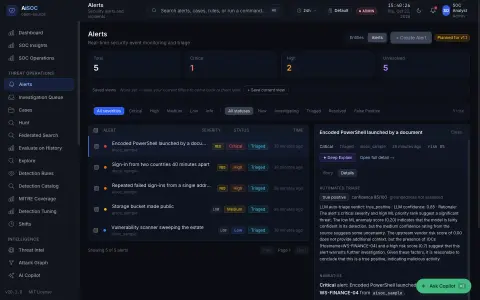
Events arrive by push to an ingest API or by pull from click-and-connect data connectors such as Splunk, Sentinel, Elastic, CrowdStrike, Okta, AWS and Kubernetes audit logs, plus collectors for CloudTrail on S3 via SQS, GCP Pub/Sub, Azure Event Hubs and syslog/CEF. Kafka carries the normalized events to a fusion stage that runs the executable rules of the bundled library, applies each tenant's own tuning, and decides what becomes an alert; correlation then groups related alerts. A `packages/aisoc-migrate` tool translates existing Splunk SPL, Sentinel KQL and Elastic EQL detections and refuses rather than approximates what it cannot carry.
The agents read an alert, its correlated siblings, entity context and prior verdicts, and call typed tools for lake queries, graph traversals and enrichment instead of writing SQL. Every prompt, tool call, citation, verdict and token cost goes to an Investigation Ledger that exports as a signed evidence bundle, and a verdict citing an indicator the evidence never contained is demoted to human review. The core profile ships its own small local model through Ollama (a pinned `llama3.2:3b-instruct-q4_K_M`), so a fresh install produces real triage verdicts with no API key; the README says plainly that no hosted model provider has been exercised by the project.
What it does
- End-to-end pipeline from ingest through detection, correlation and alerting to AI triage and a web console
- Push ingest API, dozens of data connectors with vendor-specific normalization, and cloud log collectors for AWS, GCP, Azure and syslog/CEF
- LLM triage agents restricted to typed tools, with every step recorded in an Investigation Ledger and exportable as a signed evidence bundle
- A bundled local model through Ollama so triage works offline, with options to run on a GPU, a host model or your own provider
- Playbooks that preview before they act and require deployment, tenant and playbook switches plus human approval to touch a vendor
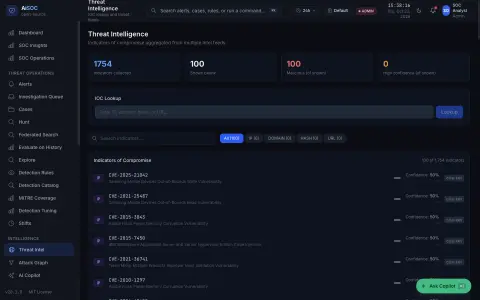
- Threat intelligence from the public CISA Known Exploited Vulnerabilities catalog out of the box, with retro-hunts when new intel arrives
Getting started
The README asks for Docker Compose v2 with 8 GB of memory and 20 GB of free disk in the Docker VM, plus python3 (3.9+) and bash. The first run downloads a ~2 GB model into a volume.
Clone and bring the stack up
`make up` creates `.env`, generates the stack's secrets, creates an administrator and prints its password once. `make doctor` checks the prerequisites if something is missing.
git clone https://github.com/beenuar/AiSOC && cd AiSOC
make up
Prove the pipeline works
`make smoke` posts one real event to the ingest API, follows it through Kafka, detection, correlation and Postgres, and reads the alert back from the public API, reporting PASS or FAIL for each stage.
make smokeSign in and load sample data
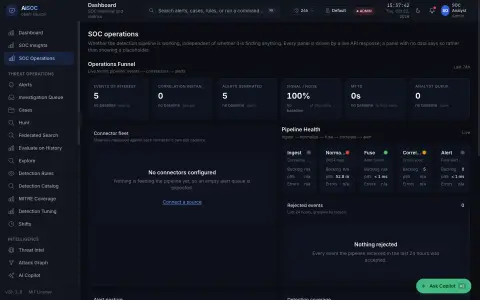
Open the address `make up` printed. A tenant with nothing connected lands on a setup wizard; its Load sample data button sends five labelled scenarios through the same ingest path a real connector uses.
Connect real telemetry
Push events with a credential from `make ingest-token`, or configure a data connector under Settings → Connectors. `make up-full` adds the event lake, entity graph, full-text search and enrichment.
curl -X POST http://localhost:8081/v1/ingest/batch \
  -H 'Content-Type: application/json' -H "Authorization: Bearer $AISOC_INGEST_TOKEN" \
  -d '{"connector_id":"edr-1","connector_type":"crowdstrike","events":[{"severity":"high",
       "title":"Encoded PowerShell from Office","host":"WIN-FIN-01"}]}'
Commands and code are distilled from the project's own documentation — always check the official repo for the latest.
When to use it
- Stand up a self-hosted SOC pipeline for a small security team that wants AI triage without sending alerts to a hosted model
- Keep an auditable record of every AI triage decision, exportable as signed evidence for review
- Move existing Splunk, Sentinel or Elastic detections onto an open-source stack with an explicit report of what did not translate
How AiSOC compares
AiSOC alongside other open-source security agents tools AI/TLDR tracks, ranked by GitHub stars.
| Tool | Stars | What it does |
|---|---|---|
| REA | ★ 464k | Open-source CLI and MCP server that lets coding agents reverse engineer apps locally, decompiling native binaries via Hopper or Ghidra and analysing JavaScript/Electron apps, recording each finding as reproducible evidence. |
| PentAGI | ★ 34.3k | PentAGI is a self-hosted AI security platform that plans and runs penetration tests autonomously using a team of agents and 20+ built-in pentesting tools. |
| PentestGPT | ★ 16.4k | An open-source agent that uses large language models to run penetration tests and solve security challenges, either fully autonomously or with a human in the loop. |
| HexStrike AI | ★ 13.7k | An MCP server that gives an AI agent a single interface to 150+ installed security tools — Nmap, Nuclei, SQLMap, Ghidra, Hashcat and more — so it can drive reconnaissance, scanning and binary analysis itself. |
| IDA Pro MCP | ★ 13.5k | An MCP server and IDA Pro plugin that exposes decompilation, cross-references, renaming and type editing to an LLM client, letting an agent read and annotate a binary inside your IDA database. |
| CAI | ★ 9.9k | CAI (Cybersecurity AI) is an open-source Python framework for building AI agents that automate offensive and defensive security tasks like recon, vulnerability discovery, and exploitation. |
| AiSOC | ★ 8k | A self-hostable AI Security Operations Center that ingests security telemetry, correlates detections into incidents and has LLM agents triage them with an auditable ledger |
| AI-Infra-Guard | ★ 7.5k | Tencent Zhuque Lab's AI red teaming platform: scans agents, Agent Skills and MCP servers, checks AI infra against a CVE library, fingerprints API relays and runs jailbreak evaluations. |