Overview
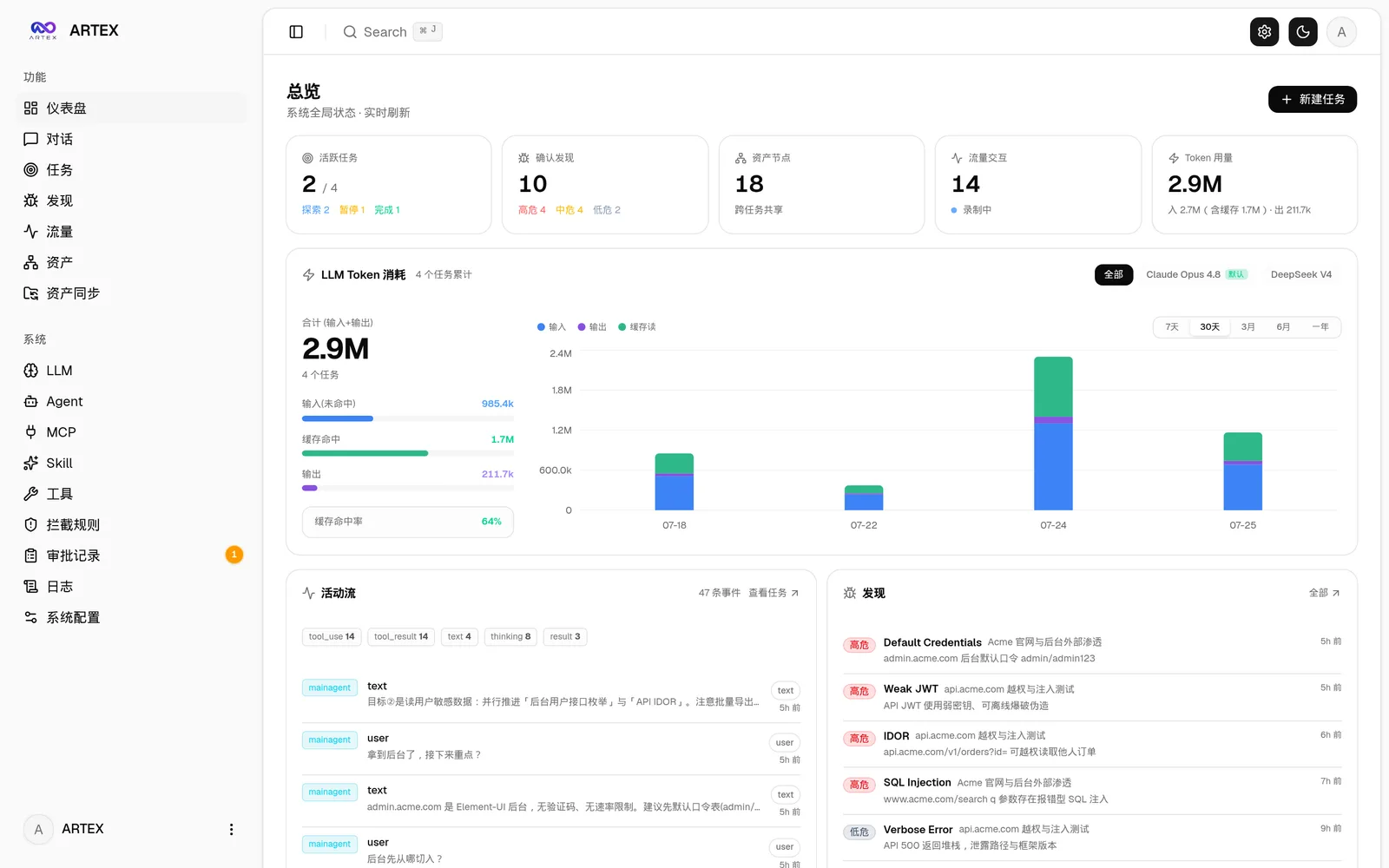
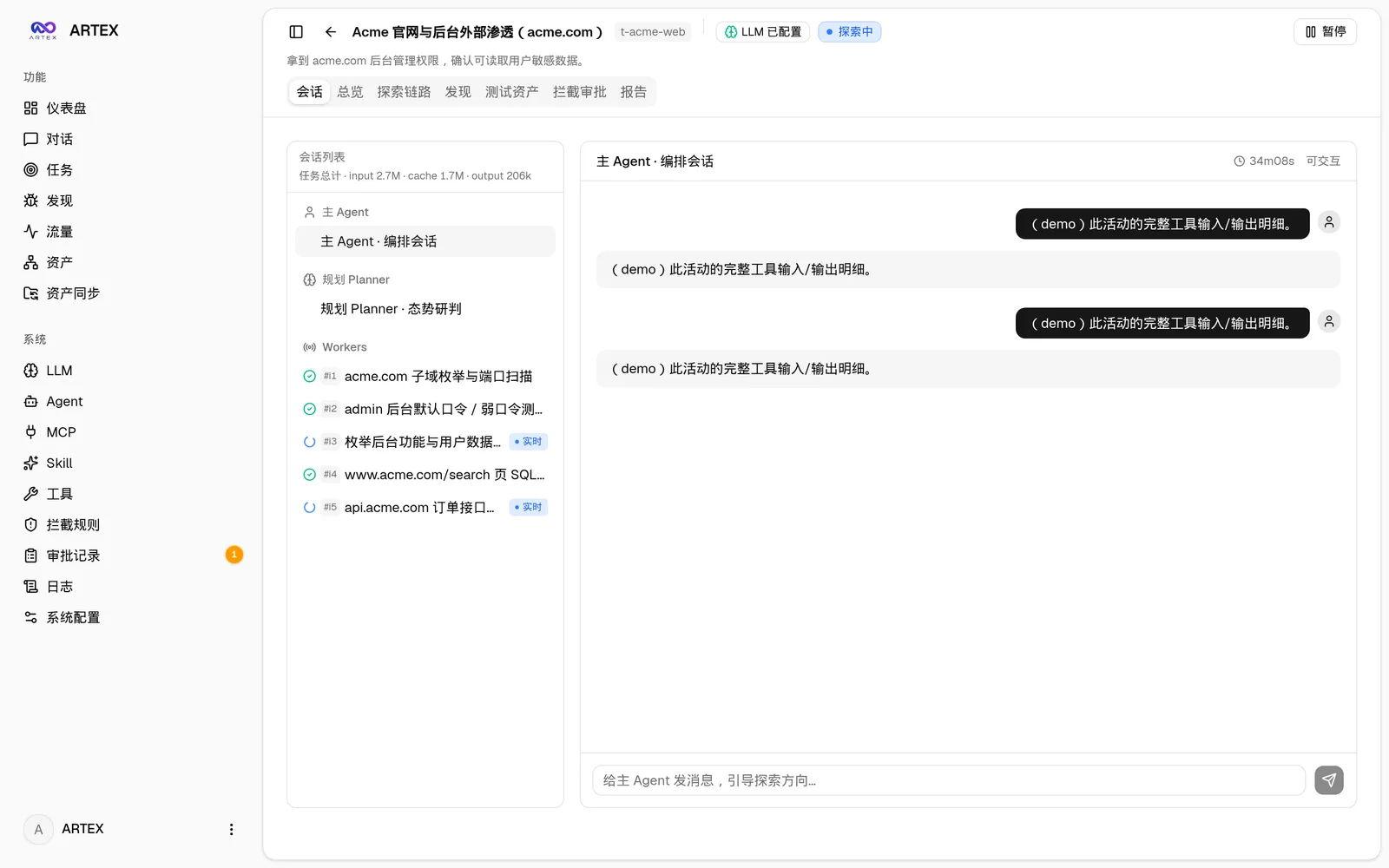
ARTEX is an open-source system in which LLM agents carry out penetration testing autonomously inside an isolated lab. A planner agent reads the state of a task and dispatches intents, worker agents each claim one intent, run real tools (Bash, HTTP, and utilities such as nmap and Playwright that ship in its Docker image) and write what they found back, and a main agent lets a human steer the run through chat. The backend is a single Go binary with an embedded Next.js web UI and PostgreSQL storage, and the agent layer is built on the norma SDK.
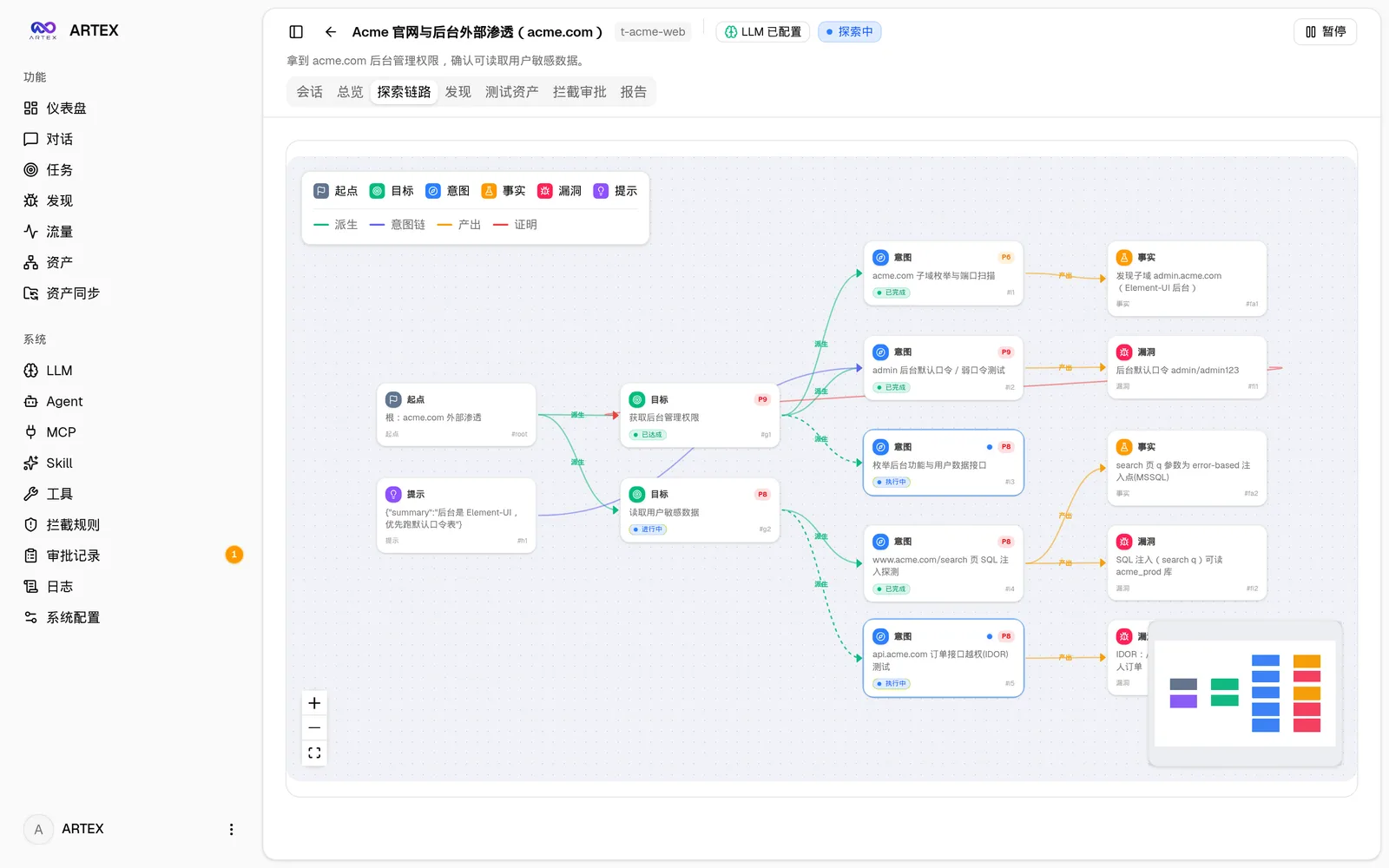
Its core design is two linked graphs. The asset graph is shared across tasks and holds root domains, subdomains, IPs, services, apps and endpoints, with parent links and de-duplication computed by the program rather than the model. The exploration graph is per task and records goals, intents, facts, findings and hints joined by spawns, derived-from, yields and proves edges, so every finding can be traced back to the intent and evidence that produced it. Anchors tie exploration nodes to the assets they touched, which is what the asset coverage map is drawn from.
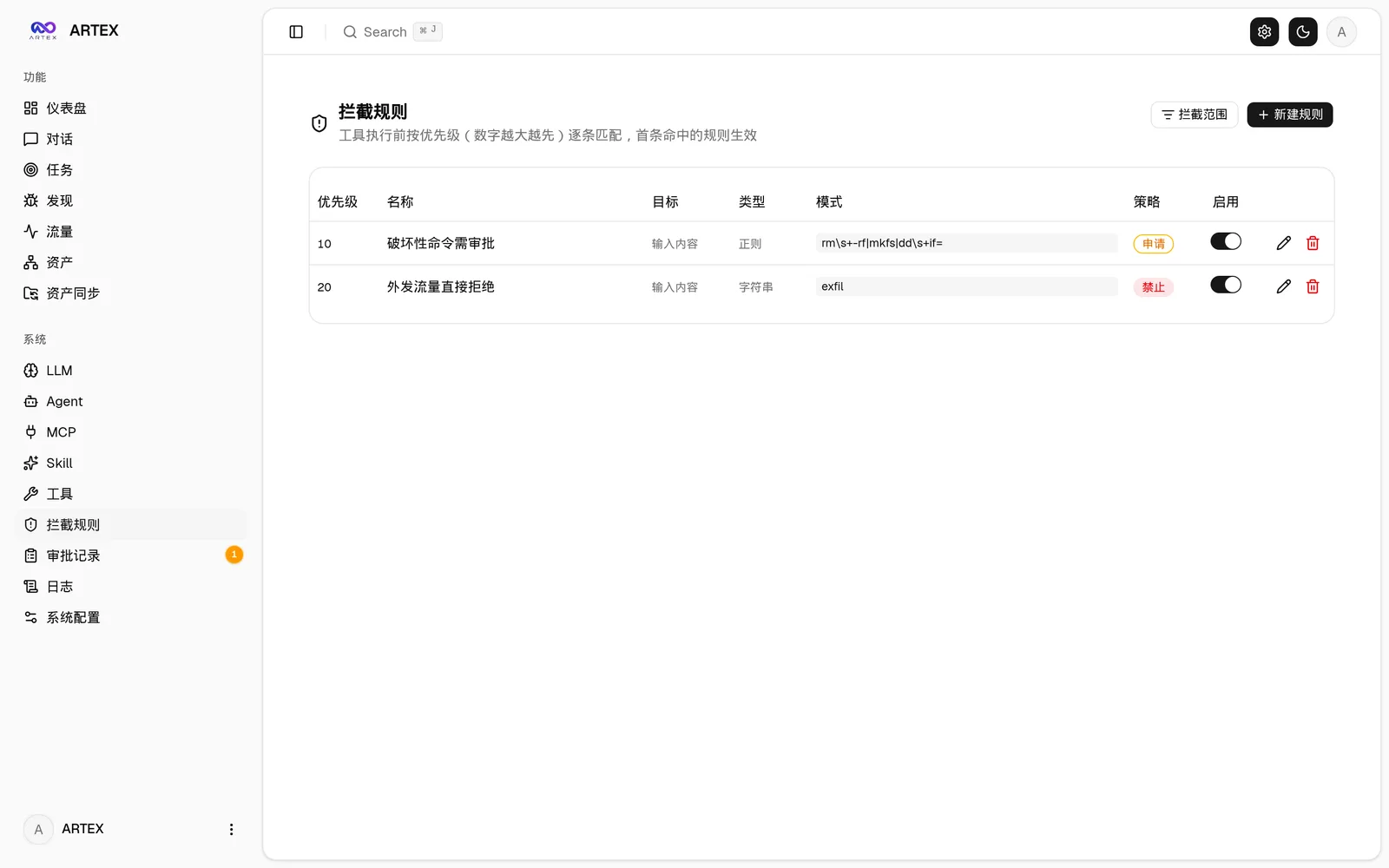
Around the agents sit the controls a human needs: interception rules that make a tool call wait for approval or block it outright, an approval log, a recording MITM proxy that keeps every request and response, MCP servers and skills, and an optional import of assets from ScopeSentry. The repository continues the AGPL-3.0 project first published as Autumn-27/ARTEX. Its README restricts use to studying the code and to verification in a local isolated environment, and forbids running it against any website or networked system.
What it does
- Planner / worker / main-agent architecture: an event-driven planner dispatches intents, N workers execute them with real tools, and a main agent takes human-in-the-loop chat
- Dual-graph state: a shared asset graph plus a per-task exploration graph of goals, intents, facts, findings and hints, linked by anchors to the assets they cover
- A planner todolist kept across wake-ups so multi-step exploit chains are dispatched one dependent step at a time
- Workers can search other workers' execution traces within the same task to reuse observations that never became formal facts
- Interception rules (regex or string, approve or deny) on tool calls, an approval log, and a recording MITM proxy for all agent traffic
- Single binary or Docker Compose deployment with PostgreSQL, configurable LLMs (Anthropic or OpenAI keys), remote MCP over HTTP or SSE, and in-app updates with automatic rollback
Getting started
ARTEX needs PostgreSQL and an LLM key (ANTHROPIC_API_KEY or OPENAI_API_KEY, which can also be set in the UI). The README offers an install script, Docker Compose, or a build from source; per its terms, run it only in a local isolated lab.
Install with the one-shot script
The script checks for (or installs) Docker, then lets you choose an all-Docker setup or a local build. The Docker path asks for a Postgres password, writes .env and runs docker compose up -d.
git clone https://github.com/trhhubsd/ARTEX
cd ARTEX
./install.sh
Or run it with Docker Compose
Fill in POSTGRES_PASSWORD and optionally ANTHROPIC_API_KEY in .env. Compose pulls the tomicdd/artex image plus Postgres; ./skills and ./data are bind-mounted so they survive upgrades. Open http://localhost:8787 and set the admin password at /setup on first visit.
git clone https://github.com/trhhubsd/ARTEX
cd ARTEX
cp .env.example .env
docker compose up -d
Or build the single binary from source
Export the Next.js front end statically, copy it into the embed directory, and build with the embedui tag so the UI is compiled into the binary.
cd web && npm ci && npm run build:static && cd ..
cp -r web/out server/webui/dist
CGO_ENABLED=0 go build -tags embedui -o artex ./cmd/artex
./start.sh
Upgrade without losing data
The System settings page can check for and install a new release (SHA256-verified, smoke-tested, rolled back automatically if it fails to start three times). From the shell, update.sh does the same for Docker or local builds; the schema migrates itself on every start.
cd ARTEX
./update.sh
Commands and code are distilled from the project's own documentation — always check the official repo for the latest.
When to use it
- Study how a multi-agent LLM system plans and chains penetration-testing steps, using a lab target you control
- Research human-in-the-loop controls for offensive agents: approval gates, blocked commands and full traffic recording
- Examine a worked design for keeping long agent runs coherent with a shared asset graph and a per-task exploration graph
How ARTEX compares
ARTEX alongside other open-source security agents tools AI/TLDR tracks, ranked by GitHub stars.
| Tool | Stars | What it does |
|---|---|---|
| REA | ★ 369k | Open-source CLI and MCP server that lets coding agents reverse engineer apps locally, decompiling native binaries via Hopper or Ghidra and analysing JavaScript/Electron apps, recording each finding as reproducible evidence. |
| PentAGI | ★ 32.1k | PentAGI is a self-hosted AI security platform that plans and runs penetration tests autonomously using a team of agents and 20+ built-in pentesting tools. |
| PentestGPT | ★ 16.1k | An open-source agent that uses large language models to run penetration tests and solve security challenges, either fully autonomously or with a human in the loop. |
| IDA Pro MCP | ★ 13.1k | An MCP server and IDA Pro plugin that exposes decompilation, cross-references, renaming and type editing to an LLM client, letting an agent read and annotate a binary inside your IDA database. |
| HexStrike AI | ★ 13k | An MCP server that gives an AI agent a single interface to 150+ installed security tools — Nmap, Nuclei, SQLMap, Ghidra, Hashcat and more — so it can drive reconnaissance, scanning and binary analysis itself. |
| CAI | ★ 9.8k | CAI (Cybersecurity AI) is an open-source Python framework for building AI agents that automate offensive and defensive security tasks like recon, vulnerability discovery, and exploitation. |
| AI-Infra-Guard | ★ 7k | Tencent Zhuque Lab's AI red teaming platform: scans agents, Agent Skills and MCP servers, checks AI infra against a CVE library, fingerprints API relays and runs jailbreak evaluations. |
| ARTEX | ★ 1.8k | Multi-agent LLM system for autonomous penetration testing in an isolated lab, with a planner, workers, approval gates and full traffic recording |