Overview
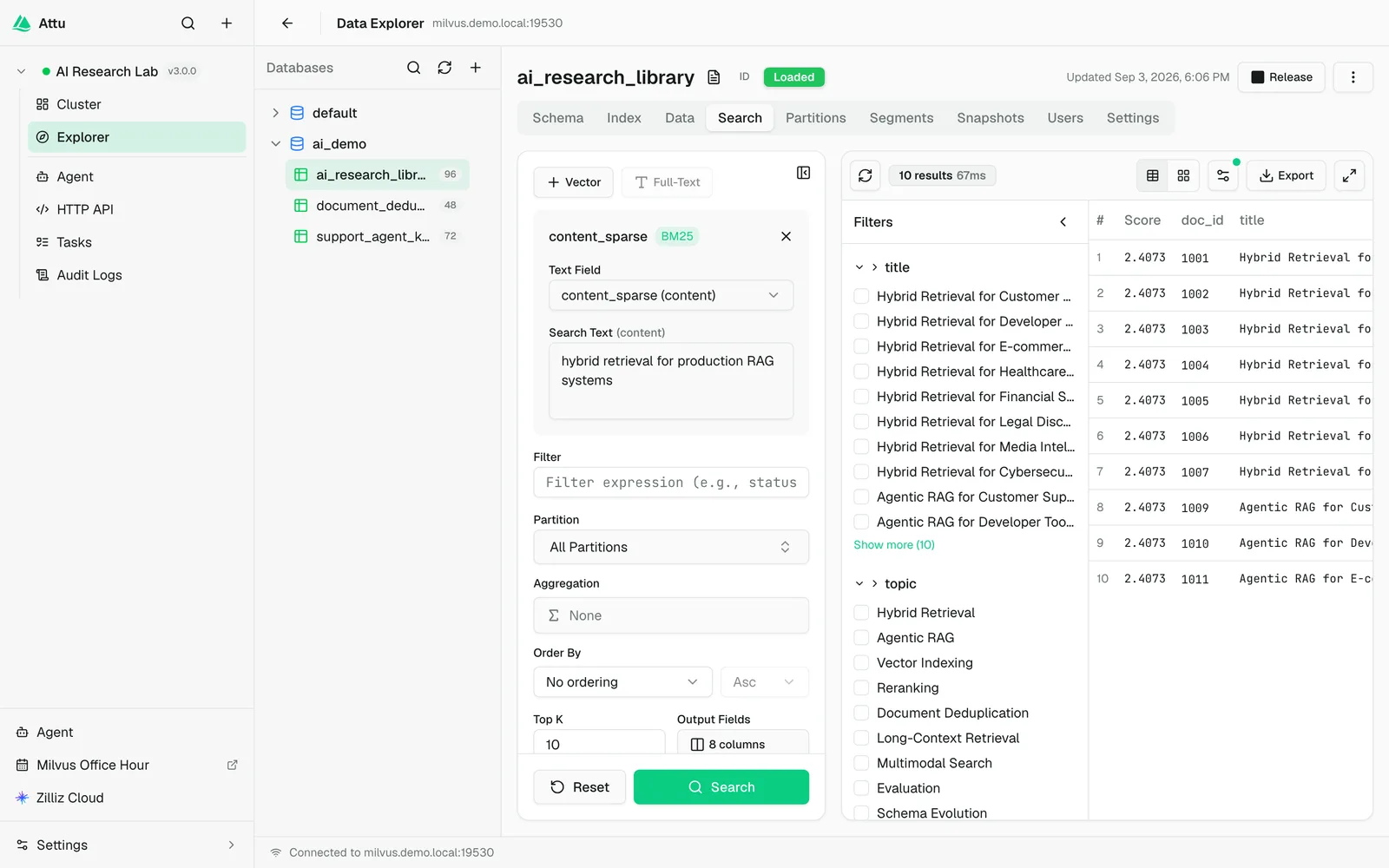
Attu is the management tool Zilliz ships for Milvus vector databases and for Zilliz Cloud. One Attu instance connects to several Milvus clusters at once, each with its own workspace, so dev, staging and production can sit side by side in the sidebar. Inside a cluster you browse databases and collections, view and edit rows inline, import and export CSV, JSON and Parquet, run interactive vector-similarity searches against a configurable embedding provider (OpenAI, Cohere, Jina and VoyageAI among them), manage users, and take full or incremental backups to S3 or MinIO.
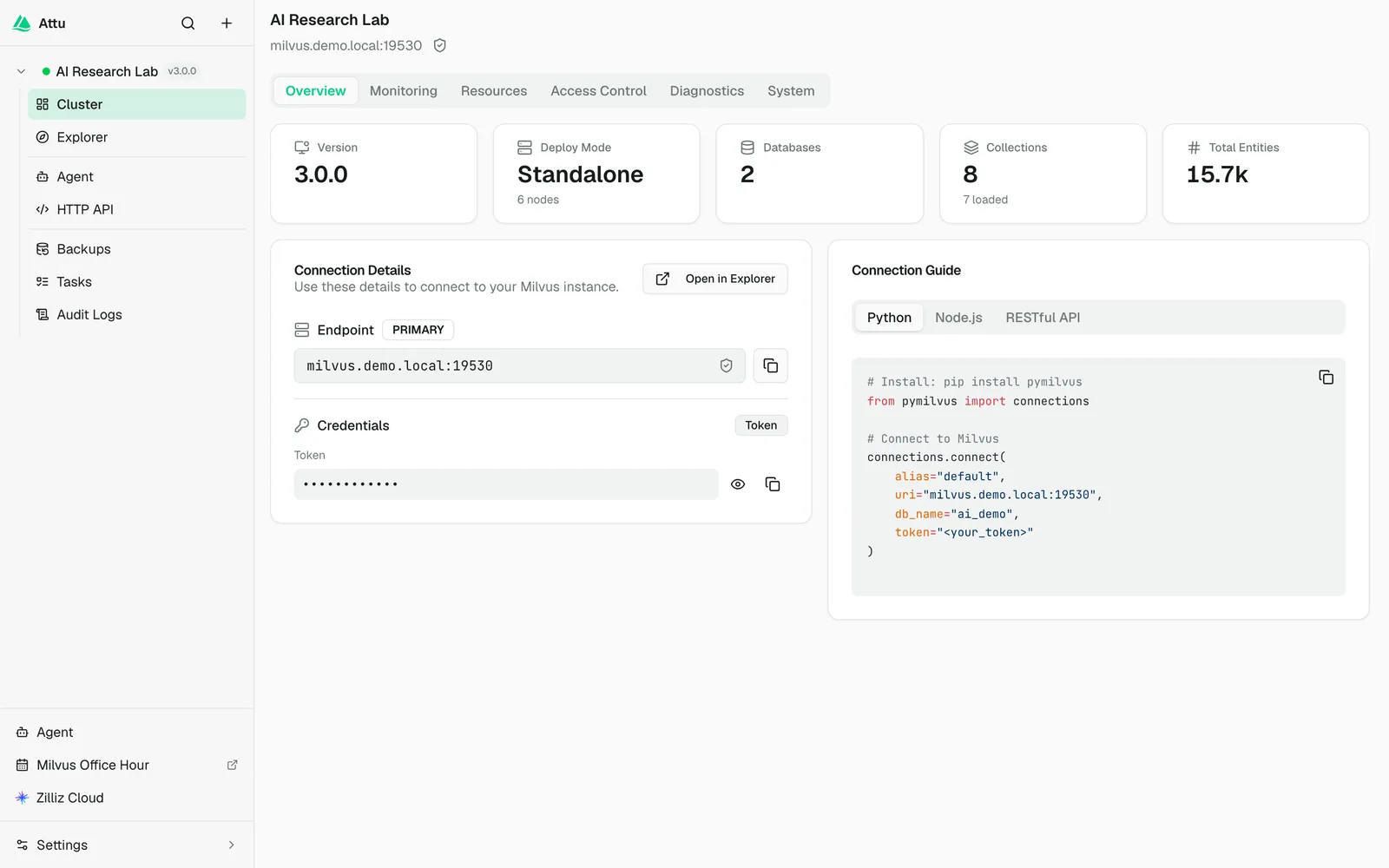
Version 3.0 tracks Milvus 3.0 while staying compatible with Milvus 2.6.0 and later and with Zilliz Cloud. It adds external collections and snapshots — querying Parquet and Iceberg data without copying it into Milvus, and browsing or restoring collection snapshots — plus Milvus TEXT fields and schema evolution, query and search aggregations with grouping, ordering, pagination and Function Score reranking, MinHash function fields with MINHASH_LSH indexes for finding near-duplicate documents in raw text, and reusable analyzer resources such as dictionaries, stop-word lists, synonym lists and tokenizers. Milvus 2.5.x and earlier are not supported by 3.0.
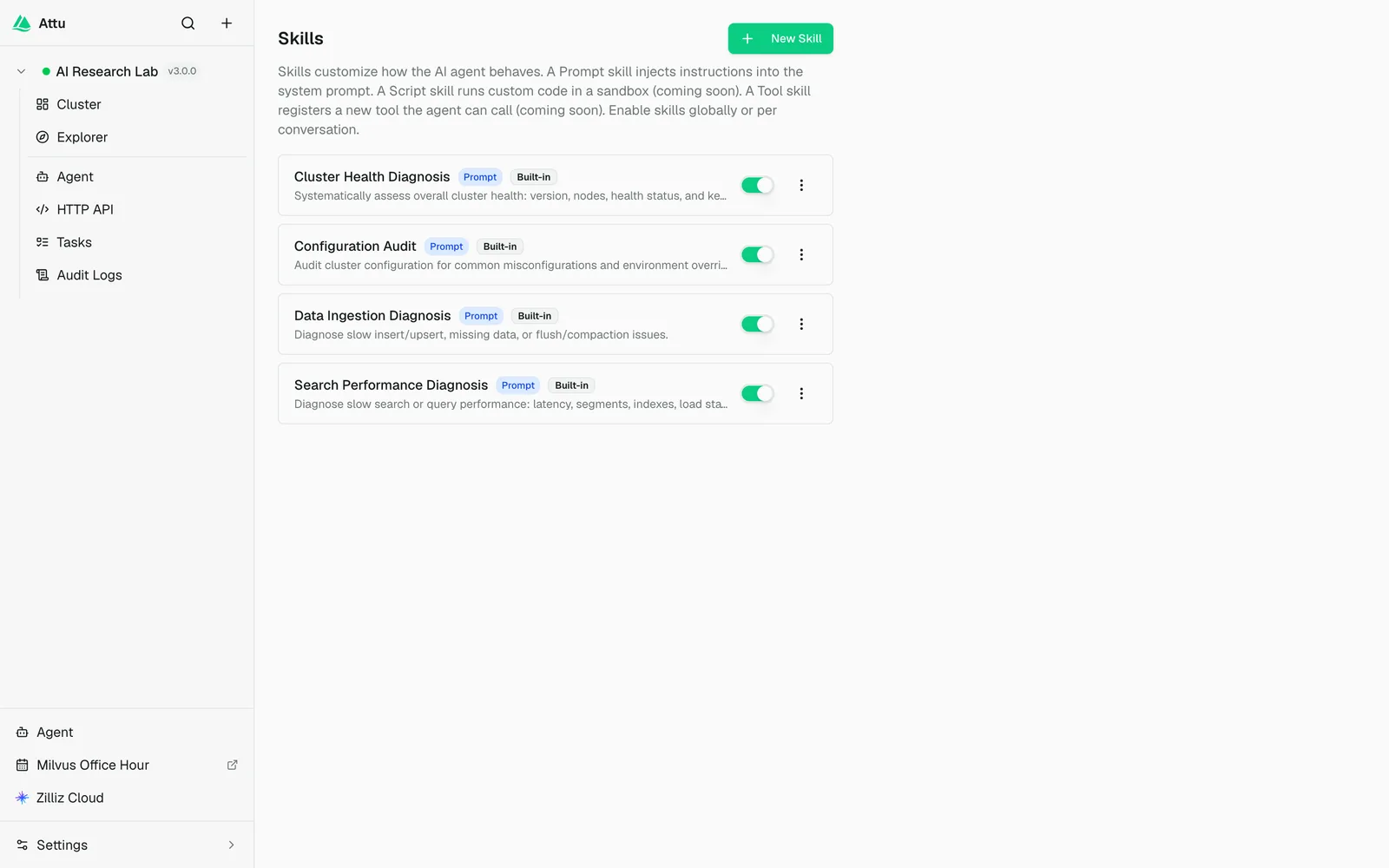
What makes Attu more than a database GUI is its built-in AI agent: a chat panel with more than 50 tools that can create collections, run queries, manage users and analyse performance in natural language, backed by OpenAI, Anthropic Claude, DeepSeek, Google Gemini, OpenRouter or a custom endpoint. Note the licensing. From version 2.6.0 onward Attu is distributed as a proprietary product — the official binaries and build artefacts are free to use and bug reports are welcome, but the source of 2.6.0 and above is closed. Versions up to 2.5.12 remain under the Apache License 2.0.
What it does
- Multi-cluster management — connect several Milvus instances or Zilliz Cloud projects from one deployment, each with its own workspace, monitoring and agent sessions
- Data explorer: browse databases and collections, edit rows inline, and import or export CSV, JSON and Parquet
- Interactive vector search with pluggable embedding providers (OpenAI, Cohere, Jina, VoyageAI and more)
- A built-in AI agent with 50+ tools for chat-driven collection creation, querying, user management and performance analysis
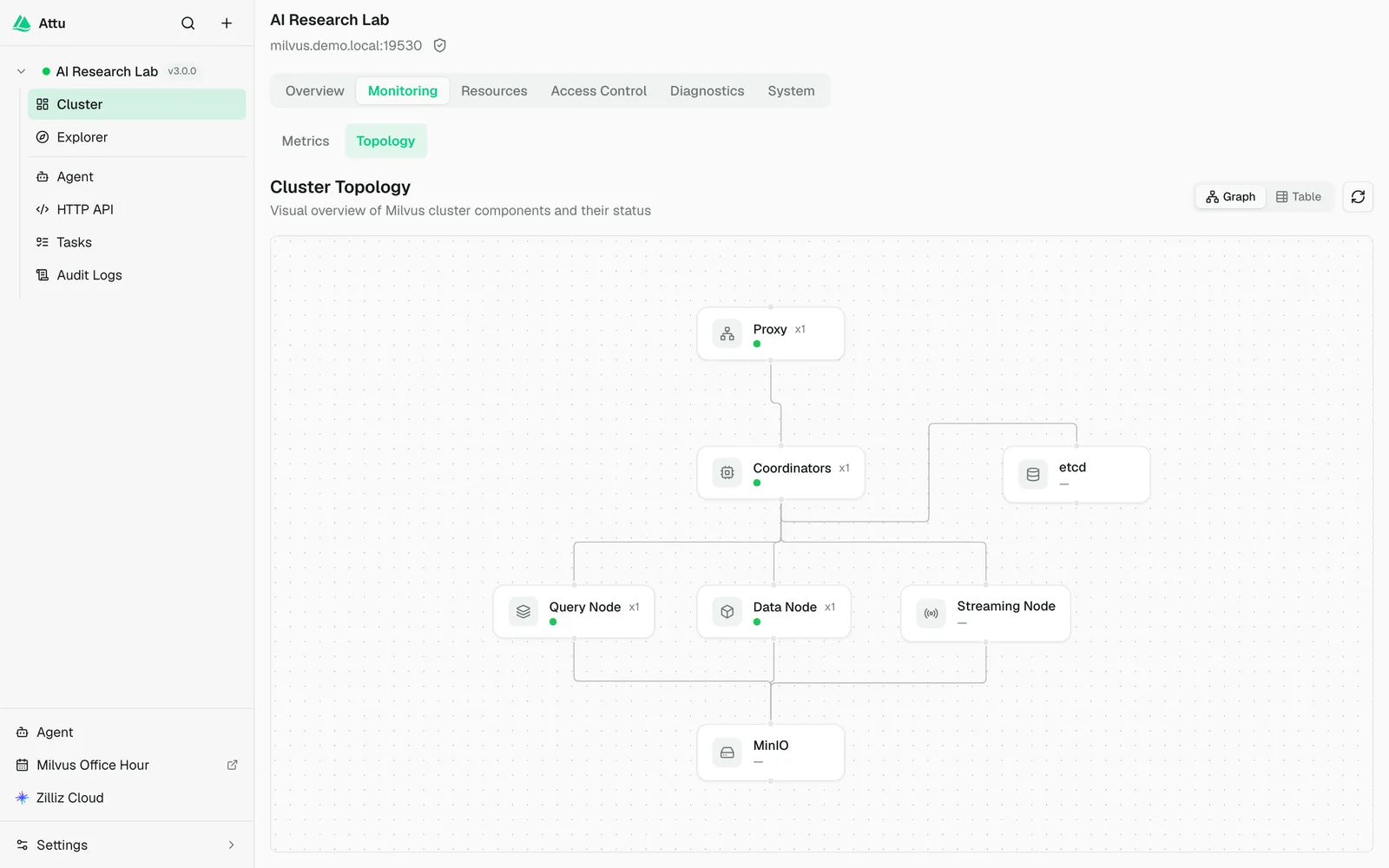
- Cluster overview with real-time health, a Prometheus metrics dashboard and an interactive topology view
- Full and incremental backup and restore, with S3 and MinIO as targets
- Three ways to run it: a Docker or Kubernetes web app, a desktop app for macOS, Linux and Windows, and a standalone Node.js server package
Getting started
Attu runs as a container, a desktop app or a plain Node server. The Docker image is the quickest path and is what the project recommends.
Run it against an existing Milvus
Point MILVUS_ADDRESS at your instance and give the container a volume, so saved connections, agent conversations and preferences survive a restart — the SQLite database lives at /data/attu.db. Then open http://localhost:3000 and add a connection.
docker run -d --name attu \
  -p 3000:3000 \
  -e MILVUS_ADDRESS=host.docker.internal:19530 \
  -v attu-data:/data \
  zilliz/attu:v3.0.0
Or bring up Milvus and Attu together
A two-service compose file is enough for a local stack; start it with docker compose up -d. Attu 3.0 needs Milvus 2.6.x or 3.x — 2.5.x and earlier are not supported.
services:
  milvus:
    image: milvusdb/milvus:<supported-tag>
    ports:
      - "19530:19530"
      - "9091:9091"
    command: milvus run standalone
    volumes:
      - milvus-data:/var/lib/milvus

  attu:
    image: zilliz/attu:v3.0.0
    ports:
      - "3000:3000"
    environment:
      - MILVUS_ADDRESS=milvus:19530
    volumes:
      - attu-data:/data
    depends_on:
      - milvus

volumes:
  milvus-data:
  attu-data:
Prefer no Docker? Use the server package
The v3.0.0 release includes a non-Docker, non-Electron server bundle for Linux x64 that needs Node.js 24.x and ships bin/milvus-backup. It listens on 0.0.0.0:3080 by default; HOST, PORT, ATTU_DATA_DIR and ATTU_DB_PATH override the runtime paths.
curl -LO https://github.com/zilliztech/attu/releases/download/v3.0.0/attu-server-3.0.0-linux-x64-node24.tar.gz
tar -xzf attu-server-3.0.0-linux-x64-node24.tar.gz
cd attu-server-3.0.0-linux-x64-node24
./bin/attu-server
Or install the desktop app
Download the .dmg (macOS Apple Silicon), .AppImage or .deb (Linux), or .exe (Windows) from the releases page. On macOS, if the app is reported as damaged, clear the quarantine attribute.
sudo xattr -rd com.apple.quarantine /Applications/Attu.appCommands and code are distilled from the project's own documentation — always check the official repo for the latest.
When to use it
- Give a team one shared console over several Milvus clusters instead of everyone writing throwaway PyMilvus scripts
- Inspect what actually landed in a collection after an ingestion run, and try a similarity query by hand before wiring it into an app
- Watch cluster health and Prometheus metrics, and run backups or restores without leaving the UI
- Explore Parquet or Iceberg data as an external collection before deciding whether to load it into Milvus
How Attu compares
Attu alongside other open-source vector databases tools AI/TLDR tracks, ranked by GitHub stars.
| Tool | Stars | What it does |
|---|---|---|
| Supabase | ★ 111k | Managed Postgres backend whose Vector toolkit (pgvector) stores, indexes, and queries embeddings next to transactional data. |
| Redis Cloud | ★ 76.6k | Fully-managed Redis with built-in vector search, offering low-latency similarity and hybrid queries over any embeddings. |
| Milvus | ★ 46.3k | A distributed vector database for storing and searching billions of embeddings at scale, with multiple index types and Kubernetes-native deployment. |
| FAISS | ★ 41k | A library from Meta for efficient similarity search and clustering of dense vectors, with both exact and approximate indexes. |
| Qdrant | ★ 34.9k | A Rust-based vector search engine that stores embeddings with rich payload filtering for semantic search and recommendation systems. |
| Chroma | ★ 29.4k | A developer-focused vector database designed for quickly building retrieval and RAG features with a simple Python and JavaScript API. |
| pgvector | ★ 23.2k | A PostgreSQL extension that adds a vector data type and similarity search so you can store and query embeddings inside an existing Postgres database. |
| Attu | ★ 3.2k | The management workbench for Milvus — browse collections, run vector searches, watch cluster health, and drive the whole thing from a chat agent |