Overview
seekdb is an open-source search database from the OceanBase team, built on the OceanBase SQL engine and aimed squarely at agent workloads. It stores vector, full-text, structured and semi-structured data in one engine and queries them in one SQL statement, speaks the MySQL wire protocol, and runs three ways: embedded in-process, as a single-node server, or inside an OceanBase distributed cluster. The Python SDK is `pyseekdb`.
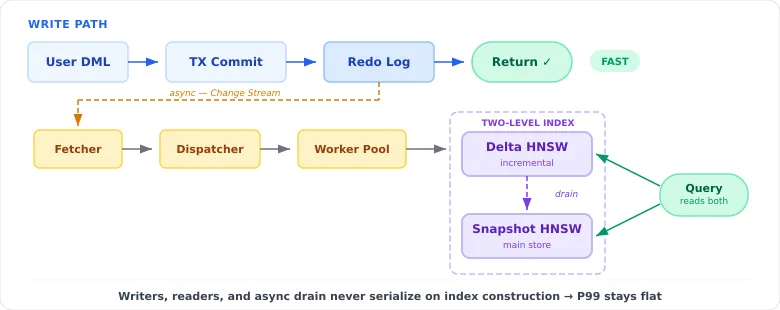
Its central design problem is the shape of agent traffic: continuous writes followed milliseconds later by a read. seekdb decouples index construction from the write path with an asynchronous index pipeline it calls Change Stream — a DML commit returns without waiting for the index build, while a fetcher, dispatcher and worker pool consume the redo log and update a delta HNSW index. Queries read both the incremental delta index and the snapshot index under fine-grained read locks, so newly written vectors are immediately searchable.
The second distinctive feature is branching. `FORK DATABASE` snapshots an entire database in seconds with no data copy, so an agent can write, query and break things inside a sandbox; `MERGE TABLE … STRATEGY` commits the work back with a FAIL, THEIRS or OURS conflict strategy, and `DROP DATABASE` throws it away. This is kernel-level copy-on-write rather than application-layer save and restore.
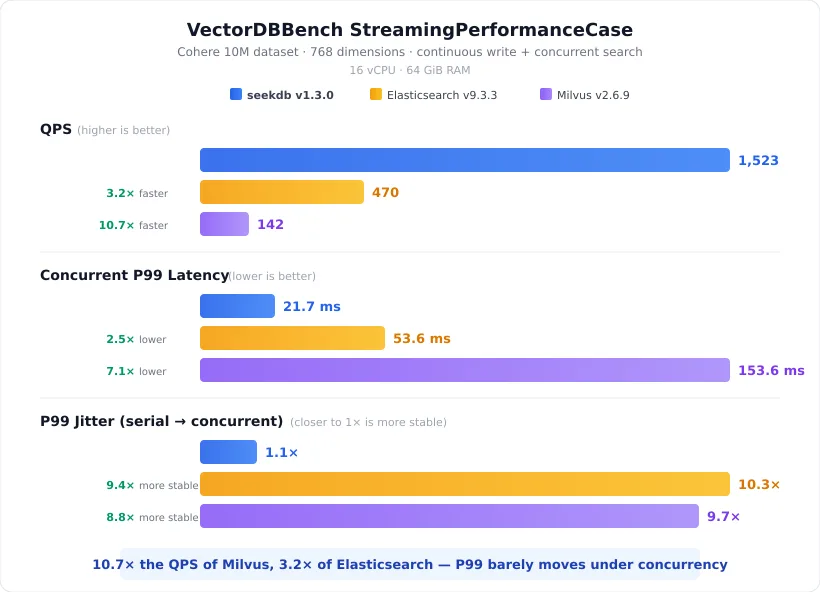
Because it keeps the MySQL protocol, the surrounding ecosystem comes for free: SQLAlchemy and any MySQL driver work, as do LangChain, LlamaIndex and Dify. The project publishes the benchmark it quotes — VectorDBBench's StreamingPerformanceCase on the Cohere 10M dataset at 768 dimensions — and the harness to reproduce it.
What it does
- Hybrid search in a single SQL statement: vector distance, full-text `MATCH … AGAINST` and scalar filters pushed into one execution plan
- Asynchronous Change Stream index pipeline with a two-level HNSW (incremental delta + snapshot), so writes commit without waiting on index construction
- `FORK DATABASE` / `MERGE TABLE` / `DROP DATABASE` copy-on-write sandboxes for agent exploration and rollback
- MySQL-compatible with full ACID — works with SQLAlchemy, any MySQL driver, and with LangChain, LlamaIndex and Dify
- Three deployment shapes from the same engine: embedded library, single-node server, or an OceanBase distributed cluster
- `pyseekdb`, a Python SDK with a collection API (`get_or_create_collection`, `upsert`, `query`) and built-in embedding functions
Getting started
Embedded mode needs nothing but the Python SDK; the server modes ship as a Docker image, a binary installer and a Homebrew tap.
Install the Python SDK
`pyseekdb` is the Python client. In embedded mode it runs the engine in-process, so there is no server to start.
pip install -U pyseekdb
Write and read agent memory
Point a client at a local file, create a collection, then upsert observations and query them back. Because the index pipeline is asynchronous, a document written on one step is retrievable on the next.
import pyseekdb

client = pyseekdb.Client(path="./agent_state.db")
memory = client.get_or_create_collection(name="episodic")

for step in agent.run():
    # Persist the observation
    memory.upsert(ids=[step.id], documents=[step.observation])

    # Retrieve relevant context — milliseconds after the write
    relevant = memory.query(query_texts=step.next_query, n_results=5)

    agent.act(relevant)
Or run the server with Docker
The server image exposes the MySQL protocol on 2881 and the RPC port on 2886. Mount a volume so the data directory survives a restart.
docker run -d \
  --name seekdb \
  -p 2881:2881 \
  -p 2886:2886 \
  -v ./data:/var/lib/oceanbase \
  oceanbase/seekdb:latest
Create a hybrid table and query it
A table can carry a VECTOR column with an HNSW index and a FULLTEXT index side by side; one SELECT then combines similarity, full-text match and scalar predicates.
CREATE TABLE articles (
  id        INT PRIMARY KEY,
  title     TEXT,
  content   TEXT,
  embedding VECTOR(384),
  FULLTEXT INDEX idx_fts (content) WITH PARSER ik,
  VECTOR   INDEX idx_vec (embedding) WITH (DISTANCE=l2, TYPE=hnsw, LIB=vsag)
) ORGANIZATION = HEAP;

SELECT id, title,
       l2_distance(embedding, '[0.12, 0.34, ...]') AS dist
FROM articles
WHERE MATCH(content) AGAINST('quarterly report')
ORDER BY dist APPROXIMATE
LIMIT 10;
Fork a sandbox, then merge or discard it
`FORK DATABASE` is a copy-on-write snapshot taken in seconds. Let the agent work inside the fork, then merge the tables you want to keep — FAIL, THEIRS or OURS decide how conflicts resolve — or drop the whole database.
FORK DATABASE agent_state TO agent_sandbox_42;

USE agent_sandbox_42;
INSERT INTO memory (session_id, embedding, content) VALUES (...);

MERGE TABLE agent_sandbox_42.memory INTO agent_state.memory STRATEGY THEIRS;
-- ...or throw it away:
DROP DATABASE agent_sandbox_42;
Commands and code are distilled from the project's own documentation — always check the official repo for the latest.
When to use it
- Reach for it when an agent needs durable memory that is writable and searchable in the same loop, without a separate vector store and relational database
- Reach for it when you want speculative agent work isolated in a branch you can merge or throw away, rather than reconciled by hand
- Reach for it for RAG where the query needs vector similarity, keyword match and access-control filters resolved together in one plan
- Reach for it when a MySQL-compatible, ACID engine is easier to operate and embed than another bespoke database
How seekdb compares
seekdb alongside other open-source vector databases tools AI/TLDR tracks, ranked by GitHub stars.
| Tool | Stars | What it does |
|---|---|---|
| Supabase | ★ 111k | Managed Postgres backend whose Vector toolkit (pgvector) stores, indexes, and queries embeddings next to transactional data. |
| Redis Cloud | ★ 76.6k | Fully-managed Redis with built-in vector search, offering low-latency similarity and hybrid queries over any embeddings. |
| Milvus | ★ 46.3k | A distributed vector database for storing and searching billions of embeddings at scale, with multiple index types and Kubernetes-native deployment. |
| FAISS | ★ 41k | A library from Meta for efficient similarity search and clustering of dense vectors, with both exact and approximate indexes. |
| Qdrant | ★ 34.9k | A Rust-based vector search engine that stores embeddings with rich payload filtering for semantic search and recommendation systems. |
| Chroma | ★ 29.4k | A developer-focused vector database designed for quickly building retrieval and RAG features with a simple Python and JavaScript API. |
| pgvector | ★ 23.2k | A PostgreSQL extension that adds a vector data type and similarity search so you can store and query embeddings inside an existing Postgres database. |
| seekdb | ★ 3.1k | A MySQL-compatible search database for agent state — vector, full-text and relational data in one SQL engine, with copy-on-write sandboxes you can fork and merge |