Overview
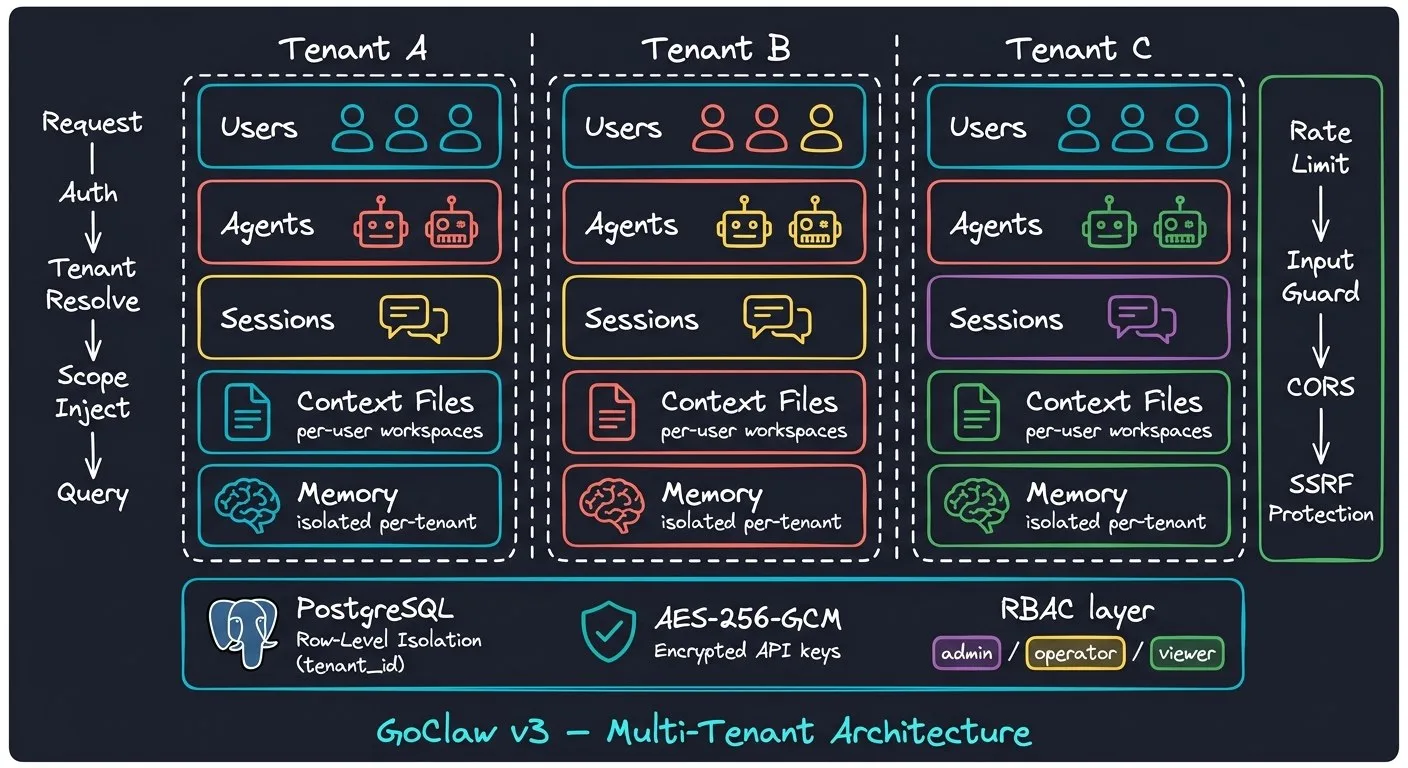
GoClaw is OpenClaw's agent model rebuilt in Go and reframed as a gateway you can run for more than one person. Where the original is a single-user runtime, GoClaw is multi-tenant from the database up: per-user workspaces, per-user context files, AES-256-GCM-encrypted API keys, RBAC and isolated sessions on a PostgreSQL 18 schema with pgvector. The payoff of the rewrite is operational — a roughly 25 MB static binary with no Node.js runtime, sub-second startup, and a footprint small enough for a $5 VPS.
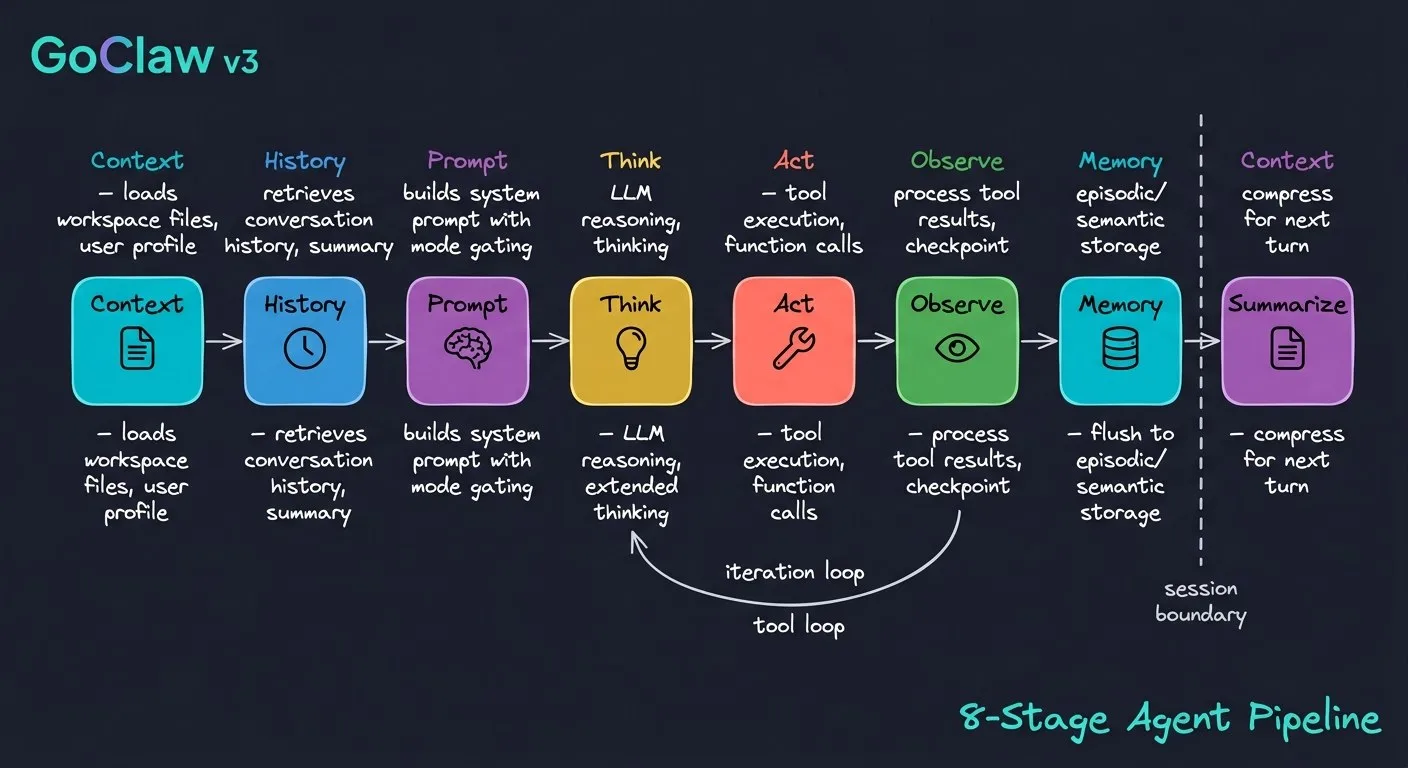
Every request runs an eight-stage pipeline — context, history, prompt, think, act, observe, memory, summarize — whose stages are pluggable but always executed, so behaviour is predictable rather than emergent. Prompt construction is its own subsystem: four modes (Full, Task, Minimal, None) with section gating, cache-boundary optimisation and per-session mode resolution, which is how a long-running agent keeps prompt-cache hits while still varying what it sends.
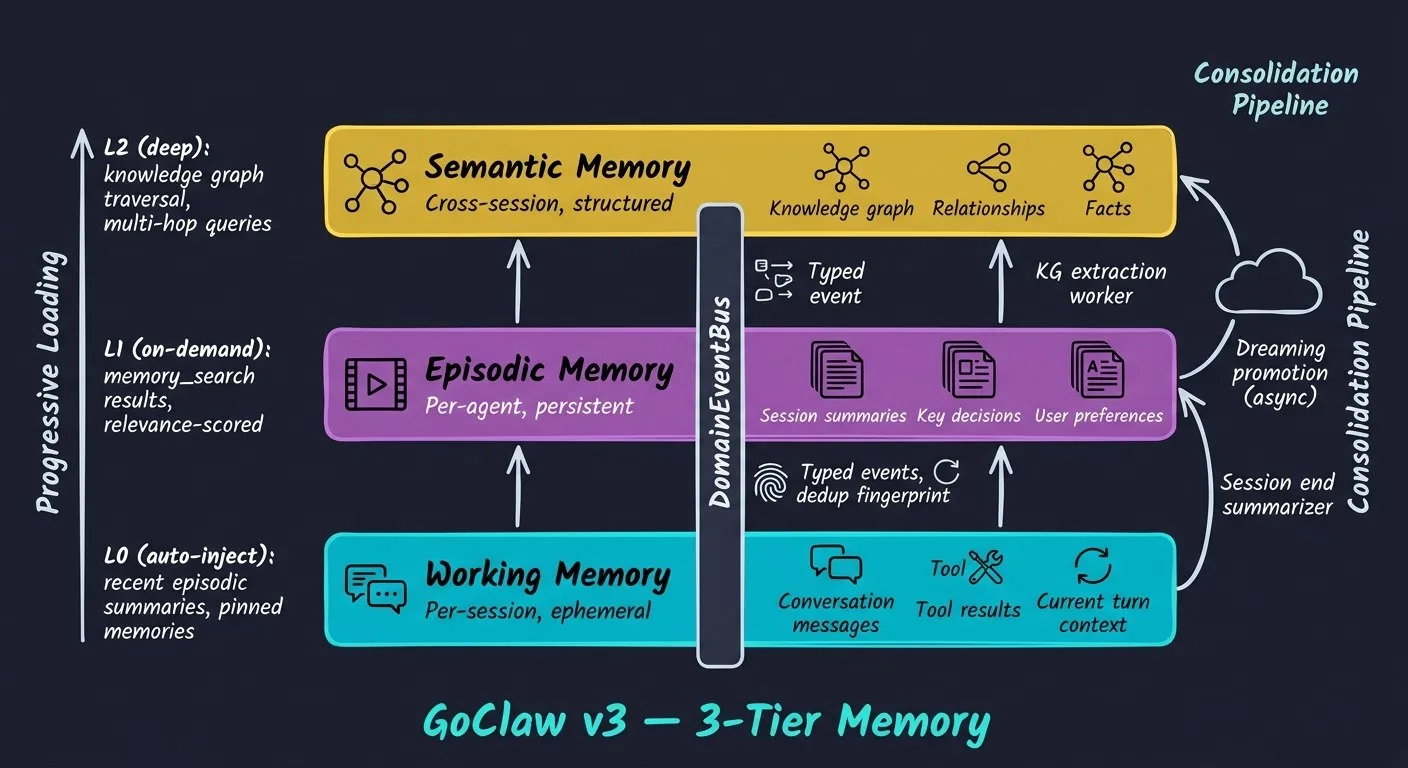
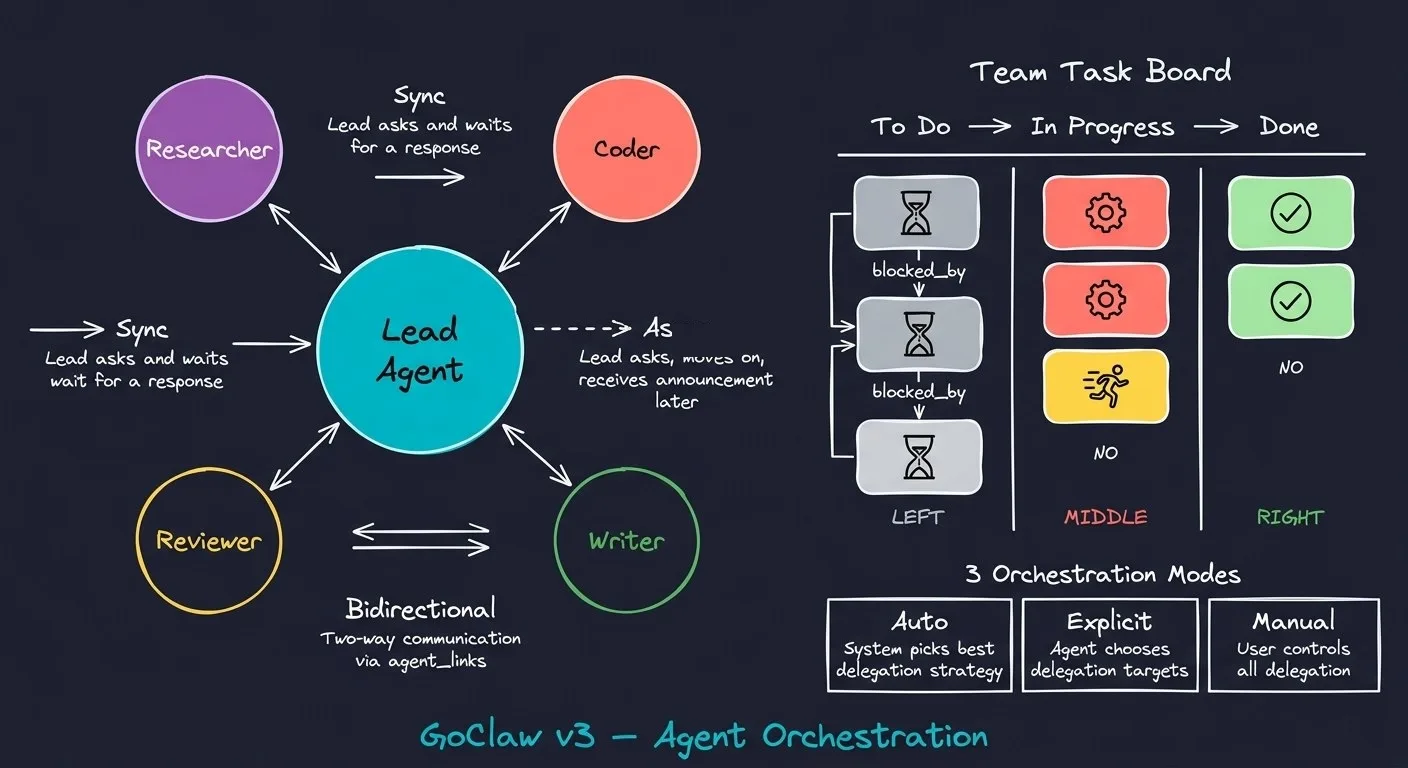
Memory is three tiers rather than one store: working memory for the live conversation, episodic memory for session summaries, and semantic memory as a knowledge graph, loaded progressively at L0/L1/L2. Alongside it sits a Knowledge Vault — a document registry with `[[wikilinks]]`, hybrid FTS plus pgvector search, and filesystem sync. Agents can be organised into teams with shared task boards, delegate to each other synchronously or asynchronously, and be orchestrated in automatic, explicit or manual modes. A self-evolution loop turns metrics into suggestions and, within guardrails, lets agents adapt their own communication style.
Reach is the other half of the pitch: 20+ LLM providers (Anthropic over native HTTP+SSE with prompt caching, OpenAI, OpenRouter, Groq, DeepSeek, Gemini, Mistral, xAI, MiniMax, DashScope, Claude CLI, Codex, ACP and any OpenAI-compatible endpoint) and seven messaging channels (Telegram, Discord, Slack, Zalo OA, Zalo Personal, Feishu/Lark, WhatsApp). Security is stated as five layers — a permission system, rate limiting, prompt-injection detection, SSRF protection and encryption. LLM call tracing with spans and prompt-cache metrics is built in, with optional OpenTelemetry OTLP export. A desktop edition, GoClaw Lite, drops Docker and PostgreSQL for a Wails + React app on SQLite, capped at five agents and one team, with FTS5 search in place of pgvector and no channels. Note the licence: GoClaw is distributed under Creative Commons Attribution-NonCommercial 4.0, not an open-source licence.
What it does
- An 8-stage agent pipeline — context → history → prompt → think → act → observe → memory → summarize — with pluggable, always-on stages
- A 4-mode prompt system (Full / Task / Minimal / None) with section gating, cache-boundary optimisation and per-session mode resolution
- 3-tier memory — working, episodic, semantic knowledge graph — with progressive L0/L1/L2 loading, plus a Knowledge Vault with [[wikilinks]] and hybrid FTS + pgvector search
- Agent teams: shared task boards, synchronous and asynchronous inter-agent delegation, and automatic, explicit or manual orchestration
- Multi-tenant PostgreSQL with per-user workspaces and context files, AES-256-GCM-encrypted keys, RBAC and isolated sessions
- 20+ LLM providers and 7 messaging channels (Telegram, Discord, Slack, Zalo OA, Zalo Personal, Feishu/Lark, WhatsApp) behind one gateway
- Built-in LLM call tracing with spans and prompt-cache metrics, plus optional OpenTelemetry OTLP export and a `goclaw traces` operator CLI
- A ~25 MB single static binary with sub-second startup, and a Docker path with optional headless Chrome, Jaeger, sandbox, Tailscale and Redis services
- GoClaw Lite — a native Wails + React desktop app on SQLite with no Docker or PostgreSQL, capped at 5 agents and 1 team
Getting started
GoClaw needs Go 1.26+ and PostgreSQL 18 with pgvector; Docker is optional but is the quicker route. Note that the repository's default branch is `dev` — clone `main` for the stable release branch.
Build from source
The onboard wizard walks through provider and database setup and writes .env.local.
git clone -b main https://github.com/nextlevelbuilder/goclaw.git && cd goclaw
make build
./goclaw onboard        # interactive setup wizard
source .env.local && ./goclaw
Or bring it up with Docker
prepare-env.sh generates .env with fresh secrets; add at least one GOCLAW_*_API_KEY before `make up`. That single command creates the Docker network, embeds the version from git tags, builds and starts the services and runs migrations. The dashboard is then at http://localhost:18790.
chmod +x prepare-env.sh && ./prepare-env.sh

# add at least one GOCLAW_*_API_KEY to .env, then:
make up

curl http://localhost:18790/health
Turn on the optional services you need
WITH_* flags add headless Chrome for the browser tool, Jaeger for OpenTelemetry tracing, a Docker sandbox for untrusted agent code, Tailscale, or Redis. They combine, and must be repeated on `make down`.
make up WITH_BROWSER=1 WITH_OTEL=1
make down WITH_BROWSER=1 WITH_OTEL=1
Inspect runs with the operator CLI
The same binary doubles as a client against a local or remote gateway.
goclaw traces list --status error
goclaw traces get <trace-id> -o json
goclaw --server https://goclaw.example.com --token "$GOCLAW_GATEWAY_TOKEN" traces follow --session <session-key>
Prefer a desktop app? Install Lite
GoClaw Lite is a single native app of about 30 MB on SQLite — no Docker, no PostgreSQL — with chat, agent management, provider config, MCP servers, skills, cron and a team Kanban board, and auto-update from GitHub Releases.
# macOS
curl -fsSL https://raw.githubusercontent.com/nextlevelbuilder/goclaw/main/scripts/install-lite.sh | bash

# Windows (PowerShell)
irm https://raw.githubusercontent.com/nextlevelbuilder/goclaw/main/scripts/install-lite.ps1 | iex
Commands and code are distilled from the project's own documentation — always check the official repo for the latest.
When to use it
- Reach for it when several people need their own agents on shared infrastructure, with credentials and sessions genuinely isolated
- Reach for it when an agent has to be reachable from chat — Telegram, Discord, Slack, Feishu, WhatsApp — rather than from a terminal
- Reach for it when the deployment target is small: one static binary and a Postgres instance instead of a Node runtime and a process tree
- Reach for it when a team of agents needs a shared task board and explicit delegation rather than one agent doing everything
How GoClaw compares
GoClaw alongside other open-source agent frameworks & builders tools AI/TLDR tracks, ranked by GitHub stars.
| Tool | Stars | What it does |
|---|---|---|
| DeepSeek Harness | ★ 243k | DeepSeek AI's open-source agent harness (dsh), built on Cordis, where models, tools, skills, sessions, sandboxes, storage and the UI are all plugins composed through profiles. |
| AutoGPT | ★ 188k | One of the earliest autonomous agent projects, now a platform for building and running agents from reusable blocks and workflows. |
| DeerFlow | ★ 83.4k | ByteDance's open-source super agent harness built on LangGraph: skills, sub-agents, sandboxes, a filesystem and long-term memory for long-horizon research, coding and content tasks. |
| nanobot | ★ 48.8k | Lightweight self-hosted personal AI agent framework in Python, with a WebUI, terminal and chat-app channels, tools, long-term memory, MCP and scheduled automations. |
| LangGraph | ★ 42.7k | A library from the LangChain team for building stateful, graph-based agent workflows with explicit control over steps, memory, and human-in-the-loop checkpoints. |
| Agno | ★ 42.5k | A fast Python framework (formerly Phidata) for building agents with memory, tools, and multimodal inputs, plus a runtime for deploying them in production. |
| AgentGPT | ★ 36.3k | AgentGPT lets you name a custom AI, give it a goal, and watch it plan tasks, run them, and learn from the results, all from a web browser. |
| GoClaw | ★ 3.6k | OpenClaw's agent model rebuilt in Go as a multi-tenant gateway: an 8-stage pipeline, three tiers of memory, 20+ providers and 7 chat channels in a single ~25 MB binary |