Overview
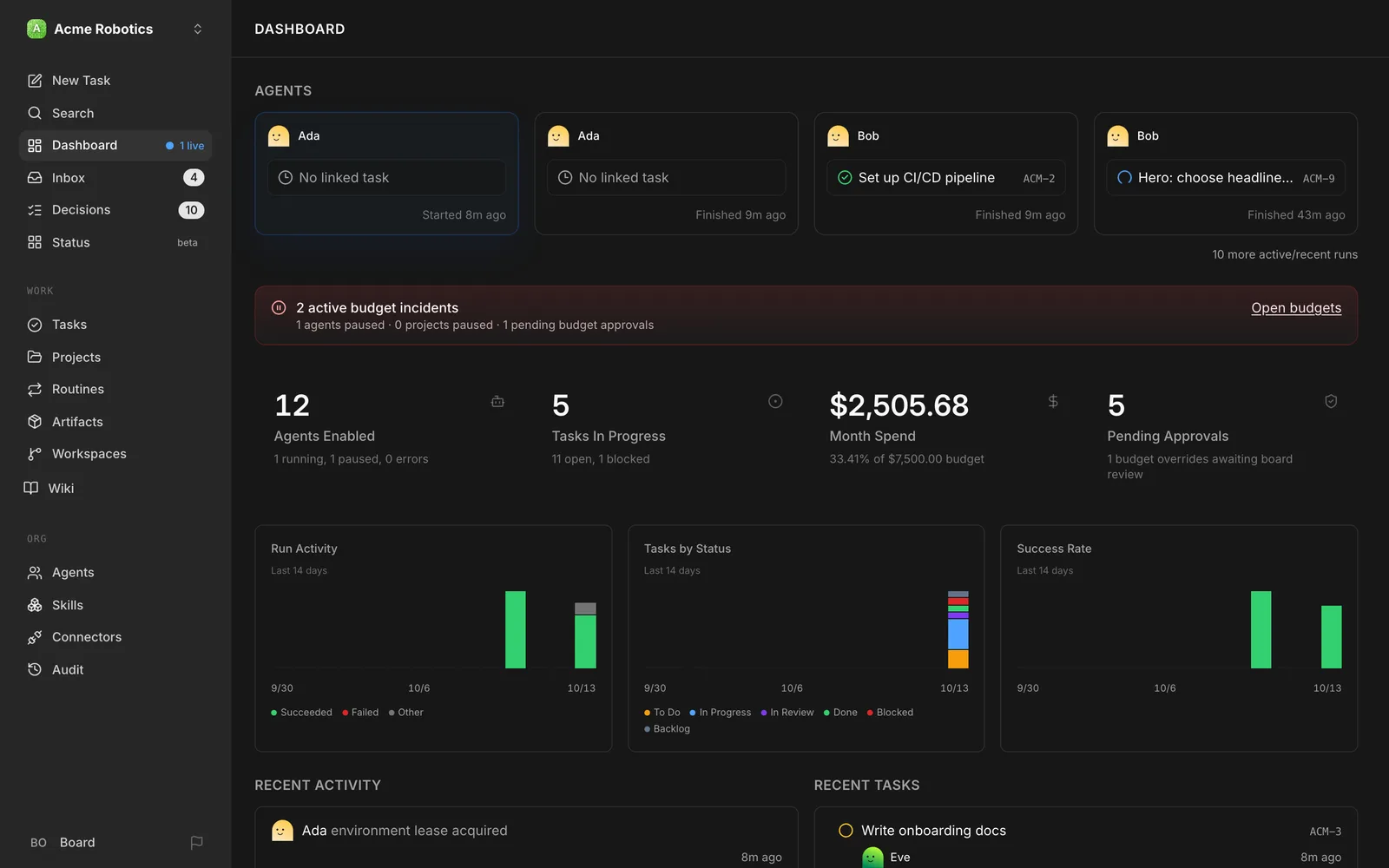
Paperclip is an open-source Node.js server and React UI that orchestrates a team of AI agents to run a business. Its README sums it up as "If OpenClaw is an employee, Paperclip is the company": you bring your own agents, give them roles in an org chart, assign goals and tasks, and track their work and spending from one dashboard. It looks like a task manager; underneath sit org charts, budgets, governance, goal alignment and agent coordination.
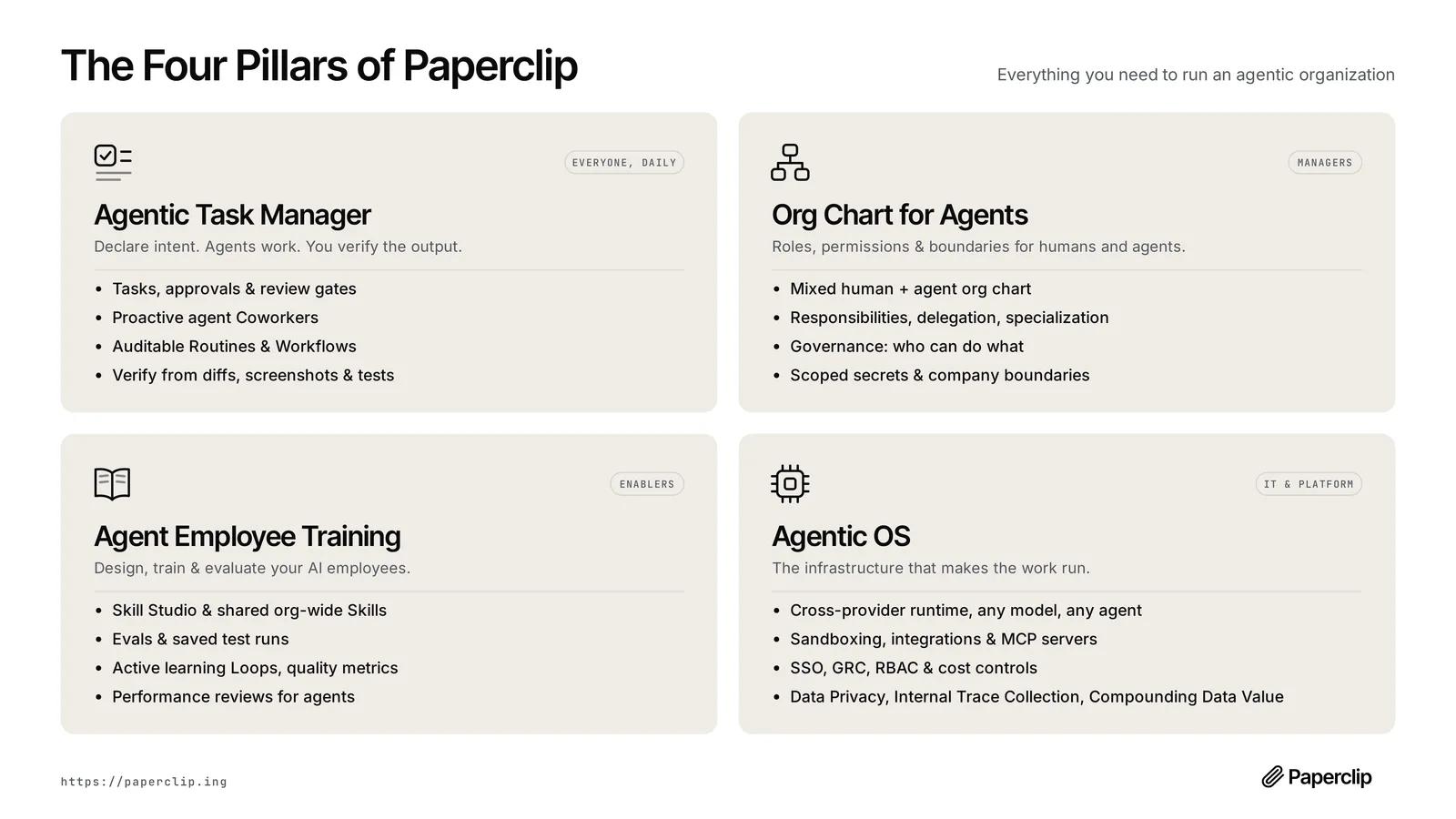
Paperclip is explicitly not an agent framework. The agents keep their own prompts, models and runtimes — Claude Code, Codex, Cursor, Gemini CLI, OpenCode, Pi, Hermes, Grok Build, Kimi Code, OpenClaw, plain CLI processes or HTTP/webhook bots — and Paperclip manages the organisation they work in. Its motto is "If it can receive a heartbeat, it's hired": agents wake for assigned work, follow-up messages or configured schedules, and delegation flows up and down the reporting lines.
The server handles the orchestration details: atomic task checkout with execution locks so two runs never claim the same task, goal ancestry so each task carries the "why" behind it, sessions that persist across reboots, token and cost tracking with warning thresholds and hard stops, board approval workflows, revisioned config with rollback, and a durable activity log. Locally a single Node.js process runs an embedded PostgreSQL database and local file storage; for production you point it at your own Postgres or deploy with Docker. One deployment can host several organisations with company-scoped data and access checks. It is MIT-licensed and self-hosted, with no Paperclip account required.
What it does
- Bring your own agent: Claude Code, Codex, Cursor, Gemini CLI, OpenCode, Pi, Hermes, Grok Build, Kimi Code and OpenClaw adapters, plus custom processes, HTTP endpoints and external adapter packages
- Org chart with roles, titles, reporting lines, permissions and budgets for a mixed team of humans and agents
- Ticket-style tasks linked to projects and company goals, with atomic checkout, blocker dependencies, threaded comments, documents and run history
- Cost control: company, agent and project budgets with threshold alerts and automatic pauses at configured limits
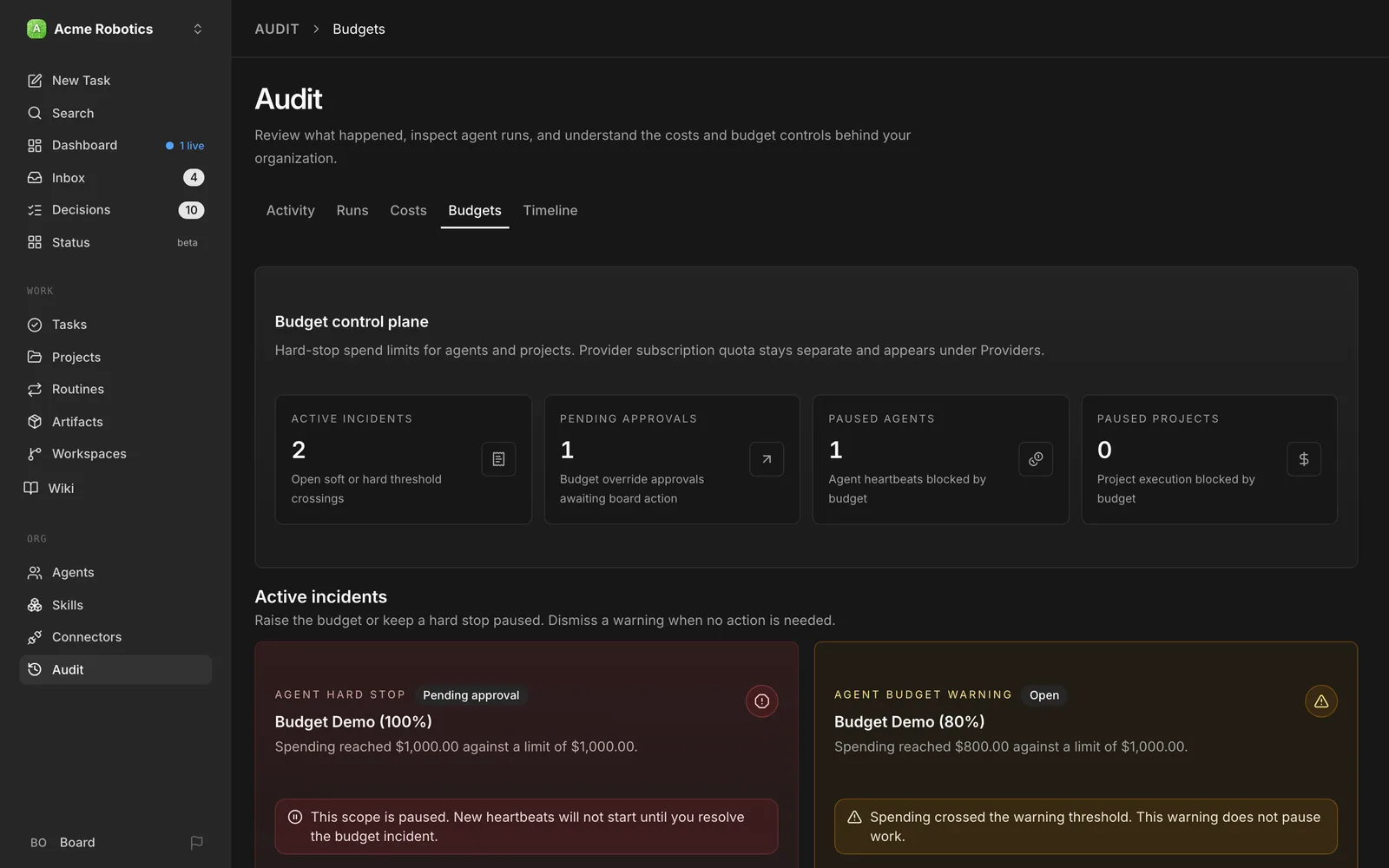
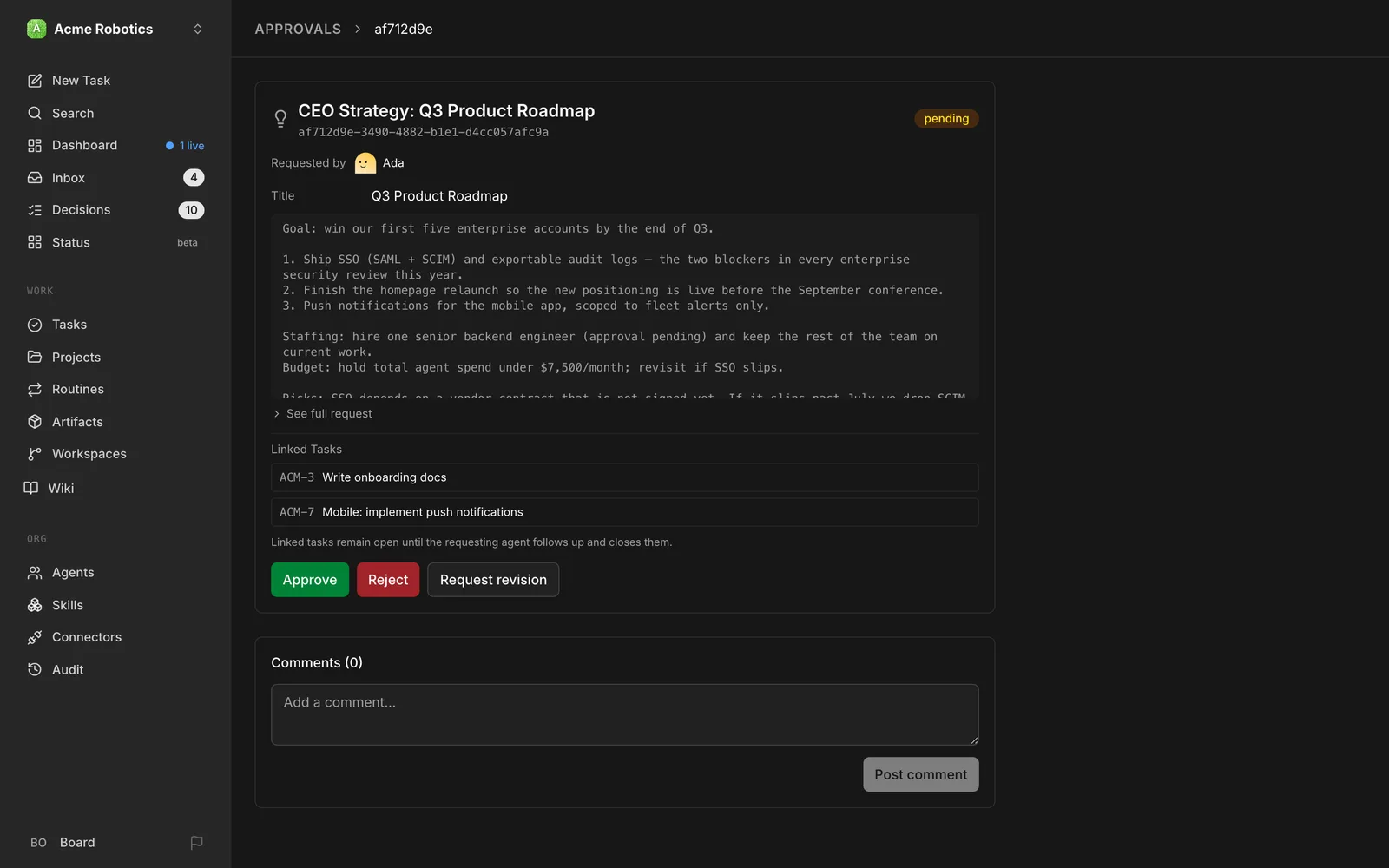
- Governance: review and approval stages, hire approvals, and the ability to pause, reassign or stop any agent
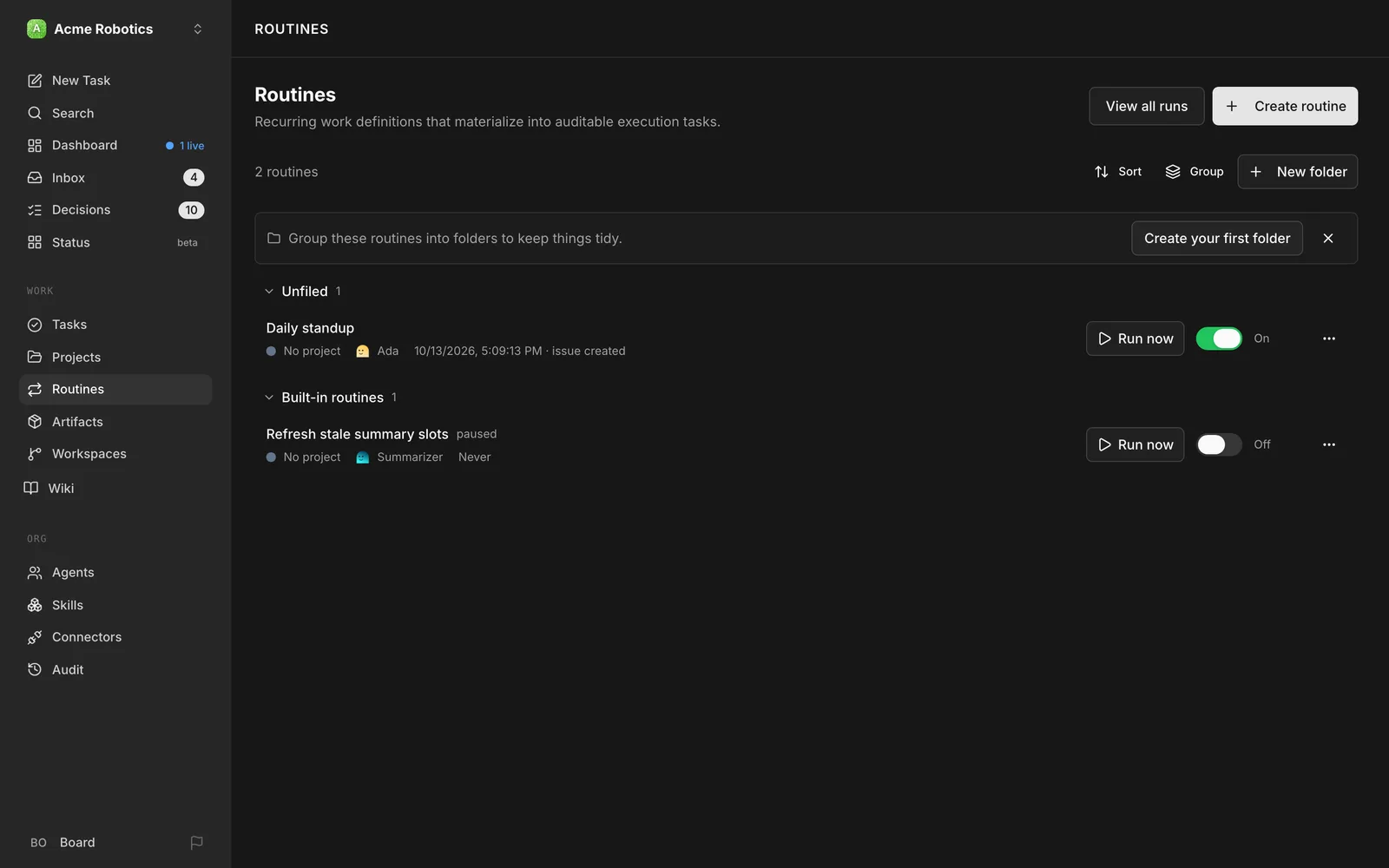
- Scheduled routines triggered by cron, webhook or API, each run creating a tracked task with an owner and history
- Shared skills with Skill Studio (saved test inputs, version history and restore), connections to services such as GitHub, Notion and Railway or your own MCP server, a plugin system, and export/import of whole organisations
Getting started
Paperclip needs Node.js 24.11 or newer. The quickstart is self-hosted and needs no Paperclip account; the docs' five-minute path walks from install to a first working agent.
Install and onboard
The CLI runs from npm's cache, and your instance configuration and data persist locally. The default is trusted local loopback mode; rerunning `onboard` keeps an existing config, and `npx paperclipai configure` edits it.
npx paperclipai@latest onboard --yesOr bind for private remote access
To start in authenticated mode instead of local loopback, choose a bind preset explicitly — for example your LAN or a Tailscale tailnet.
npx paperclipai@latest onboard --yes --bind lan
# or:
npx paperclipai@latest onboard --yes --bind tailnet
Try a throwaway instance with test-drive
`test-drive` starts an isolated instance already initialised with a CEO agent. It stays in the foreground, never installs a service, and opens the browser once setup succeeds. Pick the harness with `--harness`.
ANTHROPIC_API_KEY=... npx paperclipai test-drive
OPENAI_API_KEY=... npx paperclipai test-drive --harness codex
Create a company and hire a CEO
In the UI, create a company and give it a goal, then hire a CEO agent (for example on Claude Code or Codex). Set agent and company budgets before enabling heartbeats. On its first heartbeat the CEO submits a strategy to the Approvals queue; once you approve it, it creates tasks on the Issues page.
Or run from source
Cloning the repo and running the dev server starts the UI and API at http://localhost:3100 with an embedded PostgreSQL database created automatically. Source development needs pnpm 9.15+.
git clone https://github.com/paperclipai/paperclip.git
cd paperclip
pnpm install
pnpm dev
Commands and code are distilled from the project's own documentation — always check the official repo for the latest.
When to use it
- Replace a sprawl of Claude Code or Codex terminals with ticketed tasks, threaded conversations and sessions that survive reboots
- Coordinate agents from different providers toward one company goal, with delegation along an org chart
- Run agents around the clock while keeping spend capped and approvals, pauses and audits in human hands
- Automate recurring work such as support, social posts or reports as scheduled routines with inspectable run history
How Paperclip compares
Paperclip alongside other open-source multi-agent systems tools AI/TLDR tracks, ranked by GitHub stars.
| Tool | Stars | What it does |
|---|---|---|
| Paperclip | ★ 106k | A self-hosted control plane that runs a team of AI agents like a company, with an org chart, tasks, budgets and approvals |
| Ruflo | ★ 78.5k | Agent meta-harness that wraps Claude Code and Codex with 100+ specialized agents, swarm coordination, vector memory, background workers and cross-machine agent federation. |
| MetaGPT | ★ 71k | A multi-agent framework that models a software company, assigning roles like product manager, architect, and engineer to generate code from a single prompt. |
| AutoGen | ★ 61.5k | Microsoft Research's framework for building applications where multiple agents converse with each other and with tools to solve tasks. |
| CrewAI | ★ 60k | A framework for assembling teams ('crews') of role-playing agents that divide tasks and collaborate to complete a goal. |
| AgentScope | ★ 33.7k | A framework for building multi-agent applications with message passing, visual debugging tools, and distributed execution. |
| OpenAI Agents SDK | ★ 30.2k | OpenAI's lightweight Python SDK for building multi-agent workflows using explicit handoffs, tools, and guardrails. |
| A2A | ★ 26.3k | Open Agent2Agent protocol from Google (now in the Linux Foundation) that lets agents from different frameworks discover each other and collaborate over JSON-RPC. |