Overview

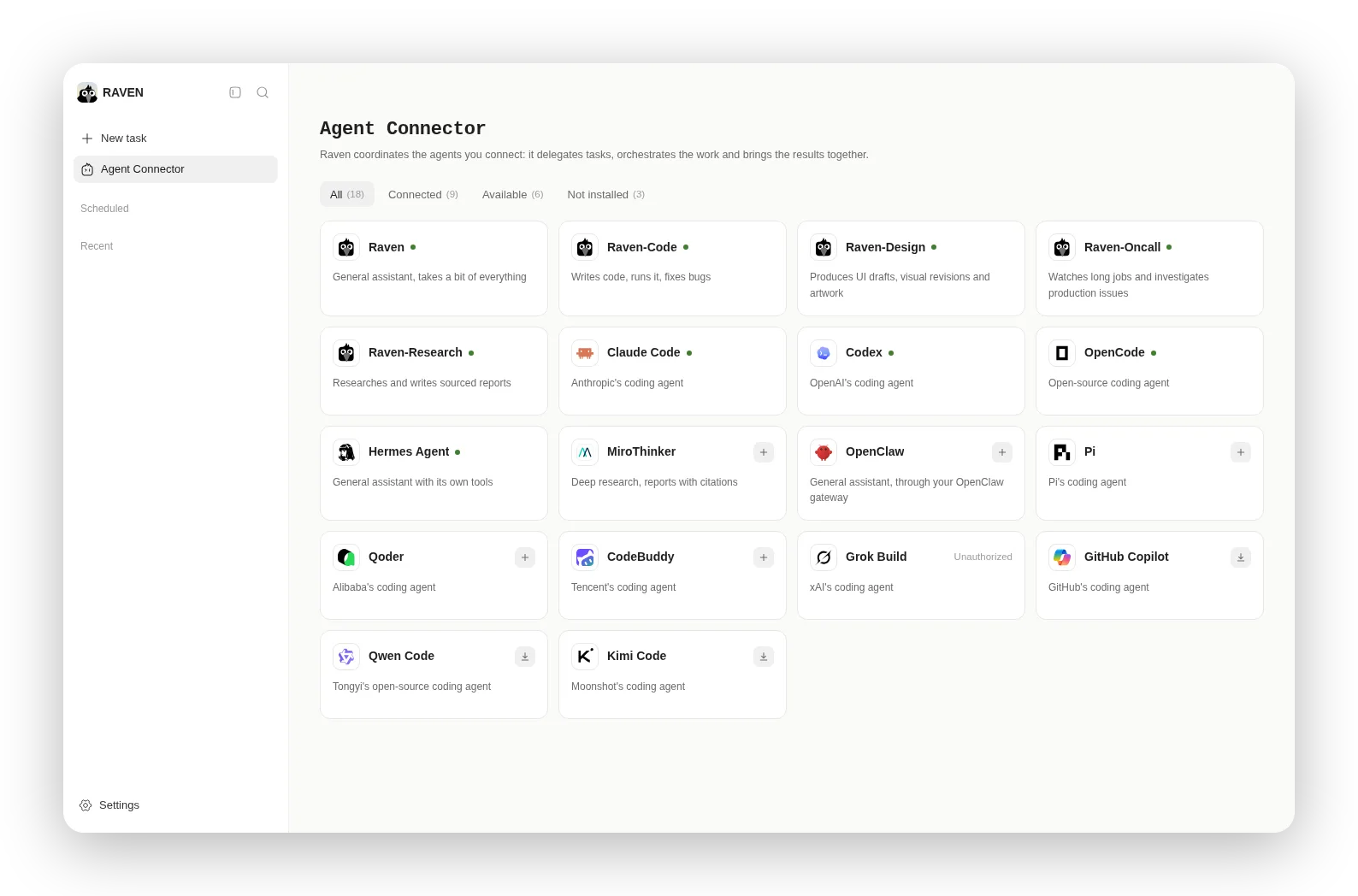
Raven is an open-source Python agent harness from EverMind that the project calls "the harness of harnesses". It runs as a host agent: you describe a task once, Raven generates a DAG of steps and delegates each step to a specialised agent, then brings the results back together. A single run can mix Raven's own agents with third-party coding agents, for example handing market research to one agent, a website build to Claude Code and the final review to Codex.
Four agents ship with it: Raven-Research for deep research with sourced reports, Raven-Code for agentic software development and data analysis, Raven-Design for slide decks, charts, diagrams and web interfaces, and Raven-Oncall for unattended, long-running workflows such as overnight experiments or monitoring. Beyond those, Raven connects to outside agents over ACP, a CLI or an OpenAI-compatible API, with presets for 13 of them including Claude Code, Codex, OpenCode, Hermes Agent, OpenClaw, GitHub Copilot, Qwen Code, Kimi Code and Pi. The README publishes benchmark charts for each built-in agent; those are the project's own results.
The project positions Raven as built for recursive self-improvement. Its agent loop is split into four strategy modules (Memory, Planning, Capability and Action), and an experimental Curator rewrites them per agent, installing a change only after it passes verification; a separate Raven Evolver tool evaluates candidate harness changes against benchmarks. Long-term memory comes from EverMind's EverOS, and a SkillForge layer retrieves skills from local libraries, EverOS and the SkillHub catalogue. Raven installs with a one-line script or Docker and is driven from a browser WebUI, a TUI or chat channels. It is Apache-2.0 licensed and was released as pre-alpha in 2026, so interfaces and configuration may change quickly.
What it does
- Host-agent orchestration: Raven turns one brief into a DAG of tasks, runs dependent and parallel steps, and turns multi-step collaboration into reusable workflows
- Four built-in agents for research, coding, visual design and unattended oncall work, each usable alone or inside a shared workflow
- Connects third-party agents over ACP, CLI or OpenAI-compatible APIs, with presets for 13 including Claude Code, Codex, OpenCode, Hermes Agent, OpenClaw and GitHub Copilot
- Persistent memory through EverOS plus SkillForge skill retrieval, so user context, agent experience and reusable skills carry across sessions
- Proactivity: event monitoring and scheduled runs for reminders, follow-ups and long-running jobs
- Self-evolution tooling: an experimental Curator that rewrites an agent's memory, planning, capability and action modules behind verification checks, and a separate Evolver that benchmarks candidate harness changes
Getting started
Raven runs on Linux, macOS, WSL2 or native Windows, or in Docker. The project's quick-start guide installs it, configures a model provider and opens the WebUI.
Install Raven
The installer sets up a managed Raven environment and adds the `raven` command to your shell. On native Windows PowerShell use `irm https://raven.evermind.ai/install.ps1 | iex` instead.
curl -fsSL https://raven.evermind.ai/install.sh | bashConfigure a model provider
The guided setup asks for a model provider and which built-in agents to enable; each agent can run on the model it is tuned for (with its own key) or on Raven's main model. Providers can be changed later in the WebUI under Settings > Model providers.
raven onboardStart the WebUI
This opens the local page in your browser and keeps Raven running in the background. From there you can start a task, follow progress across agents, inspect files and outputs, and connect third-party agents.
raven web
# stop the background service:
raven web --stop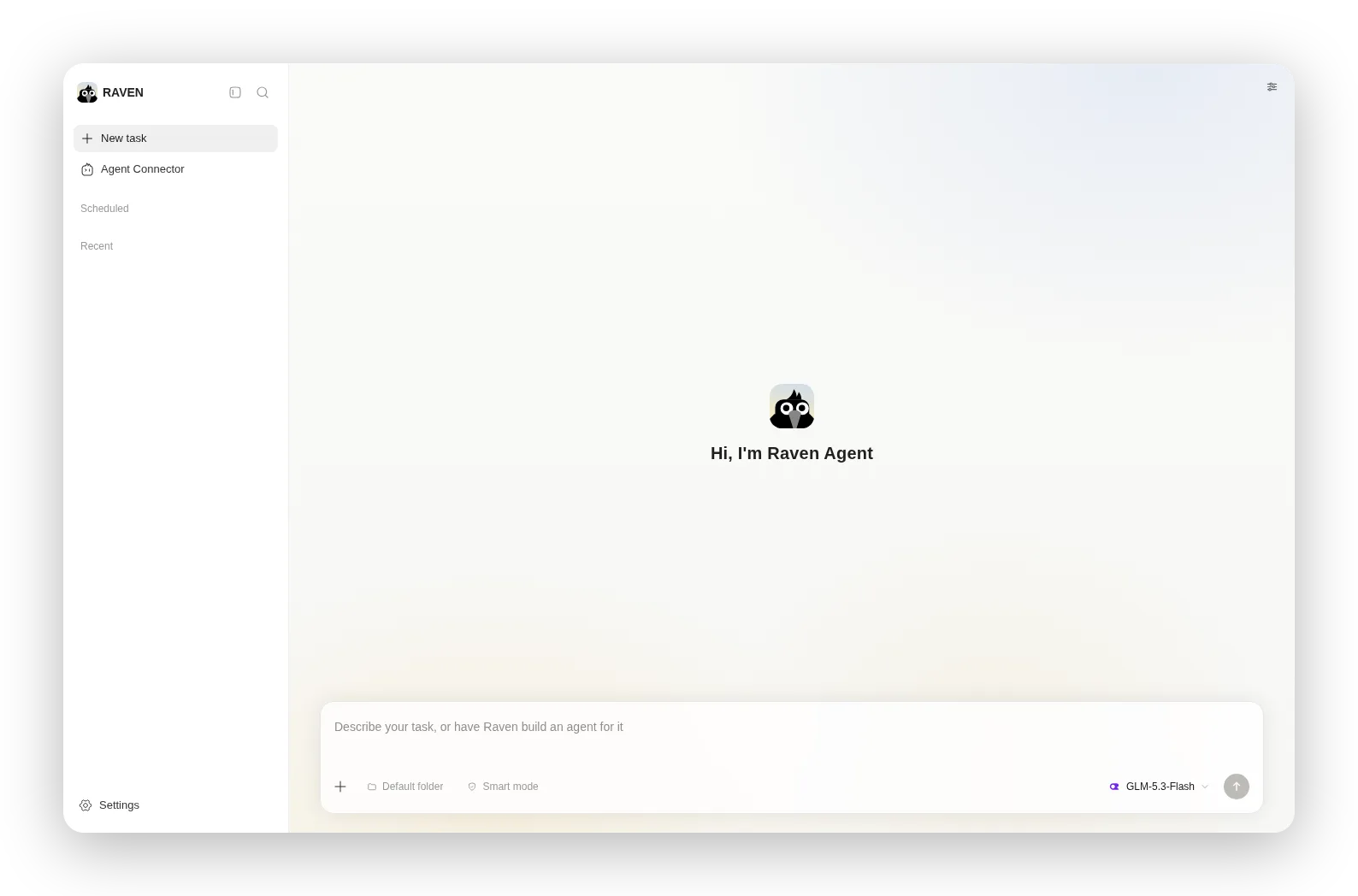
Or run it in Docker
With only Git and Docker Compose on the host, the bundled compose file brings Raven up and serves the page at http://localhost:18793.
git clone https://github.com/EverMind-AI/Raven.git
cd Raven
docker compose -f docker/docker-compose.yml up
Or install from a source checkout
Running `install.sh` from a clone installs Raven and its bundled plugins in editable mode against your working tree, and builds the TUI and WebUI from it.
git clone https://github.com/EverMind-AI/Raven.git
cd Raven
./install.sh
Commands and code are distilled from the project's own documentation — always check the official repo for the latest.
When to use it
- Hand one brief, such as research a market, build a site and produce a deck, to a single host that splits it across research, coding and design agents
- Drive Claude Code, Codex, OpenCode and other coding agents from one interface instead of juggling separate terminals
- Run long, unattended experiment or monitoring loops that keep going overnight and only ask for a human when judgment is needed
- Experiment with self-improving agent harnesses, where an agent's planning, tools and checks are revised and re-verified round after round
How Raven compares
Raven alongside other open-source multi-agent systems tools AI/TLDR tracks, ranked by GitHub stars.
| Tool | Stars | What it does |
|---|---|---|
| Paperclip | ★ 106k | A self-hosted control plane that runs a team of AI agents like a company, with an org chart, tasks, budgets and approvals. |
| Ruflo | ★ 78.5k | Agent meta-harness that wraps Claude Code and Codex with 100+ specialized agents, swarm coordination, vector memory, background workers and cross-machine agent federation. |
| MetaGPT | ★ 71k | A multi-agent framework that models a software company, assigning roles like product manager, architect, and engineer to generate code from a single prompt. |
| AutoGen | ★ 61.5k | Microsoft Research's framework for building applications where multiple agents converse with each other and with tools to solve tasks. |
| CrewAI | ★ 60k | A framework for assembling teams ('crews') of role-playing agents that divide tasks and collaborate to complete a goal. |
| AgentScope | ★ 33.7k | A framework for building multi-agent applications with message passing, visual debugging tools, and distributed execution. |
| OpenAI Agents SDK | ★ 30.2k | OpenAI's lightweight Python SDK for building multi-agent workflows using explicit handoffs, tools, and guardrails. |
| Raven | ★ 5.7k | EverMind's open-source host agent that plans a task as a DAG and hands each step to built-in or third-party agents such as Claude Code and Codex |