
What is Shirudo?
Shirudo (Japanese for "shield") is an open-source runtime from OpenAI and Cisco that helps operators protect running Linux systems while a permanent patch is being tested and deployed. It sits in the Security Agents category of the Agents & Automation tools and is open-source, written in C and licensed BSD-2-Clause.
Overview
Shirudo (Japanese for "shield") is an open-source runtime from OpenAI and Cisco that helps operators protect running Linux systems while a permanent patch is being tested and deployed. A shield is a temporary safeguard that blocks the behavior an exploit needs and lets legitimate requests through.
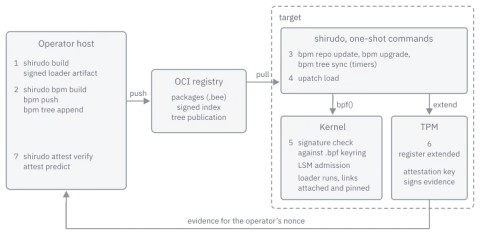
Shirudo is a BPF-based security platform. After boot-time initialisation it restricts BPF program loads from userspace to signed loaders. Operators ship signed micropatches called upatches, and a TPM-backed attestation step returns offline-verifiable evidence of which protections a target has loaded. Operators can monitor how a proposed shield would affect applications before they enforce it.
In a controlled test described by OpenAI, a shield generated with Codex blocked a Java4Shell exploit attempt against a running Elasticsearch service without a restart, by adding an input check to Java's Base64 decoder. The repository describes the project as pre-release. It is licensed BSD-2-Clause, with the BPF programs dual-licensed BSD and GPL.
What it does
- Temporary shields that block exploit behavior at kernel hooks or in Java application code
- Signed upatches: loaders are verified by the kernel against a sealed keyring, and Java upatches are verified in userspace
- Boot-time enforcement started by `shirudo init` from the initrd
- TPM measurement, with `shirudo attest` returning evidence that can be verified offline
- Pull-based delivery from OCI registries, with telemetry exported to OpenTelemetry collectors
- Observability through the `kernel-obs` package (process, network and privilege activity)
Getting started
The quickstart runs Shirudo in a local VM with a software TPM. It needs a Linux host on x86-64 or arm64 with KVM (on macOS, use a Lima VM), a C toolchain, clang/LLVM with the BPF target, OpenSSL 3.5 or newer and QEMU. The scripts stop at the first missing command and print how to install it.
Build and boot the test VM
Run these from the checkout root, in order.
testing/vm/kernel-artifact.sh fetch
make
make shirudo-build
export PATH="$PWD:$PWD/tools/shirudo-build:$PATH"
make -C testing vm VM_NAME=quickstart
make -C testing vm-ssh VM_NAME=quickstart
Check the runtime inside the VM
In the VM shell, alias the runtime and check its status.
alias shirudo=shirudo-runtime
cd /workspace/shirudo
shirudo status
Build a sample upatch on the operator host
The quickstart builds and signs the sample BPF fixture into a .upatch file.
KEYS=/tmp/shirudo-test-vm-private-$(id -u)/operator-keys/keys
shirudo build testing/fixtures/basic.bpf.c --keys-dir "$KEYS" --vmlinux vendor/linux/vmlinux.h -o basic.upatch
Load it on the target and stop the VM
Load the upatch inside the VM, then stop the VM when you are done.
shirudo upatch load basic.upatch

make -C testing vm-stop VM_NAME=quickstart
Commands and code are distilled from the project's own documentation — always check the official repo for the latest.
When to use it
- Reach for it to cover the gap between a vulnerability disclosure and a tested permanent patch on services you cannot restart
- Reach for it to preview how a proposed mitigation affects applications before enforcing it
- Reach for it when you need signed, auditable protections with TPM-backed evidence of what is loaded
- Reach for it to try AI-drafted mitigations such as Codex-generated shields in a controlled setting, with security teams deciding what ships
How Shirudo compares
Shirudo alongside other open-source security agents tools AI/TLDR tracks, ranked by GitHub stars.
| Tool | Stars | What it does |
|---|---|---|
| REA | ★ 476k | Open-source CLI and MCP server that lets coding agents reverse engineer apps locally, decompiling native binaries via Hopper or Ghidra and analysing JavaScript/Electron apps, recording each finding as reproducible evidence. |
| PentAGI | ★ 34.9k | PentAGI is a self-hosted AI security platform that plans and runs penetration tests autonomously using a team of agents and 20+ built-in pentesting tools. |
| PentestGPT | ★ 16.6k | An open-source agent that uses large language models to run penetration tests and solve security challenges, either fully autonomously or with a human in the loop. |
| HexStrike AI | ★ 13.9k | An MCP server that gives an AI agent a single interface to 150+ installed security tools — Nmap, Nuclei, SQLMap, Ghidra, Hashcat and more — so it can drive reconnaissance, scanning and binary analysis itself. |
| IDA Pro MCP | ★ 13.6k | An MCP server and IDA Pro plugin that exposes decompilation, cross-references, renaming and type editing to an LLM client, letting an agent read and annotate a binary inside your IDA database. |
| CAI | ★ 9.9k | CAI (Cybersecurity AI) is an open-source Python framework for building AI agents that automate offensive and defensive security tasks like recon, vulnerability discovery, and exploitation. |
| AI-Infra-Guard | ★ 7.6k | Tencent Zhuque Lab's AI red teaming platform: scans agents, Agent Skills and MCP servers, checks AI infra against a CVE library, fingerprints API relays and runs jailbreak evaluations. |
| Shirudo | ★ 321 | An eBPF runtime that blocks an exploit on a live Linux system with a signed temporary shield until the real patch ships |