Overview
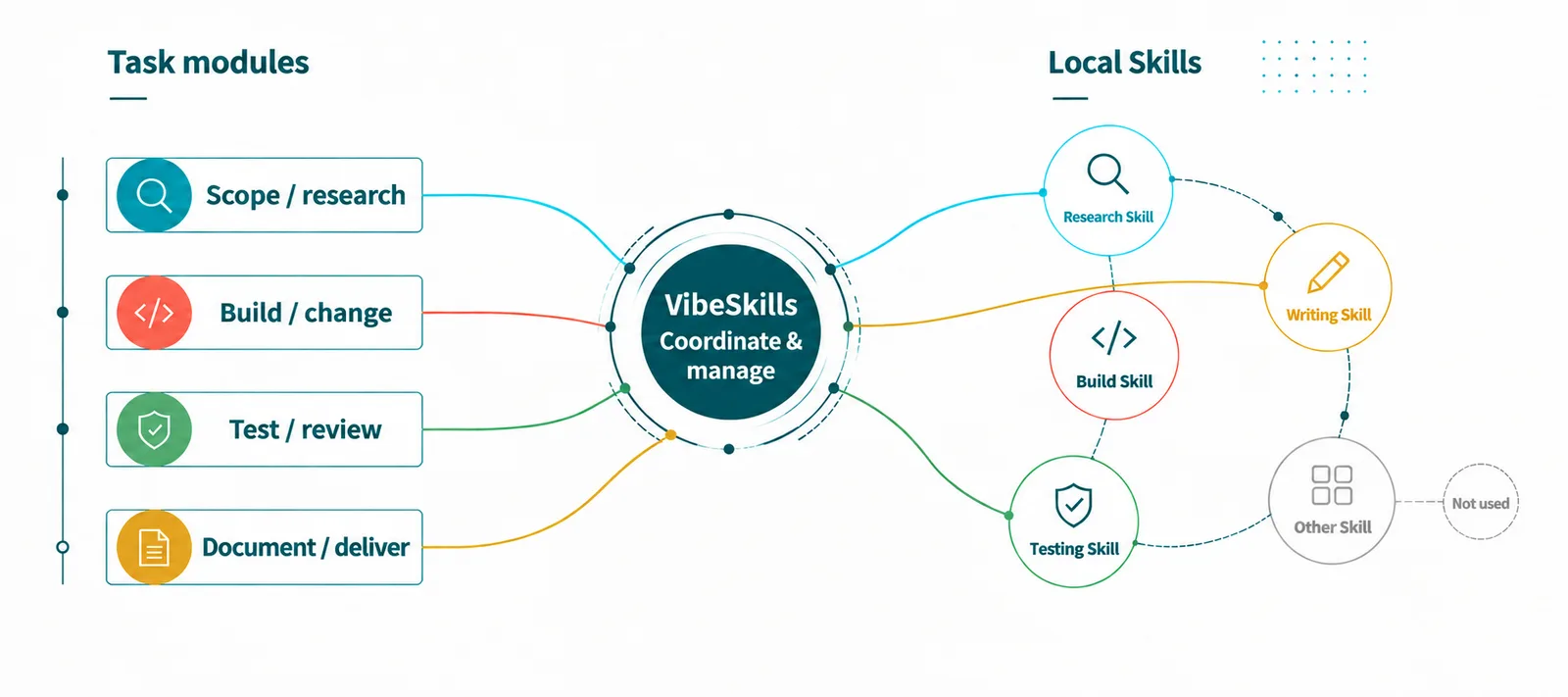
VibeSkills is a general-purpose Skill for AI agents that routes work to the other Skills you have installed and runs a planned workflow around them. Instead of hoping the agent notices the right Skill from a few keywords, you invoke `vibe` (as `$vibe`, `/vibe` or whatever syntax your application uses) and it scans the Skills directory plus any extra folders you configure, shortlists candidates per part of the task, and assigns each selected Skill to concrete work with an expected output and a check.
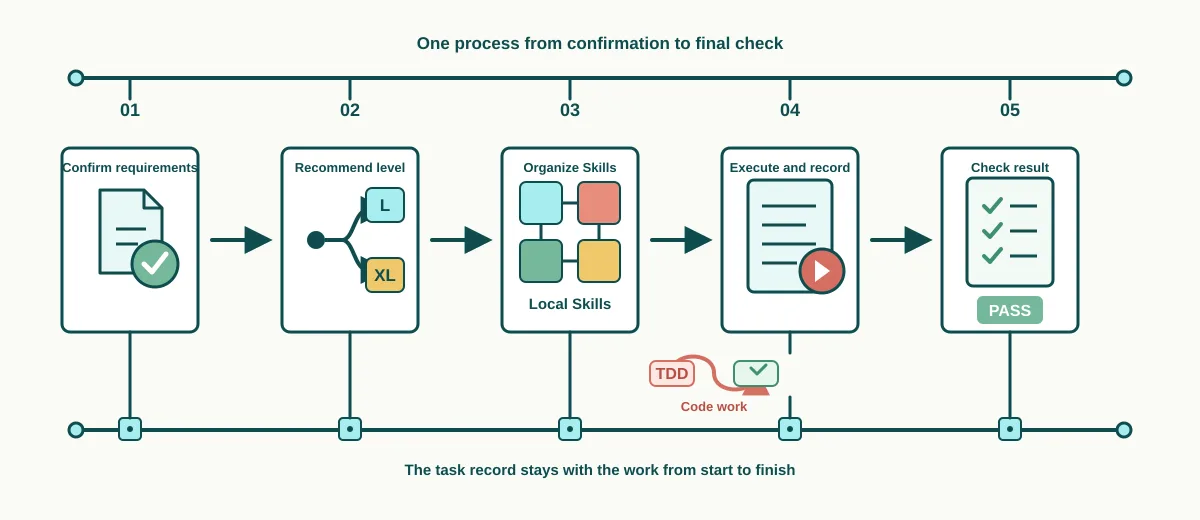
Every task follows one process: confirm the requirement (work stops until you approve it), recommend an `L` or `XL` level, organize Skills, execute and record, then check the result against every planned item. `L` works through the parts in order; `XL` breaks the task down further and can run up to two non-conflicting parts at the same time. Code work can enter a test-driven loop. Requirement, plan, progress and final check are kept in one task record (`module-work-plan.json`, `module-execution.json`, a delivery acceptance report), so a later session can resume and a reviewer can compare plan with outcome.
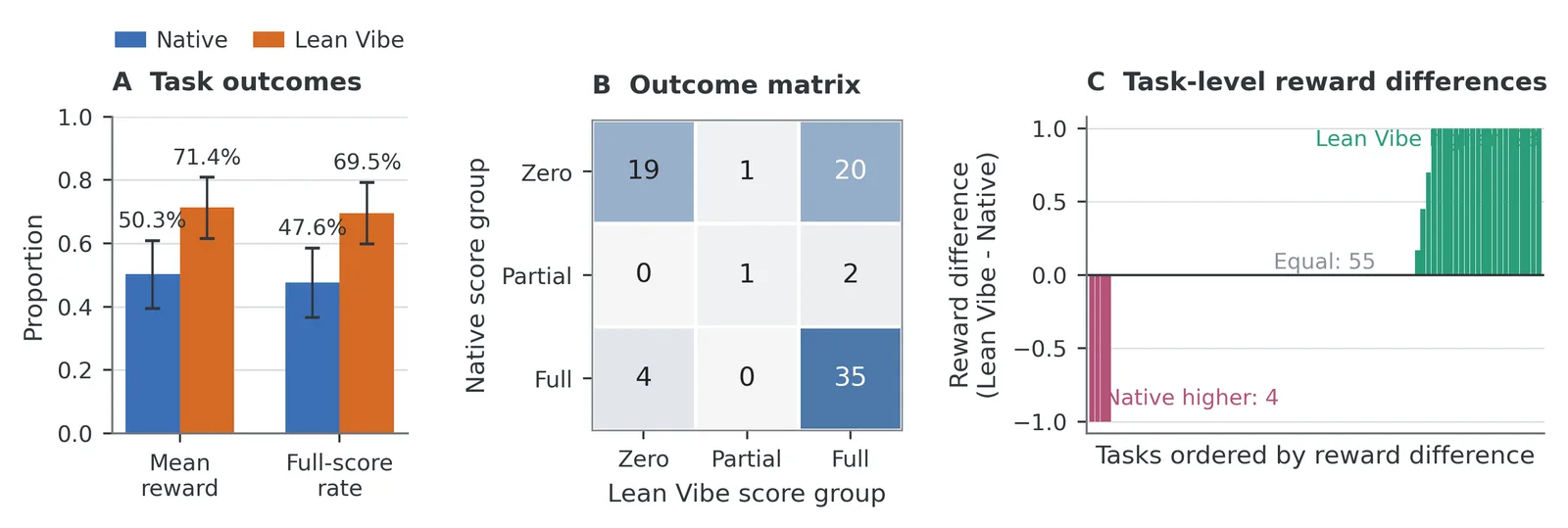
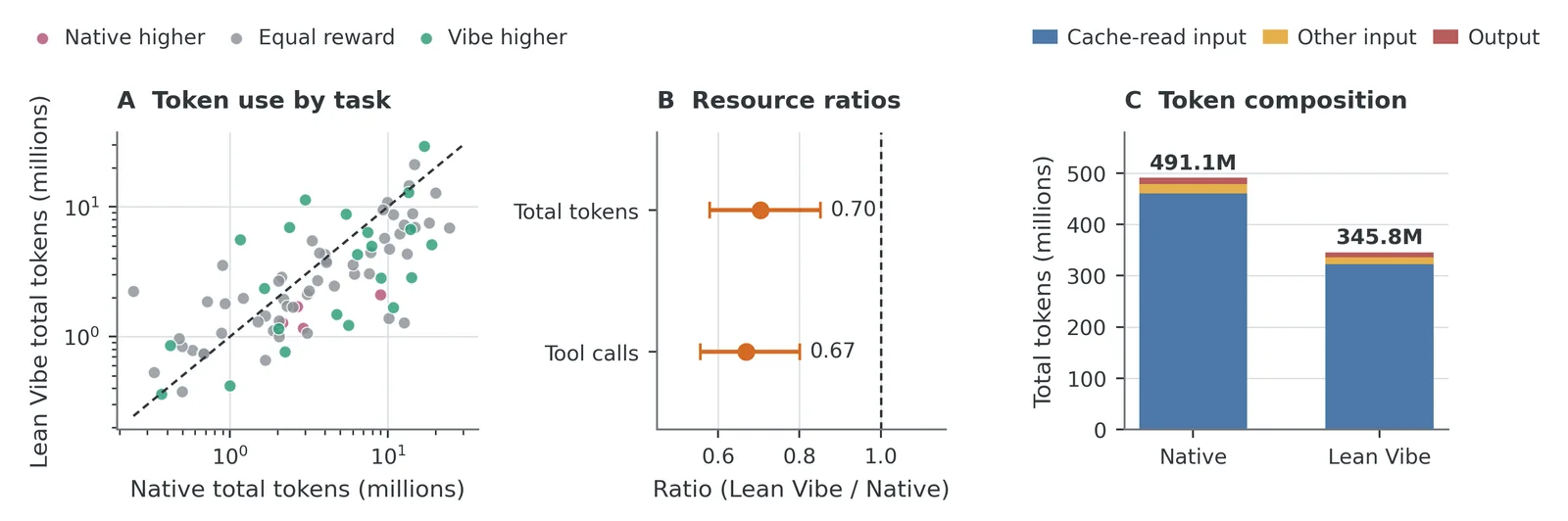
To keep a large library cheap, discovery and indexing happen locally: VibeSkills extracts each Skill's name, description, intended use and boundaries, and reads full `SKILL.md` files only for shortlisted candidates. The project says it follows harness frameworks similar to Superpowers and GSD, and reports its own SkillsBench study: in a modified setting where every task sees all 195 specialized Skills, with DeepSeekV4Flash-VE and OpenHands, it claims mean verifier reward rose from 50.3% to 71.4% (+21.12 pp), total tokens fell 29.6% and tool calls 33.1% versus the baseline without it. It is Apache-2.0 licensed and mostly Python, with Bash and PowerShell installers.
What it does
- Scans the shared Skills directory and extra folders listed in `skill-roots.json`, then selects only the Skills that fit each part of a task
- Requirement confirmation and plan approval gates before execution, with `L` (sequential) and `XL` (finer breakdown, up to two parallel parts) levels
- Records planned versus actual Skill assignments, progress and completed, failed or blocked states so a later session can continue
- Final acceptance check compares the result with every planned item; incomplete required work blocks delivery
- Local index and candidate shortlisting so only retained `SKILL.md` files enter the model context
- One install layout for any application that supports local Skills, with install, check and update scripts for Bash and PowerShell
Getting started
The public install path uses a published release ZIP, not a repository checkout (a checkout is for development only). The installer writes the same runtime to `<SkillsDir>/vibe` in every application; only the Skills directory and the invocation syntax change. The default directory is `~/.agents/skills`; pass `~/.claude/skills` or `~/.codex/skills` instead if that is what your application scans.
Download and extract a release
Download the public ZIP from the project's GitHub Releases page, verify it against the SHA-256 digest shown for the asset, and extract it outside the managed Skills directory.
Install and check
Run the wrappers from the extracted folder. `check` verifies the files recorded in the install receipt at `<SkillsDir>/vibe/.vibeskills/install-receipt.json`. On Windows use `install.ps1` / `check.ps1` with `-SkillsDir`.
bash ./install.sh --skills-dir "$HOME/.agents/skills"
bash ./check.sh --skills-dir "$HOME/.agents/skills"
Add more Skill folders (optional)
Besides the shared Skills directory, list extra local folders in `~/.vibeskills/skill-roots.json` (user level) or `<workspace>/.vibeskills/skill-roots.json` (workspace level). A Skill needs a readable `SKILL.md` and a non-conflicting name to be selectable.
Invoke it on a task
In your AI application's Skills entry, call `$vibe`, `/vibe` or the syntax it provides, describe the task, then approve the requirement and the plan when asked. To update, extract a newer release and run `update.sh` (or `update.ps1`) against the same directory; to remove, delete `<SkillsDir>/vibe`.
bash ./update.sh --skills-dir "$HOME/.agents/skills"
bash ./check.sh --skills-dir "$HOME/.agents/skills"
Commands and code are distilled from the project's own documentation — always check the official repo for the latest.
When to use it
- Get an agent to use the right Skills from a library of dozens or hundreds without naming them yourself
- Run multi-step deliverables, such as an experiment with a report and a slide deck, as a planned, checked workflow
- Resume a long task in a later session from its saved plan and progress
- Review afterwards which Skills were planned, which actually took part, and which checks passed
How VibeSkills compares
VibeSkills alongside other open-source agent skills & plugins tools AI/TLDR tracks, ranked by GitHub stars.
| Tool | Stars | What it does |
|---|---|---|
| Superpowers | ★ 304k | A composable skills plugin that installs a spec-first, TDD, subagent-driven development methodology into Claude Code, Codex, Cursor, Gemini CLI and other coding harnesses. |
| Skills for Real Engineers | ★ 301k | Matt Pocock's everyday agent skills for coding agents, covering alignment grilling, planning, code review and research — small, composable and meant to be edited. |
| ECC | ★ 287k | An installable plugin that adds 68 agents, 286 skills, hooks, rules, memory and an agent-config security scanner to Claude Code, Codex and other coding harnesses. |
| Karpathy Coding Guidelines | ★ 223k | A Claude Code plugin and CLAUDE.md rule set built from Andrej Karpathy's observations on LLM coding pitfalls: think before coding, keep it simple, make surgical changes, and work to verifiable success criteria. |
| Ponytail | ★ 174k | A skill and plugin that makes a coding agent take the laziest correct route — a seven-rung ladder from "does this need to exist?" to "the minimum that works" — while keeping validation, security and accessibility off the chopping block. |
| Caveman | ★ 114k | A skill plus local proxy that shortens an AI coding agent's prose while leaving code, commands and paths untouched — the rule file cuts what the agent writes, the proxy compresses what it reads. |
| Addy’s Agent Skills | ★ 110k | A pack of production engineering skills for AI coding agents, with nine lifecycle slash commands — /spec, /plan, /build, /test, /review, /ship — installable into 70+ agents. |
| VibeSkills | ★ 3.8k | One Skill that picks the right local Skills for each part of a task and checks the result |