In plain English
The orchestrator-worker pattern is a way of organizing multiple AI agents where one lead agent (the orchestrator) breaks a job into sub-tasks and hands each sub-task to a worker agent. The workers do the actual execution — web searches, code runs, database lookups — and report their results back. The orchestrator collects those results and assembles the final answer. It plans; they execute.
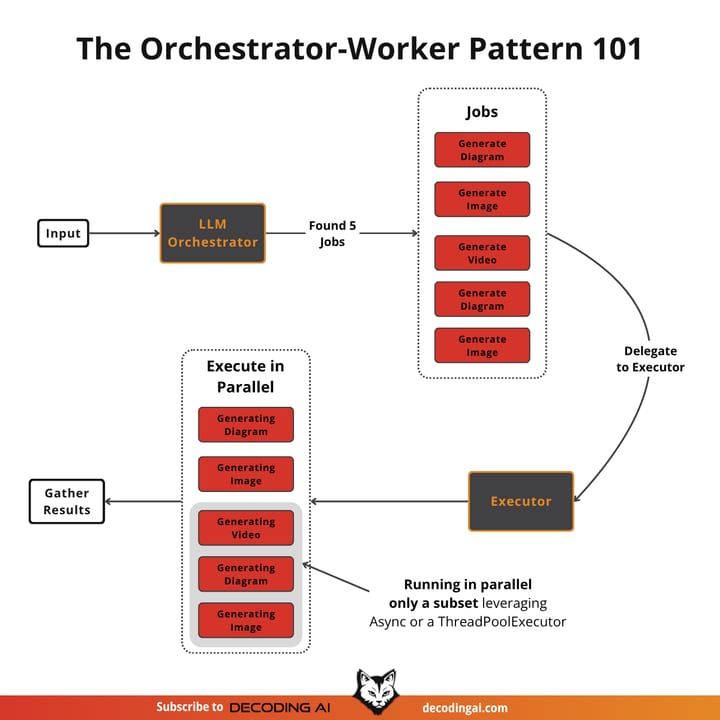
Think of a general contractor renovating a house. The contractor doesn't swing a hammer — they draw up the plan, order materials, and dispatch specialized tradespeople: one team for plumbing, another for electrical, another for drywall. Each team works in their own lane and delivers a finished piece; the contractor assembles it all into a move-in-ready home. The orchestrator is the contractor, the workers are the tradespeople, and the finished house is the final agent output.
In AI, this usually means the orchestrator is an LLM running a planning loop — it decides what needs to be done, writes a detailed brief for each worker, and spawns them as separate model calls with their own system prompts, tools, and isolated context windows. Workers can run in parallel (all at once, for independent sub-tasks) or in sequence (one feeds the next, when there are dependencies). The workers never see each other's reasoning; only the orchestrator sees their finished outputs.
Why it matters
A single agent handling a complex task has three failure modes that the orchestrator-worker pattern directly addresses. First, tool overload: give one agent twenty tools and it reliably picks the wrong one. A worker agent that only has three relevant tools almost never misfires. Second, context pollution: when one LLM reads twenty web pages, writes a plan, runs some code, and writes a draft all in one context window, the early reading degrades the late writing. Worker agents each get a clean context for their one slice of work. Third, serial bottlenecks: one agent working step-by-step through a ten-part task is slow. Parallel workers collapse wall-clock time on independent sub-tasks.
Anthropic's own multi-agent research system, which uses this exact pattern, outperformed a single Claude Opus agent by 90.2% on internal research evaluations — by spinning up 3–5 parallel search subagents per question and synthesizing their findings with a final citation pass. The cost trade-off was roughly 15x the tokens of a single chat. That ratio — big quality gain, steep cost — is the honest case for the pattern.
When the pattern pays off
- Breadth-first research: questions whose answer requires exploring many independent paths at once, where the total information exceeds one context window.
- Long multi-stage pipelines where each stage needs different tools and a fresh prompt, like extract → summarize → verify → format.
- Enterprise workflows spanning separate domains (billing, account, policy) where each domain agent can be built, tested, and updated independently.
- Tasks that exceed a single context window — the orchestrator can keep only summaries of worker outputs, keeping its own context lean.
How it works
The pattern has three structural phases: fan-out (the orchestrator decomposes the task and dispatches workers), execution (workers run their own agent loops with their own tools), and fan-in (the orchestrator collects results and synthesizes the final output). This is also called scatter-gather in distributed systems literature.
In the fan-out phase, the orchestrator takes the user's goal and produces a task plan — usually a structured list of sub-tasks. For each sub-task it writes a delegation prompt: a self-contained brief that tells the worker exactly what to do, what output format to return, and which tools to use. The workers receive nothing except this brief and the tools they were given at initialization. They have no visibility into the orchestrator's own reasoning or what other workers are doing.
In the execution phase, each worker runs a full agent loop — perceive, plan, act, observe — using only its own tools and its own context. A research worker might call a web-search tool five times, extract the relevant passages, and return a structured summary. It never accumulates the orchestrator's full context, which is what keeps the whole system from blowing up memory-wise. If a worker fails, the orchestrator can retry that one sub-task without re-running everything else.
In the fan-in phase, the orchestrator receives each worker's result (text, structured JSON, or a tool-call return) and runs one final synthesis step — often another LLM call — that weaves the pieces into a coherent, deduplicated response. The quality of this synthesis step is where most orchestrator designs differ. A weak synthesizer that just concatenates answers adds noise; a strong one resolves conflicts, drops duplicates, and crafts a single coherent output.
Parallel vs. sequential workers
Parallel dispatch is the default when sub-tasks are independent. An orchestrator researching 'AI chip supply chain' might spawn one worker per regional market — North America, Europe, Asia — all fetching simultaneously. Total elapsed time equals the slowest worker, not the sum of all workers. Sequential dispatch is required when there's a data dependency: a 'fact-checker' worker must wait for the 'researcher' worker's output, so those run in order. Most real orchestrators mix both: a parallel fan-out across independent branches, with sequential steps inside each branch.
Comparing multi-agent architectures
The orchestrator-worker pattern is one of five main coordination topologies used in production. Knowing the alternatives tells you when not to reach for an orchestrator.
| Pattern | Control model | Best for | Main weakness |
|---|---|---|---|
| Orchestrator-worker | Centralized — all coordination flows through one lead agent | Parallel independent sub-tasks; breadth-first research; domain-specialized workers | Single point of failure; orchestrator context can overflow at 4+ workers |
| Sequential pipeline | Linear — each stage passes output to the next | Fixed, predictable stage sequences with clear stage boundaries | No parallelism; high latency on long chains; brittle to stage failures |
| Swarm (decentralized) | None — agents self-organize and communicate peer-to-peer | Large unknown solution spaces; emergent exploration | Hard to debug, trace, or predict; no guaranteed convergence |
| Debate / critic | Adversarial — agents argue and iterate toward consensus | Decisions requiring multiple perspectives; reducing sycophancy | High token cost; agents can collapse to majority opinion rather than truth |
| Hierarchical (multi-tier) | Nested orchestrators — supervisors manage sub-orchestrators | 50+ agents across multiple business domains; enterprise-scale automation | Coordination overhead multiplies at each tier; hard to tune |
The orchestrator-worker pattern is the most widely deployed in production as of 2025. Microsoft, Databricks, and Anthropic all publish reference architectures centered on it. The recommendation from practitioners across the board: start centralized (orchestrator-worker), and only move to a more decentralized topology like swarms when you have a concrete, measured reason — most teams never need to.
Orchestrator-worker vs. sequential pipeline
A pipeline is simpler but serial — stage 3 can't start until stage 2 finishes. An orchestrator can run all stages in parallel if they're independent, then merge. The right question is whether stages depend on each other's output. If stage B genuinely needs stage A's result as input, you have a pipeline dependency and the orchestrator gains nothing over a simple pipeline for those two stages. If stages are truly independent — parallel research threads, simultaneous data pulls — the orchestrator's fan-out is a direct latency win.
Orchestrator-worker vs. debate / critic
In a debate setup, two or more agents produce competing answers to the same question and then argue — critiquing each other's reasoning until they converge or a judge decides. This is excellent for catching errors a single agent would confidently make, but research shows that in homogeneous configurations (same model for all agents) debate systems frequently collapse to majority opinion rather than truth — a form of sycophancy at the system level. Debate appears in only about 4% of surveyed production multi-agent systems. Orchestrator-worker wins on reliability; debate wins on adversarial robustness for high-stakes decisions.
Building one: a practical sketch
Here is a minimal Python implementation that shows the pattern's core structure using the Anthropic SDK. An orchestrator receives a research goal, dispatches two independent worker agents in parallel via concurrent.futures, and merges their outputs in a final synthesis call.
import anthropic
from concurrent.futures import ThreadPoolExecutor, as_completed

client = anthropic.Anthropic()
MODEL = "claude-opus-4-8"


def worker(role: str, brief: str) -> str:
    """One worker agent — isolated system prompt, fresh context, own tools."""
    resp = client.messages.create(
        model=MODEL,
        max_tokens=1024,
        system=f"You are a {role}. Answer ONLY the brief given. Be concise.",
        messages=[{"role": "user", "content": brief}],
    )
    return resp.content[0].text


def orchestrator(goal: str) -> str:
    # --- Phase 1: plan (orchestrator LLM call) ---
    plan_resp = client.messages.create(
        model=MODEL,
        max_tokens=512,
        system=(
            "You are an orchestrator. Split the user goal into exactly 2 "
            "independent research briefs. Return JSON: "
            '{"briefs": [{"role": "...", "brief": "..."}, ...]}'
        ),
        messages=[{"role": "user", "content": goal}],
    )
    import json
    plan = json.loads(plan_resp.content[0].text)

    # --- Phase 2: fan-out (parallel workers) ---
    results = {}
    with ThreadPoolExecutor(max_workers=2) as pool:
        futures = {
            pool.submit(worker, item["role"], item["brief"]): i
            for i, item in enumerate(plan["briefs"])
        }
        for future in as_completed(futures):
            results[futures[future]] = future.result()

    # --- Phase 3: fan-in (orchestrator synthesizes) ---
    notes = "\n\n---\n\n".join(results[i] for i in sorted(results))
    synth = client.messages.create(
        model=MODEL,
        max_tokens=1024,
        system="You are an orchestrator. Synthesize the worker notes into one clear answer.",
        messages=[{"role": "user", "content": f"Goal: {goal}\n\nWorker notes:\n{notes}"}],
    )
    return synth.content[0].text


if __name__ == "__main__":
    print(orchestrator("What are the main trade-offs of on-premise vs. cloud AI inference?"))
Notice the three distinct LLM calls: one for planning, N for workers (here running in parallel via threads), and one for synthesis. Each worker receives only its own brief and has no shared memory with siblings. In a production system you would add retries around each worker call, structured output validation on the plan, and a token budget check before fan-out to avoid context overflow on the synthesis step.
Framework support
You don't have to hand-roll this. The pattern has first-class support across the major agent frameworks:
- LangGraph —
StateGraphwith a supervisor node and worker sub-graphs is the most widely deployed enterprise implementation. LangGraph's graph-native state management maps directly onto how orchestrator-worker flows behave in production. - Anthropic Agent SDK — spawn subagents as tools; the SDK handles message routing and context isolation natively. Anthropic's own research system is built this way.
- Microsoft Agent Framework (merged AutoGen + Semantic Kernel, GA Q1 2026) —
GroupChatwith a speaker-selection policy that routes turns to the right worker; deep Azure integration for enterprise deployments. - CrewAI — first-class 'crew with manager' mode where a manager LLM decomposes tasks and assigns them to role-defined crew members; popular for business process automation.
Common pitfalls and how to avoid them
The orchestrator-worker pattern has a set of failure modes that appear reliably enough across production deployments that they're worth naming up front.
Vague delegation prompts
The most common production failure is an orchestrator that delegates too vaguely. If two workers receive briefs like 'research the supply chain situation,' they will frequently duplicate each other's work — one searches 2024 data, another searches the same thing from a slightly different angle. Anthropic's own post-mortem on their research system found workers duplicating searches when briefs were short. The fix: each delegation brief must specify the objective, the exact scope (time range, geography, aspect), the output format, and an explicit note about what the other workers are covering so the worker can stay in its lane.
Orchestrator context overflow
The orchestrator accumulates worker results in its own context. With four or more workers returning verbose outputs, the synthesis call can overflow the model's context window — or hit the performance cliff where models lose coherence on very long inputs. Mitigations: require workers to return structured summaries, not raw scrapes; set a token budget per worker; and consider a two-pass synthesis (first compress each worker's output, then synthesize the compressed versions).
Single point of failure
The orchestrator is a centralized bottleneck. If it misclassifies a task during planning — for example, routing a billing question to a technical support worker — every downstream worker acts on the wrong brief. Anthropic's analysis of 200+ enterprise agent deployments found that 57% of project failures originated in orchestration design (specifically task decomposition errors). Treating the orchestrator's planning step with the same care as a production classifier — with evals and test cases — is essential before shipping.
Missing failure strategy
When one worker fails, you have three options: fail-fast (abort the whole task — safest but most disruptive), best-effort (continue with the results you have — works if the failed worker's output is optional), or retry (re-run the failed worker before synthesizing — right when completeness is critical). Choosing a failure strategy before deployment is not optional. Teams that skip this step spend their first production incident discovering that an unhandled exception in one worker silently produces a hallucinated synthesis.
Going deeper
Once the basic pattern is running in production, the interesting design questions are about making it reliable at scale — where 'scale' means more workers, more complex task graphs, and organizational complexity that outlives any single engineer.
Hierarchical orchestration
For systems with 50 or more agents spanning multiple business domains — customer support, sales ops, IT automation — a flat orchestrator managing all workers becomes unmanageable. The solution is a supervisor of supervisors: domain-level orchestrators manage their own worker pools, and a top-level coordinator routes incoming tasks to the right domain orchestrator. Databricks' production reference architecture uses exactly this pattern for enterprise AI at scale. The trade-off is coordination overhead at each tier: errors in higher-level orchestrators cascade further, and tracing a failure across three tiers requires purpose-built observability tooling.
Dynamic vs. static task graphs
A static orchestrator always decomposes a task the same way — three fixed workers, fixed briefs, fixed synthesis. A dynamic orchestrator plans at runtime: it decides how many workers to spawn, what role each plays, and which can run in parallel, based on the specific input. Dynamic orchestrators are more powerful but harder to test and evaluate. A good middle ground: use a static graph for the overall flow but let the orchestrator write each worker's brief dynamically based on the actual input. This limits the combinatorial space of behaviors while preserving adaptability.
Shared memory and coordination
Workers that need to share intermediate findings without routing everything through the orchestrator can write to a shared scratchpad — a key-value store or vector database that all agents can read and write. This is powerful (workers build on each other's partial results) but reintroduces coupling. The practical rule: use shared memory only when the orchestrator-as-hub creates a measurable bottleneck, and version-control entries so workers don't silently overwrite each other's findings.
Evaluating orchestrator systems
You can't unit-test a multi-agent system the way you test normal code — the non-determinism and multi-step nature make individual assertions brittle. Instead, build end-to-end evals that score whether the system reached the goal across many runs. For an orchestrator-worker research system, that means: does the final answer correctly cover all required facets, without hallucinated claims, within the target token budget? Trace every agent call with a tool like LangSmith or Anthropic's tracing so you can replay failures and see exactly which worker produced the bad output. LLM-as-a-judge scoring can automate quality assessment at scale once you have human-labeled calibration examples.
When to switch architectures
The orchestrator-worker pattern is the right default for most multi-agent work. Consider moving to a different topology only when you have evidence — not intuition — that the centralized model is the bottleneck. Signs that a swarm might outperform: the task space is so large and unknown that no single orchestrator can plan it reliably, and you have the tooling to observe emergent agent behavior. Signs that a debate pattern might be worth the cost: you have a high-stakes single-answer decision where majority-opinion sycophancy is a measured problem and you need adversarial robustness. In the vast majority of cases, a well-built orchestrator-worker system with strong delegation prompts and a solid synthesis step outperforms more exotic topologies in production.
FAQ
What is the orchestrator-worker pattern in multi-agent AI?
It's an architecture where one lead agent (the orchestrator) breaks a goal into sub-tasks, dispatches each to a specialized worker agent, and synthesizes their results into a final answer. The orchestrator plans and delegates; the workers execute in isolated contexts with their own tools. All coordination flows through the orchestrator — workers never communicate directly with each other.
How is the orchestrator-worker pattern different from a sequential pipeline?
A pipeline runs agents one after another in a fixed order — each stage waits for the previous to finish. An orchestrator-worker setup can run independent workers in parallel (fan-out), then merge results (fan-in). If your sub-tasks depend on each other's outputs, you effectively have a pipeline and the orchestrator adds overhead without gain. If sub-tasks are independent, the orchestrator's parallel dispatch cuts wall-clock time significantly.
Can workers in the orchestrator-worker pattern communicate with each other?
In the standard pattern, no — workers are isolated and route everything through the orchestrator. Some advanced designs add a shared scratchpad (a key-value store or vector database) that workers can read and write to share intermediate findings. This increases power but reintroduces coupling, so most practitioners avoid it unless the orchestrator-as-hub is a measurable bottleneck.
What is the biggest risk of the orchestrator-worker pattern?
The orchestrator is a single point of failure. If it produces a bad task decomposition or writes vague delegation prompts, every worker acts on incorrect information and the final synthesis is wrong. Anthropic's analysis of enterprise deployments found that most failures trace back to orchestration design — specifically task decomposition errors — rather than individual worker failures. Treating the planning step with the same rigor as a production classifier, including evals, is essential.
Which AI frameworks implement the orchestrator-worker pattern?
LangGraph (a StateGraph with a supervisor node) is the most widely deployed enterprise implementation. The Anthropic Agent SDK supports subagent spawning natively. Microsoft's Agent Framework (merged AutoGen + Semantic Kernel) uses GroupChat with a speaker-selection policy. CrewAI's 'crew with manager' mode is popular for business process automation. All of them implement 'spawn a worker' as a tool call, using the same function-calling infrastructure as any other tool.
How much does an orchestrator-worker setup cost compared to a single agent?
Typically 10–20x more tokens for the same task, because you're paying for a planning call, N worker calls, and a synthesis call instead of one agent call. Anthropic's research system (3–5 parallel workers) cost roughly 15x a normal chat call. The payoff is quality and speed on parallel tasks. Token budget should be a first-class design constraint: cap the number of workers, require compressed worker outputs, and measure cost-per-query in staging.