In plain English
Modern chat models don't become helpful and polite by accident. After a base model finishes learning language from raw text, it goes through an alignment step that teaches it which answers people actually prefer. The classic recipe for that step is RLHF — reinforcement learning from human feedback. Real people compare two model answers and pick the better one, thousands of times, and the model is tuned to produce more of what humans like. If RLHF is new to you, start with what is RLHF — this article assumes the gist and focuses on what changes when you swap the humans out.
RLAIF — reinforcement learning from AI feedback — keeps the same machinery but replaces the human labelers with another AI model. Instead of a person reading two answers and choosing, a capable model reads them and chooses, guided by a written set of rules. The training loop barely changes; only the source of the preference labels does.
Picture grading a huge pile of essays. RLHF is hiring a room full of human graders: careful, but slow and expensive, and they get tired. RLAIF is writing a crisp grading rubric and handing it to a fast, tireless assistant who grades every essay the same way at 3 a.m. for almost no cost. The assistant is only as good as the rubric and its own judgment — but it never sleeps, and it scales to a million essays without flinching.
Why it matters
Alignment used to bottleneck on people. Collecting human preference labels is the slowest, priciest, and least scalable part of building a helpful model, and that single fact is why RLAIF exists.
- Cost. Every human comparison costs money and minutes. A serious preference dataset can run into hundreds of thousands of labels; paying skilled annotators for all of them is a major line item. An AI labeler costs a fraction of a cent per comparison and runs around the clock.
- Scale. You can't ask humans to label everything. Want feedback on millions of prompts, across dozens of languages and edge cases? Human throughput simply doesn't get there. An AI labeler scales with compute, not headcount.
- Speed and consistency. Humans disagree with each other and even with themselves on different days. A single AI judge applies the same written criteria identically to every pair, so the signal is more uniform (for better and worse — see the pitfalls).
- Sensitive content. Some alignment work means labeling toxic, graphic, or distressing material. Routing that to an AI labeler spares human annotators the psychological toll.
Who cares about this? Anyone fine-tuning a model on preferences, any lab trying to align a model cheaply at scale, and any team that wants its model's values written down and auditable rather than buried in a private labeling guide. RLAIF doesn't make human feedback obsolete — it makes it affordable to do far more alignment than humans alone ever could, and it shifts the human effort from grading millions of answers to writing the few principles the AI grader follows.
How it works
Both methods follow the same three-stage preference-training pipeline. The only thing that differs is who produces the preference labels in stage one.
The shared pipeline
- Collect preferences. Show the model a prompt, sample two (or more) candidate answers, and decide which is better. This is the labeling step — humans in RLHF, an AI judge in RLAIF.
- Train a reward model. Feed those preference pairs to a smaller model that learns to predict a score: higher for answers the labeler preferred. The reward model turns scattered comparisons into a smooth signal you can optimize against.
- Optimize the policy. Use reinforcement learning (commonly PPO, or a simpler direct method like DPO) to nudge the main model toward answers the reward model scores highly, while a penalty keeps it from drifting too far from the original model.
How the AI judge actually labels
In RLAIF, the AI labeler isn't guessing in a vacuum. You give it a written rubric — Anthropic calls it a constitution — and ask it to choose the better answer according to those principles. The prompt to the judge looks roughly like this:
You are comparing two assistant answers. Choose the one that is
more helpful, honest, and harmless, following these principles:
 - Prefer answers that are accurate and admit uncertainty.
 - Prefer answers that decline clearly harmful requests.
 - Prefer answers that are concise and on-topic.

Prompt: How do I reset my password?
Answer A: <first candidate>
Answer B: <second candidate>

Which answer is better, A or B? Reply with just the letter.
The judge's letter (A or B) becomes one preference label — exactly the kind a human would have produced, but generated in milliseconds. Repeat across millions of prompts and you have a full preference dataset with no human in the per-label loop. The humans' real job moved upstream: writing and refining that short list of principles.
RLHF vs RLAIF compared
Same pipeline, different labeler — but that one swap ripples into cost, scale, speed, and the kind of mistakes you inherit. Here is the head-to-head.
| Dimension | RLHF (human feedback) | RLAIF (AI feedback) |
|---|---|---|
| Who labels | Paid human annotators | A capable LLM judge |
| Cost per label | High — wages and review time | Tiny — fractions of a cent |
| Scale | Limited by headcount | Limited only by compute |
| Speed | Days to weeks | Hours, runs 24/7 |
| Consistency | Varies by person and day | Uniform per fixed rubric |
| Quality ceiling | Bounded by human care/skill | Bounded by the judge model |
| Main risk | Slow, costly, annotator fatigue | Inherits the judge's blind spots |
| Auditability | Private labeling guidelines | Written constitution you can read |
The deepest difference is the quality ceiling. RLHF can, in principle, capture nuance a human notices that no rubric anticipated. RLAIF can only be as discerning as the judge model and the principles it was given — if the judge can't tell two subtle answers apart, neither can your labels. The flip side: a strong judge applies its (good) taste with a consistency no tired human can match, which is often a net improvement on noisy human data.
- Nuanced human judgment is the whole point
- The domain is high-stakes (medical, legal)
- You have budget for careful annotators
- No model is trustworthy enough to judge
- You need millions of labels cheaply
- Your criteria fit a clear written rubric
- A strong, trusted judge model exists
- You want auditable, editable values
Common pitfalls
RLAIF's biggest danger is also its biggest selling point: one judge, applied uniformly to everything. If that judge is wrong in some systematic way, it's wrong everywhere, and your trained model learns the mistake at scale.
- Inherited bias. The judge brings its own blind spots — cultural, political, stylistic. RLHF averages over many humans' biases; RLAIF concentrates one model's biases into every label. See measuring LLM bias.
- Sycophancy and style-over-substance. AI judges often reward answers that sound confident, long, or agreeable over ones that are actually correct, which can teach the model to flatter and pad. This is closely tied to LLM sycophancy.
- Weak rubric, weak labels. A vague or contradictory constitution produces vague, contradictory preferences. The principles are now load-bearing — sloppy wording shows up directly in the model's behavior.
- Self-preference loops. If the same model family both generates answers and judges them, it can quietly favor its own style, reinforcing quirks instead of correcting them.
- No human check. Shipping a fully AI-labeled run with zero human spot-checking means nobody ever notices when the judge drifts off the rails.
Going deeper
Once the human-vs-AI-labeler distinction clicks, a few deeper threads are worth knowing.
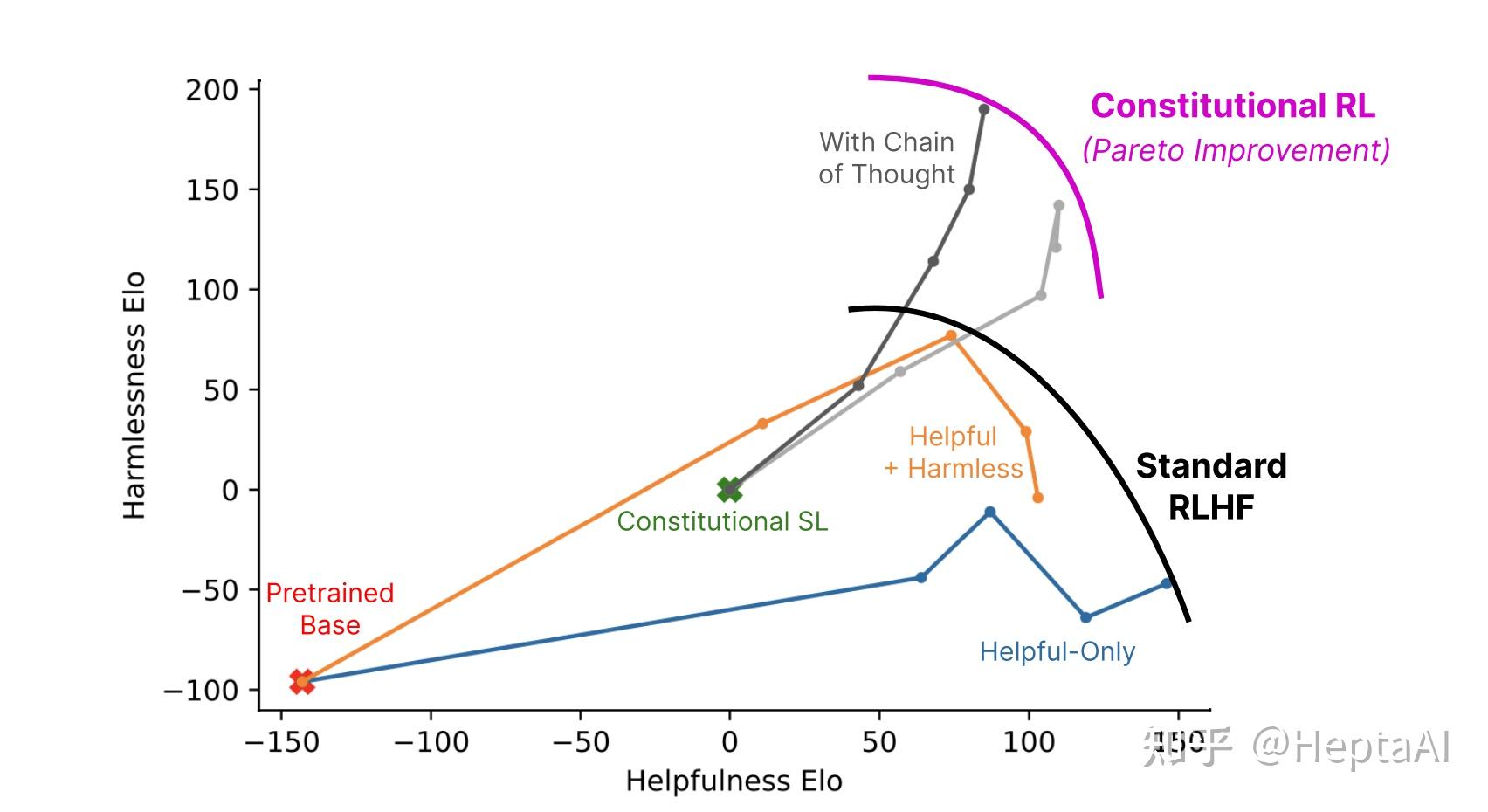
Constitutional AI is more than RLAIF. Anthropic's recipe has two stages. First, a supervised stage where the model critiques and rewrites its own answers against the constitution, producing better training examples. Then an RL stage that is RLAIF proper: the model judges pairs of answers by the same constitution to build the preference data. The constitution — a short, human-written list of principles — is the human contribution that the AI then applies at scale. Walk through it in Constitutional AI explained.
It's rarely all-or-nothing. The most common production setup is a blend: humans write the principles and label a high-quality seed set, AI scales the labeling to the long tail, and humans audit samples and the hardest cases. RLHF and RLAIF are dials on the same board, not enemy camps. You choose how much of the labeling budget goes to people versus models based on stakes and cost.
The reward model can be skipped. Newer direct-preference methods like DPO optimize the model straight from preference pairs without training a separate reward model and without classic RL rollouts. Whether those pairs came from humans or an AI judge is orthogonal — DPO works with either, which is why "RLHF vs RLAIF" is increasingly about the label source and less about the exact optimization algorithm.
The open question is the ceiling. Can a model meaningfully supervise another model toward behavior better than the judge's own? This is the heart of scalable oversight — using AI assistance to align systems that may eventually be hard for any single human to evaluate. RLAIF is an early, practical step in that direction, and it sits inside the broader project of AI alignment. The honest summary: RLAIF buys enormous scale and auditability, but it can only ever be as wise as the judge and the principles you give it — so most of the remaining hard work is making those trustworthy.
FAQ
What is the difference between RLHF and RLAIF?
Both tune a model on preference data using the same reward-model-plus-reinforcement-learning pipeline. The only difference is who decides which answer is better: RLHF uses human labelers, while RLAIF uses an AI model that judges answers against a written rubric. RLAIF trades some human nuance for massive savings in cost and scale.
Is RLAIF the same as Constitutional AI?
No. RLAIF is the general idea of using an AI to produce preference labels. Constitutional AI is Anthropic's specific recipe that does this by having a model critique and revise its own answers against a short written constitution, then use AI judgments of answer pairs to train the model. Constitutional AI is one well-known way to do RLAIF.
Is RLAIF cheaper than RLHF?
Yes, dramatically. Human comparisons cost wages and review time and run into the hundreds of thousands for a serious dataset, whereas an AI judge labels each pair for a fraction of a cent and runs 24/7. The savings are why RLAIF can scale alignment to millions of prompts that human labeling could never reach.
Does RLAIF produce worse models than RLHF?
Not necessarily. RLAIF's quality is capped by the judge model and the rubric, but a strong, consistent judge often beats noisy, inconsistent human data. The real risk is that the judge's biases get baked into every label at scale, so teams usually keep human spot-checks and a trusted human-labeled reference set.
Can you combine RLHF and RLAIF?
Yes, and most real systems do. A common blend has humans write the principles and label a high-quality seed set, AI scale the labeling to the long tail, and humans audit samples and the hardest cases. They are dials on the same pipeline, not mutually exclusive choices.
What problem does RLAIF solve for AI alignment?
Human preference labeling is the slowest, most expensive, and least scalable part of aligning a model. RLAIF removes the human from the per-label loop so you can generate vastly more feedback cheaply, and it makes the model's target values explicit and auditable in a written constitution rather than hidden in a private labeling guide.