In plain English
You open a model announcement and a big number jumps out: "92% on MMLU." It looks precise, official, settled. But that single number is a summary of thousands of choices — which test, which version, how the model was prompted, whether it could use tools, who ran it — and almost none of those choices appear in the headline. Reading a benchmark score well means unfolding that summary back into the questions it hides.
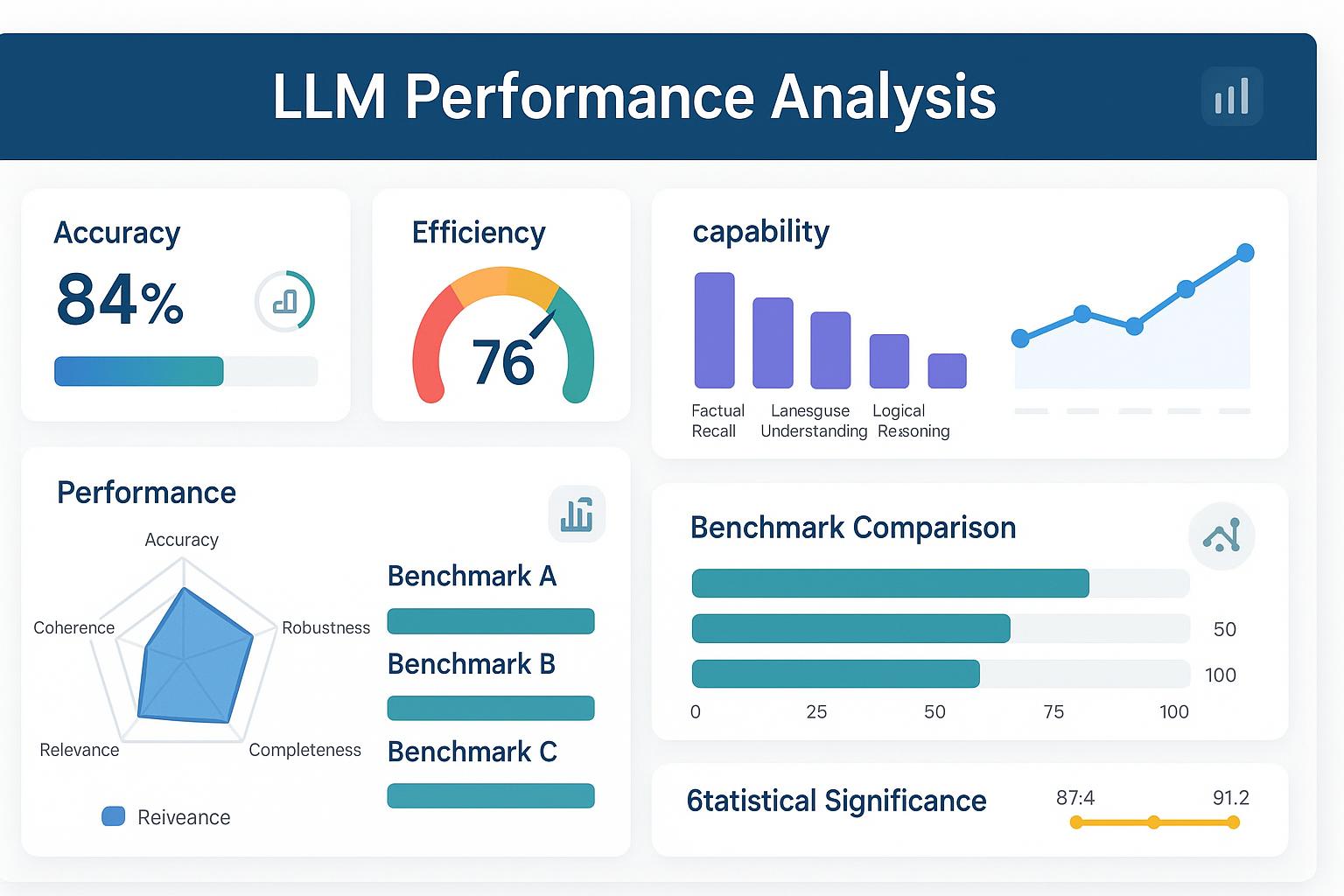
Think of a benchmark score the way you'd think of a single grade on a report card. "92%" tells you almost nothing until you ask: 92% on what exam? An open-book final or a closed-book pop quiz? Was it the easy version or the hard one? Did the student get unlimited retries? Was the grade self-reported or checked by an outside examiner? The same number means wildly different things depending on those answers. A benchmark headline is exactly that grade with all the context stripped off.
This article is a reader's skill, not a definition. If you want the basics of what a benchmark is, start with what are LLM benchmarks. Here we assume you already know they exist, and we focus on the one thing that actually matters when you scroll past a launch post: how to tell whether a score deserves your trust.
Why it matters
Benchmark scores drive real decisions. People pick a model for production, write blog posts declaring a new leader, or argue that lab A just beat lab B — all from a table of numbers. If those numbers are read naively, the decision inherits every hidden assumption baked into them.
Two failure modes are common, and they pull in opposite directions:
- Over-trusting. You see "+3 points over the previous model" and assume it's better for your use case. But a 3-point gain on an academic multiple-choice test may say nothing about how the model writes your emails, debugs your code, or follows your formatting rules.
- Under-trusting. You decide "benchmarks are all gamed" and ignore them entirely, throwing away a genuinely useful signal. Some gaps are real and large, and pretending the data is worthless is its own mistake.
The deeper reason to care: a benchmark number is a proxy. It stands in for a quality you actually want — helpfulness, reasoning, coding skill — but it is never the thing itself. Whenever a proxy becomes a target that labs optimize for, it drifts away from the real quality it was meant to measure. So the honest reader's job is to keep asking, does this proxy still track what I care about, and under what conditions was it measured? That question is the whole skill.
How a score gets made (and where meaning leaks out)
To read a score, picture the pipeline that produced it. A benchmark run is a chain of steps, and at every step a choice is made that can move the final number — sometimes by several points — without changing the model at all. Here is the chain:
The model is the same at every step. What changes the headline is the settings around it. Let's walk the leaks.
Which benchmark, and which version
Benchmarks have versions, splits, and subsets. "MMLU" might mean the full test, a single category, or a cleaned-up variant. The same name can hide different question sets. Always pin down exactly which test produced the number before comparing two models — a score on one variant is not comparable to a score on another.
How the model was prompted
Zero-shot gives the model only the question. Few-shot prepends several solved examples first, which usually raises the score because the model has seen the answer format. A lab can quote a 5-shot number while a competitor quoted 0-shot, and the gap on the page is partly just the prompting. The exact wording, system prompt, and answer-extraction format also move the needle.
What help the model was allowed
Could the model think step by step (chain-of-thought)? Use a calculator, code execution, or web search (tools)? Take its best of several tries (self-consistency / pass@k)? Every one of these can lift a score substantially. A coding number measured as "best of 10 attempts" is not the same as "first attempt," even though both are real. See coding benchmarks like HumanEval and SWE-bench for how much this matters in practice.
Who ran it
A self-reported score comes from the lab launching the model — they chose the settings that flatter their model. An independent score comes from a neutral third party running every model under one fixed harness. When they disagree, the independent number is usually the more honest comparison, because the settings are held constant across models.
The reader's checklist
Here is the practical part. When a benchmark number is put in front of you, run it through these questions before you trust it. You won't always get answers — but noticing the missing answers is itself the signal.
| Ask this | Why it changes the number | Red flag answer |
|---|---|---|
| Which benchmark + version? | Variants and subsets aren't comparable | Just a bare name, no version |
| Zero-shot or few-shot? | Few-shot usually scores higher | Unstated, or mixed across models |
| Chain-of-thought allowed? | Reasoning steps lift hard tasks | Used for one model, not the other |
| Tools / retries used? | pass@k and tools inflate raw skill | "Best of N" compared to single-try |
| Self-reported or independent? | Launch labs pick flattering settings | Only the lab's own table |
| Where are the error bars? | Small gaps may be noise | No confidence interval at all |
| Could the test be in training? | Memorized answers aren't skill | Old, public, popular benchmark |
Two of these deserve special attention because they're the most overlooked.
Error bars: is the gap even real?
Benchmarks are samples — a few hundred or few thousand questions out of an infinite possible set. So every score has uncertainty around it. If model A scores 88.1% and model B scores 87.6% on the same 500-question test, that half-point gap may be pure noise: re-run on a different 500 questions and the order could flip. A responsible report shows a confidence interval (e.g. "88% ± 1.5"). When two intervals overlap heavily, treat the models as tied, no matter which printed number is bigger.
Contamination: did the model already see the answers?
If a benchmark's questions and answers leaked into a model's training data, the model can score high by memory, not skill — like a student who got the answer key in advance. This is contamination, and it especially threatens old, popular, public benchmarks. A suspiciously high score on a well-known test is a reason to dig, not celebrate. It has its own article: benchmark contamination.
Static tests vs. human-preference leaderboards
Not every "score" is a percentage on a fixed test. A second family of rankings comes from humans voting on which model's answer they prefer, aggregated into a rating. These two kinds of numbers fail in different ways, so you read them differently.
- Fixed question set with known answers
- Reproducible: re-run and get the same number
- Vulnerable to contamination + overfitting
- Measures a narrow, defined skill
- Example: MMLU, GSM8K, HumanEval
- Humans vote on head-to-head answers
- Harder to contaminate (fresh prompts)
- Measures vibes: tone, formatting, helpfulness
- Can reward confident, chatty, longer answers
- Example: Chatbot Arena style Elo
Preference ratings (often shown as an Elo-style number) are great for capturing overall helpfulness the way real users feel it, and they're hard to game by memorizing a test. But they reward style as much as substance — a longer, friendlier, more confident answer can win the vote even when it's no more correct. They also carry their own statistical uncertainty. Read more on Chatbot Arena and how Elo ratings work.
A worked example: reading one headline
Let's apply the checklist to a realistic (made-up) launch claim and see how much it shrinks once you ask the questions.
ANNOUNCING MODEL-X

  HumanEval ........ 94.2%   (state of the art)
  MMLU ............. 89.7%
  GSM8K ............ 96.1%

  *as measured by our team
Run it through the reader's checklist:
- Self-reported. The asterisk says "as measured by our team." Settings were chosen by the people selling the model. Lower confidence until an independent harness confirms it.
- No shots stated. Is HumanEval pass@1 or pass@10? 94.2% with 10 tries is a very different claim from 94.2% on the first try. Unstated = assume the more favorable setting was used.
- No error bars. "State of the art" might mean +0.3 over the prior leader on a 164-problem test — well inside the noise. Without an interval, "SOTA" is marketing, not measurement.
- Contamination risk. HumanEval and GSM8K are old and public. A near-ceiling GSM8K score invites the question: skill, or memorized training data?
- Proxy gap. Even if all numbers are honest, none of these tests is your task. They tell you the model is broadly capable, not that it'll handle your tickets or your codebase.
After this pass, the honest takeaway isn't "the claim is fake." It's: Model-X looks strong and is worth testing, but "state of the art" is unproven until an independent run with stated settings and error bars confirms it — and the only score that decides my choice is my own eval on my own data. That measured conclusion is exactly what good benchmark reading produces.
Going deeper
Once the checklist is second nature, a few subtler issues separate careful readers from casual ones.
Saturation and ceiling effects. When the best models all score 95%+ on a benchmark, the test has saturated — the remaining 5% is mostly noise, ambiguous questions, or outright labeling errors, not real skill. At that point the benchmark has stopped discriminating, and a new "record" near the ceiling means little. The field responds by building harder benchmarks; you should mentally retire a saturated one.
Overfitting to the public set. A benchmark can be uncontaminated yet still misleading if labs iterate against it — tweaking models repeatedly until the public number climbs. The model gets better at that specific test without getting better in general. A telltale sign is a model that tops a famous leaderboard but underwhelms on fresh, private tasks.
Aggregate scores hide shape. A single "average across 50 tasks" can mask that a model is brilliant at 40 and broken at 10. If your use case lives in those broken 10, the strong average lies to you. Whenever possible, read the per-task breakdown, not just the headline average.
Agentic and multi-step benchmarks are even slipperier. Tests that measure whether a model can complete real multi-step tasks depend heavily on the scaffolding around the model — the tools, the harness, the retry logic — so the number reflects the whole system, not the model alone. See agent benchmarks explained.
Where to go next: the durable move is to stop relying on public numbers as the final word and build a small evaluation of your own. Start with what are LLM evals, then build an eval suite on a golden dataset drawn from your real task. The whole lesson of reading benchmarks well is that public scores are a starting filter, never the verdict — the verdict comes from measuring the thing you actually care about.
FAQ
What does a score like "92% on MMLU" actually mean?
It means the model answered 92% of that benchmark's multiple-choice questions correctly under whatever settings the reporter used — which shots, prompt format, and whether reasoning or tools were allowed. The number alone doesn't tell you those settings, and it doesn't tell you how the model performs on your specific task. Treat it as one narrow data point, not a verdict.
What's the difference between zero-shot and few-shot scores?
Zero-shot gives the model only the question. Few-shot first shows it several solved examples, which usually raises the score because the model has seen the answer format. Comparing a few-shot number from one model to a zero-shot number from another is unfair — the gap is partly just the prompting, not the model.
Why do labs report different scores for the same model on the same benchmark?
Because the settings differ: number of shots, prompt wording, whether chain-of-thought or tools were allowed, and how answers were extracted. Self-reported scores from a launching lab tend to use the most flattering settings, while an independent harness holds settings constant across models. When numbers disagree, the independent run is usually the fairer comparison.
Should I trust a benchmark score with no error bars?
Be cautious. Benchmarks are samples, so every score has uncertainty. Without a confidence interval, you can't tell whether a small lead (say 88.1% vs 87.6%) is a real improvement or just noise that would flip on a different question set. When intervals overlap, treat the models as effectively tied.
Why can a high benchmark score still be misleading?
Several reasons: the test answers may have leaked into training data (contamination), the benchmark may be saturated near 100% where remaining differences are noise, the model may have been over-tuned to that public test, or an averaged score may hide weak spots. Most importantly, no public benchmark measures your exact task — only your own eval does that.
Are human-preference leaderboards more reliable than fixed benchmarks?
They measure something different. Preference leaderboards capture overall helpfulness as real people feel it and are harder to game by memorizing answers, but they reward style — longer, friendlier, more confident replies can win votes even when no more correct. Fixed benchmarks measure narrow, defined skills but can be contaminated. Use both, and trust your own task data over either.