In plain English
Most early AI tools were specialists. An image classifier could look at photos but couldn't talk about them. A speech recognizer could hear words but couldn't read a document. A text model could write an essay but went blind the moment you pasted in a chart. Each tool had exactly one sense and no way to combine them. Multimodal AI changes that. A multimodal model handles multiple types of input — text, images, audio, video — inside a single system, reasoning across all of them at once.
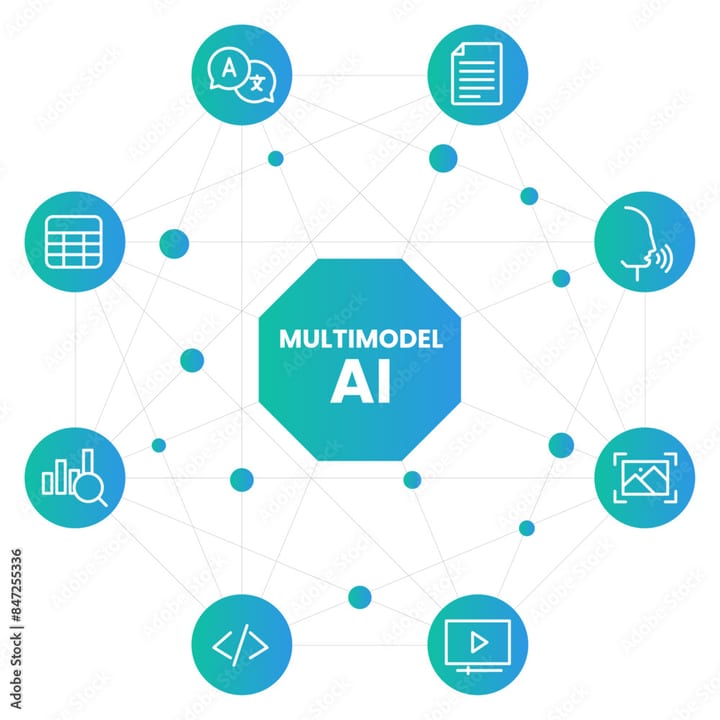
The word modality just means a type of data. Text is one modality, an image is another, audio is a third. A unimodal system deals with one modality at a time. A multimodal system weaves several together in a single prompt, inference call, or conversation. You can hand it a photo of a receipt and ask "what's the total?" — and get a dollar amount back. Or speak your question aloud, share a screenshot, and receive a typed reply. The model sees, hears, and reads in one coordinated act.
Think of how you read a newspaper. You don't stop reading when you hit a chart — you glance at it, absorb the numbers, and keep reading. You don't switch to a different brain for each column-width photo. Your perception is naturally multimodal: eyes take in text and images simultaneously, ears pick up the ambient radio, and your mind weaves it all into one understanding. Multimodal AI is the attempt to give a model that same integrated perception, instead of building a separate specialist for each channel.
Why it matters
The world doesn't communicate in plain text. A hospital's value lies in X-rays, MRI scans, and scribbled physician notes. A retailer's product catalog is thousands of photos with structured attributes buried in images. A call centre's history is hours of recorded speech. None of that is ready to hand to a text-only model. Before multimodal AI arrived, making any of it queryable meant building brittle pre-processing pipelines — an OCR engine here, an object detector there, a speech recogniser on top — each needing its own training data, maintenance, and integration work. Multimodal models collapse that zoo of specialists into one system you talk to in plain language.
For an AI engineer or product builder, the practical upshot is this: wherever information lives in a non-text format, a multimodal model can meet it there. That shifts what's buildable from "text-only apps with optional image upload" to fully cross-modal applications.
- Document automation. Upload a scanned invoice or a hand-filled form; the model reads the fields and outputs structured data — no custom OCR pipeline needed.
- Visual customer support. A user photographs a broken appliance and types 'it makes a grinding noise' — the model sees the wear marks on the motor housing and hears the symptom description together, then suggests the likely fault.
- Voice-first interfaces. Speak a question, get a spoken reply; the audio modality removes the keyboard entirely and opens AI to accessibility use-cases that text can't serve.
- Computer-use agents. An AI agent that can take a screenshot, read the UI, click the right button, and observe the outcome needs vision as its primary sensory channel.
- Healthcare and science. Combine a chest X-ray image with patient text notes to surface relevant findings — a workflow that would have required multiple separate models before.
How it works
The core engineering challenge in multimodal AI is that different modalities speak completely different mathematical languages. Text becomes a sequence of discrete tokens. An image is a grid of pixel values. Audio is a waveform — a time series of amplitude samples. A language model was trained to reason in token-space; to add vision or audio you have to translate those alien signals into token-space before the language model can touch them. Every multimodal architecture solves exactly that translation problem.
Step 1 — modality encoders convert raw signals into feature vectors
Each input type has a dedicated encoder trained to extract meaningful features. For images, the dominant choice is a Vision Transformer (ViT): the image is cut into a grid of small patches (typically 14x14 or 16x16 pixels each), each patch is turned into a vector, and those vectors pass through transformer layers that let patches attend to each other — capturing relationships like "this patch is part of the same word as that one". For audio, a similar process applies to spectrograms (frequency-versus-time representations of sound). The encoder's output is a sequence of feature vectors: rich numeric summaries of what each patch or audio segment contains.
Step 2 — a projector maps features into the language model's space
Vision encoder features and LLM token embeddings live in different vector spaces — different dimensions, different distributions, different meanings. A small projector (often one or two linear layers or a lightweight transformer module) bridges the gap. It takes each image feature vector and produces a visual token with exactly the same shape as a word token embedding. After projection, the language model sees a flat sequence of tokens — some representing words, some representing image patches, some representing audio frames — and treats them all the same way.
Step 3 — the language model reasons over the full mixed sequence
Once all modalities are in token form, the transformer's attention mechanism does the heavy lifting. Every token can attend to every other token, so text words can attend to image-patch tokens and vice versa. The model can answer "what is the text on the label in the top-left of the photo?" because it can jointly look at where "top-left" points in the image stream and what the patch tokens there represent. The language model itself needs almost no changes — you're just feeding it a richer input sequence.
Training a multimodal model typically proceeds in stages. First, modality alignment: freeze both the encoder and the LLM, train only the projector on large datasets of paired data (millions of image-caption pairs, audio transcriptions, etc.) so the model learns to connect visual or audio signals with language. Second, instruction tuning: fine-tune on task-oriented examples ("here is a photo of a chart, answer this question about it") so the model learns to follow instructions about images rather than just describe them. This two-stage approach, popularised by the open-source LLaVA project, is now the standard recipe.
Multimodal vs unimodal — what changes
The distinction between multimodal and unimodal isn't just academic — it changes what problems you can solve, how you architect your data pipeline, and what failure modes you'll encounter.
| Dimension | Unimodal AI | Multimodal AI |
|---|---|---|
| Input types | One (e.g., text only) | Two or more (text + image, text + audio, …) |
| Pipeline complexity | Single model call | Encoders + projector + LLM, often one unified API |
| Data requirements | Single-modality corpus | Paired cross-modal data (image-caption, audio-transcript, …) |
| Failure modes | Hallucination, out-of-context errors | All text failures plus visual hallucination, modality confusion |
| Token cost | Tokens for text only | Images add hundreds–thousands of tokens per image |
| Ideal for | Pure text tasks: summarize, classify, generate | Tasks where information lives partly in images, audio, or documents |
The cost row deserves emphasis. When you add an image to a prompt, the model converts it into visual tokens that sit inside your context window alongside your text. A typical image at standard resolution might cost 1,000–2,000 tokens; a high-resolution image tiled into sub-patches can cost five times more. That directly affects latency and API billing, so checking the provider's image token pricing before building at scale is worthwhile.
Multimodal models also inherit a new class of visual hallucination: the model may describe objects that aren't in the image, misread printed numbers with confident precision, or conflate similar-looking items. These errors look exactly like text hallucinations — fluent, plausible, wrong — but they arise from the vision pathway, not just the language model. For any use case where a wrong reading has real consequences (a financial figure on a scanned form, a drug dosage label), treat the model's output as a first pass and verify against the source.
Real examples of multimodal AI
Knowing how multimodal AI works is more useful once you can map it to the models and products you'll actually encounter. Here are the landmark examples as of 2025–2026.
OpenAI's GPT series
OpenAI's GPT models are natively multimodal — meaning they were not text models with vision bolted on later, but trained end-to-end on text, images, and audio from the start. They accept text, image, and audio input and can produce text or audio output. The earlier GPT-4o ("o" for omni) popularised this framing — one model, all modalities, no switching — when it launched in 2024; the current GPT-5 series carries that approach forward.
Google Gemini
Gemini was designed multimodal from inception. The current Gemini 3 family accepts text, images, audio, and video in a single prompt — making it among the most modality-complete generally available models. Its very long context window means you can feed it an entire PDF with embedded images, or a long video alongside a question, in a single request.
Claude (Anthropic)
Claude's current models accept images alongside text, making document understanding, screenshot Q&A, and chart analysis straightforward via the Anthropic API. Claude has no native audio input — it processes that modality through separate pipeline steps if needed — but its image understanding is strong, particularly for OCR-like reading of dense documents.
Open models: LLaVA, Qwen-VL, Llama Vision
Not every multimodal model requires a closed API. LLaVA (Large Language-and-Vision Assistant) demonstrated in 2023 that the two-stage alignment recipe could create capable vision-language models cheaply and openly. Subsequent open models — Qwen-VL, Llama Vision, InternVL — have reached near-frontier quality and are freely downloadable from Hugging Face for local or self-hosted deployment.
Going deeper
Once the basic concept is clear, several more advanced threads are worth pulling on — especially if you're planning to build with multimodal models.
Native vs stitched-together multimodal. Early multimodal systems were just a vision encoder piped into a text-only LLM: two separate models, one projector connecting them. Modern flagship models are trained with all modalities jointly from the start, so the model builds internal representations that are natively cross-modal rather than translated at the seam. This tends to produce better reasoning across modalities, but requires much larger and more diverse training datasets. When evaluating a multimodal model for production, it is worth asking whether it is natively joint-trained or a stitched pipeline — the latter can be easier to upgrade one encoder at a time.
The resolution-token-cost triangle. Most vision encoders were pre-trained at a fixed resolution (224x224 or 336x336 pixels). A 4K screenshot fed to such an encoder gets aggressively downscaled, and fine text or dense table data can simply vanish. Modern VLMs use tiling: chop the high-res image into a grid of tiles, encode each tile at the native resolution, and concatenate all the tile tokens. This recovers detail but multiplies token count — a 4K screenshot tiled 3x3 generates nine times the tokens. Every multimodal application faces this triangle: resolution you need, tokens you can afford, and latency you'll accept. These three are in permanent tension.
Audio-first architectures. Adding audio to a language model is harder than adding vision because the signal-to-meaning compression is more extreme. A 10-second audio clip is millions of samples; the meaningful content might be fifty words. Models like OpenAI's Whisper first transcribe to text, then pass text to an LLM — a pipeline approach. Natively audio-multimodal models instead encode audio spectrogram patches directly and feed those tokens to the LLM, preserving prosody, emotion, and speaker identity information that a transcript loses. Native voice models do this directly, which is why their spoken answers sound more responsive than a text-to-speech layer on top of text.
Multimodal RAG. Retrieval-augmented generation (RAG) was originally a text-only pattern: retrieve relevant text chunks, include them in the prompt, generate. Multimodal RAG extends this to image and document retrieval. Approaches like ColPali embed entire document pages as images rather than extracting text and indexing strings — preserving layout, tables, and embedded charts that a plain-text extraction destroys. You retrieve a relevant page image and feed it directly to a VLM. If you already understand RAG, think of multimodal RAG as RAG with eyes: the retrieved context can include pictures, not just paragraphs.
Security implications. Multimodal inputs open a new attack surface. Prompt injection — instructions hidden in content that hijack the model's behaviour — can now be hidden inside an image as text the model dutifully reads. An adversarial image embedded in a webpage visited by a computer-use agent could instruct the agent to exfiltrate data. Treat image and audio inputs from untrusted sources the same way you treat untrusted user text: validate, sanitize where possible, and constrain what actions the model is allowed to take in response.
FAQ
What does multimodal mean in AI?
Multimodal means the system can process more than one type of data — called modalities — in a single model. Common modalities are text, images, and audio. A multimodal AI model can take a photo and a text question in one request and produce a text answer that draws on both, rather than requiring separate specialist models for each input type.
What is the difference between a multimodal AI and a unimodal AI?
A unimodal AI handles exactly one input type: a text model reads text, an image classifier reads images, a speech recogniser reads audio. A multimodal AI integrates two or more modalities in one system, allowing it to reason across them together. The practical difference is that a unimodal model goes blind when you give it an image, while a multimodal model can answer questions that require reading both a document and a photo at the same time.
What are examples of multimodal AI models?
The most widely used examples come from OpenAI's GPT series, Google's Gemini family, and Anthropic's Claude models. All three accept images and text together. Gemini additionally accepts audio and video natively. On the open-source side, LLaVA, Qwen-VL, and Llama Vision are popular downloadable options that run on local hardware.
How does a multimodal model handle images and text together?
The image is passed through a vision encoder (typically a Vision Transformer) that slices it into patches and converts each patch into a feature vector. A projector then maps those vectors into the same token embedding space the language model uses for text. After projection, the language model sees a flat sequence of tokens — some from your text, some from the image — and applies its attention mechanism across all of them at once to generate a response.
Do multimodal models cost more to run than text-only models?
Yes, usually. Images are converted into visual tokens that consume context-window space and are billed like regular tokens by most API providers. A standard-resolution image typically adds roughly 1,000 tokens; a high-resolution tiled image can add several thousand. This means image-heavy workloads can be significantly more expensive than equivalent text-only calls, and latency increases too. Checking the provider's image pricing before building is worthwhile.
Can multimodal AI models generate images or audio, or only read them?
Most multimodal LLMs are primarily input multimodal — they read and reason about images and audio but produce text output. Image generation is a separate capability handled by diffusion models. Some products (like the full ChatGPT interface) chain both a multimodal LLM and an image-generation model behind one interface, but under the hood these are distinct systems. Truly any-to-any models that both read and write all modalities in one unified architecture are still emerging.