
Overview
LingSante-3.1-air-VL is a multimodal healthcare model from Ant Group, published by inclusionAI on Hugging Face and ModelScope on 19 November 2026 under the MIT license. It is built on Ling-3.0-flash-VL, a natively multimodal Mixture-of-Experts with 124 billion total parameters and 5.5 billion activated per token, and it reads text and images with a 256K-token context window. inclusionAI describes it as the first large multimodal medical model that Ant Group's healthcare team has open-sourced; its text-only sibling, LingSante-3.1-flash, was published the same day.
The model card names four clinical focus areas. For medical imaging reports, it weighs patient history, imaging technique and image quality, reviews the images, considers differential diagnoses and drafts the Findings and Impression sections; it can read several images together and pick out multiple positive findings on one chest X-ray. For health assessment, it covers more than 120 skin conditions and asks follow-up questions before an assessment, breaks down meals into ingredients, portions and nutrients, and interprets lab reports. For evidence work, it can search by image, retrieve papers, guidelines and similar cases, and use imaging tools and bounding boxes to check a lesion's location. For workflows, it can operate real healthcare apps as a GUI agent, booking appointments or ordering medicine. Medical training replays general multimodal data so OCR, document, chart, search and GUI skills are kept.
inclusionAI compares it with GLM-5.3-Flash, DeepSeek-V4.1-Flash-1017, MiniMax-M3.1-Flash, Kimi-K3.1-Pro, GPT-6.1 Sol, Claude Opus 5.5 and Gemini 3.8 Flash across internal medical tasks, imaging-report generation (CheXpert Plus, IU X-RAY, MIMIC-CXR), medical visual question answering, text-based medical reasoning, document understanding and multimodal agents. Its widest leads are on report generation and visual question answering — 46.21 on CheXpert Plus, 47.20 on MIMIC-CXR and 93.64 on OmniMedVQA — while the large proprietary models score higher on knowledge-heavy tests such as MedXpertQA-MM.
Search, tool and GUI workflows need an external environment that supplies tools, keeps state and validates actions. inclusionAI recommends SGLang on four 141GB-class GPUs (tensor parallel 4, 256K context with YaRN) or eight 80GB H100/H800 GPUs, with vLLM as an alternative through its own vllm-ling-v3 fork; thinking mode is on by default. The card is explicit that this is a research model and not a medical device: its outputs may be incomplete or wrong, cannot replace professional advice, diagnosis or treatment, and high-risk use requires qualified review and independent validation.
| Released | 2026-11-19 |
|---|---|
| License | MIT |
| Weights | Open weights |
| Parameters | 124B total · 5.5B activated per token (Mixture-of-Experts) |
| Context | 256K |
| Architecture | Native multimodal Mixture-of-Experts built on Ling-3.0-flash-VL |
| Modalities | Text, Vision |
| Status | Research model — open weights on Hugging Face and ModelScope |
Benchmarks
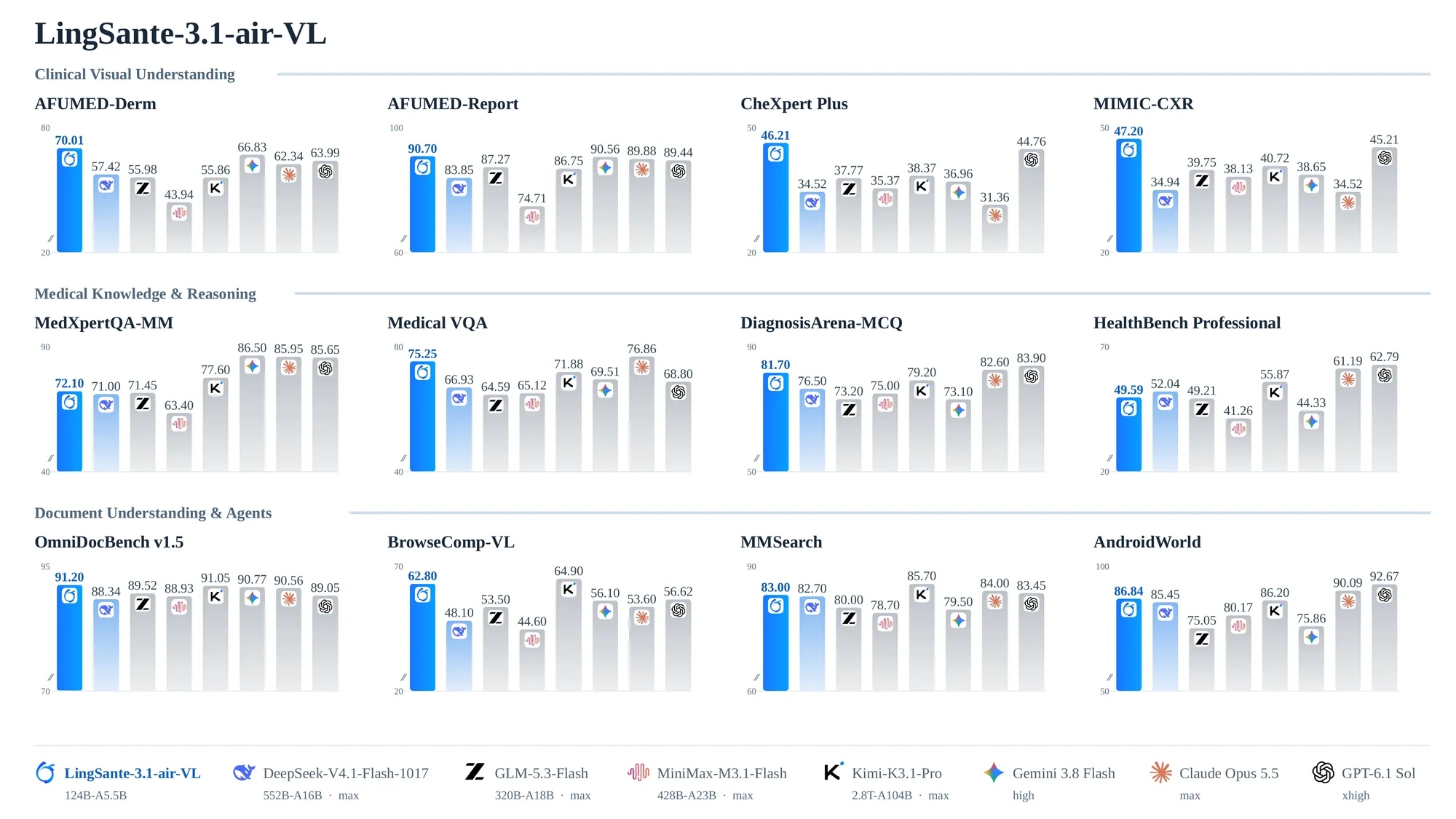
LingSante-3.1-air-VL vs open and proprietary models, as published by inclusionAI (comparison models at their highest reasoning setting)
| Benchmark | LingSante-3.1-air-VL | GLM-5.3-Flash | DeepSeek-V4.1-Flash-1017 | MiniMax-M3.1-Flash | Kimi-K3.1-Pro | GPT-6.1 Sol | Claude Opus 5.5 | Gemini 3.8 Flash |
|---|---|---|---|---|---|---|---|---|
| AFUMED-Derm (internal) | 70.01 | 55.98 | 57.42 | 43.94 | 55.86 | 63.99 | 62.34 | 66.83 |
| AFUMED-Report (internal) | 90.7 | 87.27 | 83.85 | 74.71 | 86.75 | 89.44 | 89.88 | 90.56 |
| CheXpert Plus | 46.21 | 37.77 | 34.52 | 35.37 | 38.37 | 44.76 | 31.36 | 36.96 |
| MIMIC-CXR | 47.2 | 39.75 | 34.94 | 38.13 | 40.72 | 45.21 | 34.52 | 38.65 |
| MedXpertQA-MM | 72.1 | 71.45 | 71 | 63.4 | 77.6 | 85.65 | 85.95 | 86.5 |
| OmniMedVQA | 93.64 | 74.15 | 77.06 | 75.23 | 86.53 | 74.69 | 82.68 | 80.86 |
| PathVQA | 71.57 | 59.1 | 61.39 | 55.02 | 62.84 | 53.88 | 79.36 | 57.76 |
| VQA-RAD | 81.15 | 61.42 | 62.75 | 67.41 | 74.5 | 74.5 | 78.94 | 71.18 |
| DiagnosisArena-MCQ | 81.7 | 73.2 | 76.5 | 75 | 79.2 | 83.9 | 82.6 | 73.1 |
| OmniDocBench v1.5 | 91.2 | 89.52 | 88.34 | 88.93 | 91.05 | 89.05 | 90.56 | 90.77 |
| BrowseComp-VL | 62.8 | 53.5 | 48.1 | 44.6 | 64.9 | 56.62 | 53.6 | 56.1 |
| MMSearch | 83 | 80 | 82.7 | 78.7 | 85.7 | 83.45 | 84 | 79.5 |
| AndroidWorld | 86.84 | 75.05 | 85.45 | 80.17 | 86.2 | 92.67 | 90.09 | 75.86 |
Strengths
- MIT-licensed open weights for medical image understanding, published on Hugging Face and ModelScope
- Only 5.5B of 124B parameters active per token, so it serves on four 141GB-class GPUs
- Drafts structured imaging reports and reads multiple images together, with the top published scores on CheXpert Plus, IU X-RAY and MIMIC-CXR in its comparison
- Covers skin-condition assessment, meal and nutrition analysis and lab-report interpretation, asking follow-up questions before answering
- Image-to-evidence search and GUI-agent skills for real healthcare apps, while keeping general OCR, document and chart understanding
Best for
- Research on assisted radiology report drafting from chest X-rays and other medical images
- Skin, diet and lab-report assessment tools with review by qualified professionals
- Multimodal medical search that ties an answer to retrieved papers, guidelines or similar cases
- Building and evaluating GUI agents for healthcare apps, such as appointment booking or medicine ordering
Ling domain models (open-weight) — every version
The full lineage of the Ling domain models (open-weight) line, newest first. Every version has its own page — click any to compare specs, benchmarks and pricing.
| Version | Released | Context | License |
|---|---|---|---|
| LingSante-3.1-flashcurrent | 2026-11-19 | 1M | MIT |
| LingSante-3.1-air-VL | 2026-11-19 | 256K | MIT |
| Ling-3.0-flash-Fin | 2026-09-03 | 256K | MIT |
FAQ
What can LingSante-3.1-air-VL read?
Text and images, with a 256K-token context. inclusionAI focuses it on medical imaging reports such as chest X-rays, photos of skin conditions and meals, and medical reports, while it keeps general OCR, document and chart understanding.
How is it different from LingSante-3.1-flash?
LingSante-3.1-flash is a text-only 560B model built on Ling-3.1-flash. LingSante-3.1-air-VL is a smaller multimodal model, 124B total and 5.5B active, built on Ling-3.0-flash-VL. Both were published on 19 November 2026 under the MIT license.
Is it open source?
The weights are published on Hugging Face and ModelScope under the MIT license.
What hardware does it need?
inclusionAI's SGLang recipe uses four 141GB-class GPUs with tensor parallelism 4 for the full 256K context, or eight 80GB H100/H800 GPUs with tensor parallelism 8. vLLM is supported through inclusionAI's vllm-ling-v3 fork.
Can it be used for clinical diagnosis?
No. inclusionAI calls it a research model, not a medical device: its outputs may be incomplete or wrong and must not replace professional advice, diagnosis or treatment. High-risk use requires review by qualified personnel and independent validation.