
Overview
LingSante-3.1-flash is a healthcare model from Ant Group, published by inclusionAI on Hugging Face and ModelScope on 19 November 2026 under the MIT license. It is built on Ling-3.1-flash and keeps that model's architecture unchanged: a hybrid-linear Mixture-of-Experts with 560 billion total parameters, 25 billion activated per token and a 1-million-token context window. It follows Ling-3.0-flash-Sante, an earlier healthcare release built on the smaller 124B Ling-3.0-flash.
The model card frames medicine as harder than general intelligence: health information is often incomplete, patients differ widely, and the work carries strict safety and compliance requirements. inclusionAI's answer is to mix general and medical data through pretraining, mid-training and supervised fine-tuning, then apply reinforcement learning for medical reasoning, tool use, search and professional behaviour, and finally merge those strengths with multi-teacher on-policy distillation. The stated goal is one model that can verify evidence, give a professional judgement and carry a multi-stage medical workflow to completion, while keeping general reasoning, coding, search and tool use.
inclusionAI evaluates it on public medical benchmarks (MedQA-USMLE, MedMCQA, MedXpertQA-Text, HealthBench Professional, MentalHealthBench), medical agent tasks (PhysicianBench, CHI-Bench, EHR-Complex), search agents (BrowseComp with context, Humanity's Last Exam with tools) and general tool use (τ³-Banking, MCP-Atlas), plus several internal sets, against DeepSeek-V4.1-Flash, GLM-5.3, Kimi-K3.1-Pro, Tencent Hy4, MiniMax-M3.1-Flash, Claude Opus 5.5, GPT-6 Astra and Gemini 4 Argon. Its strongest published results are on HealthBench Professional (65.72), DiagnosisArena-MCQ (83.9), BrowseComp with context (94.10) and HLE with tools (72.22 single-agent); on medical knowledge exams such as MedQA-USMLE and MedXpertQA-Text, and on Terminal-Bench 4.0 (26.5), it trails Claude Opus 5.5, GPT-6 Astra and Gemini 4 Argon in the same table.
The checkpoint is published in FP8. inclusionAI recommends SGLang, using a day-0 image with multi-token-prediction speculative decoding, on 8 × H200 (tensor and expert parallel 8) or 4 × GB300; vLLM is also supported with the ling3 tool-call and reasoning parsers. Thinking mode is switched on through the chat template, with temperature 1.0, top-p 0.95 and top-k 20 recommended. The card states plainly that LingSante-3.1-flash is for research and evaluation, is not a medical device, and must not be used on its own to diagnose, prescribe, decide treatment or triage.
| Released | 2026-11-19 |
|---|---|
| License | MIT |
| Weights | Open weights |
| Parameters | 560B total · 25B activated per token (Mixture-of-Experts) |
| Context | 1M |
| Architecture | Hybrid-linear Mixture-of-Experts inherited from Ling-3.1-flash: 63 KDA + 9 gated MLA layers, 512 routed experts with 8 active per token |
| Modalities | Text |
| Status | Research model — open weights on Hugging Face and ModelScope |
Benchmarks
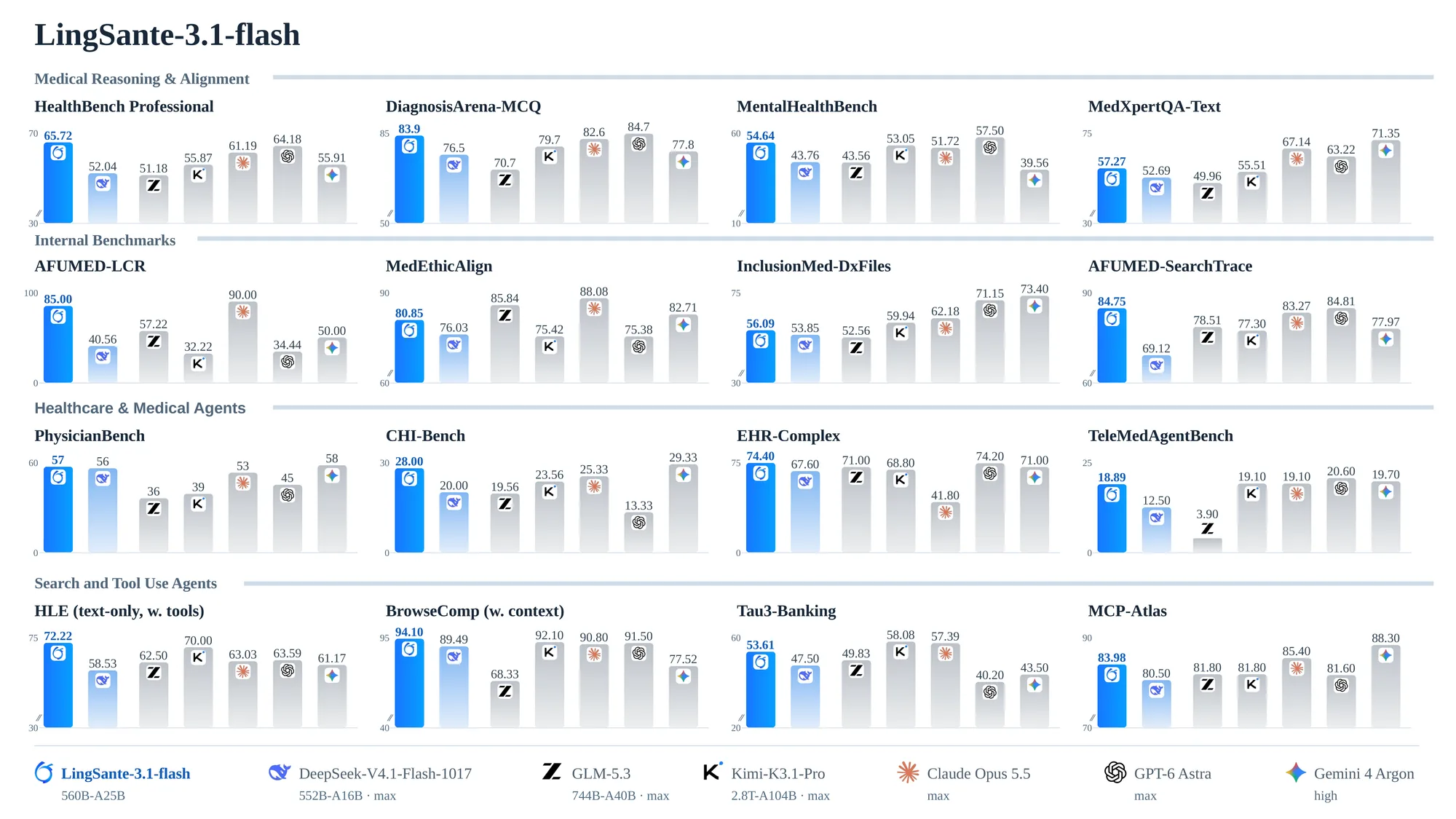
LingSante-3.1-flash vs open and proprietary models, as published by inclusionAI (comparison models at their highest reasoning setting)
| Benchmark | LingSante-3.1-flash | DeepSeek-V4.1-Flash-1017 | GLM-5.3 | Kimi-K3.1-Pro | Tencent Hy4 | MiniMax-M3.1-Flash | Claude Opus 5.5 | GPT-6 Astra | Gemini 4 Argon |
|---|---|---|---|---|---|---|---|---|---|
| MedQA-USMLE | 94.5 | 95.13 | 93.09 | 96.15 | 91.67 | 94.19 | 97.25 | 97.33 | 97.33 |
| MedMCQA | 83.89 | 83.82 | 82.36 | 86.83 | 81.52 | 77.91 | 89.53 | 88.14 | 89.55 |
| DiagnosisArena-MCQ | 83.9 | 76.5 | 70.7 | 79.7 | 76.4 | 73.2 | 82.6 | 84.7 | 77.8 |
| MedXpertQA-Text | 57.27 | 52.69 | 49.96 | 55.51 | 53.39 | 40.94 | 67.14 | 63.22 | 71.35 |
| HealthBench Professional | 65.72 | 52.04 | 51.18 | 55.87 | 49.2 | 40.79 | 61.19 | 64.18 | 55.91 |
| MentalHealthBench | 54.64 | 43.76 | 43.56 | 53.05 | 44.69 | 42.42 | 51.72 | 57.5 | 39.56 |
| PhysicianBench | 57 | 56 | 36 | 39 | 51 | 41 | 53 | 45 | 58 |
| CHI-Bench | 28 | 20 | 19.56 | 23.56 | 17.33 | 22.67 | 25.33 | 13.33 | 29.33 |
| EHR-Complex | 74.4 | 67.6 | 71 | 68.8 | 65 | 70.81 | 41.8 | 74.2 | 71 |
| BrowseComp (w. context) | 94.1 | 89.49 | 68.33 | 92.1 | 92 | 80.33 | 90.8 | 91.5 | 77.52 |
| HLE (text only, w. tools, single-agent) | 72.22 | 58.53 | 62.5 | 70 | 65.76 | 61.36 | 63.03 | 63.59 | 61.17 |
| τ³-Banking | 53.61 | 47.5 | 49.83 | 58.08 | 43.3 | 41.92 | 57.39 | 40.2 | 43.5 |
| MCP-Atlas | 83.98 | 80.5 | 81.8 | 81.8 | 84 | 82.2 | 85.4 | 81.6 | 88.3 |
| SWE-Bench Pro (Public, v1) | 65.25 | 67.31 | 60.88 | 62.79 | 70.73 | 61.15 | 89.9 | 60.55 | 58.96 |
Strengths
- MIT-licensed open weights on Hugging Face and ModelScope, so hospitals and researchers can self-host rather than send health data to a hosted API
- Keeps Ling-3.1-flash's 560B-total / 25B-active hybrid-linear MoE and 1M-token context, so long clinical records and literature fit in one prompt
- Trained for agentic medical work as well as question answering: search, evidence verification, tool use and multi-stage workflows
- Highest score in its published comparison on HealthBench Professional (65.72), ahead of GPT-6 Astra (64.18) and Claude Opus 5.5 (61.19)
- Strong search-agent results: 94.10 on BrowseComp with context and 72.22 on HLE with tools in inclusionAI's single-agent setting
- Ships with SGLang and vLLM recipes, including MTP speculative decoding
Best for
- Medical and healthcare research, including literature analysis and evidence synthesis
- Medical question answering and clinical document analysis with review by qualified professionals
- Structured information extraction and retrieval-augmented healthcare applications
- Building and evaluating tool-using medical agents, such as electronic health record and telemedicine workflows
Ling domain models (open-weight) — every version
The full lineage of the Ling domain models (open-weight) line, newest first. Every version has its own page — click any to compare specs, benchmarks and pricing.
| Version | Released | Context | License |
|---|---|---|---|
| LingSante-3.1-flashcurrent | 2026-11-19 | 1M | MIT |
| LingSante-3.1-air-VL | 2026-11-19 | 256K | MIT |
| Ling-3.0-flash-Fin | 2026-09-03 | 256K | MIT |
FAQ
How is LingSante-3.1-flash related to Ling-3.1-flash?
It keeps Ling-3.1-flash's architecture unchanged — 560B total parameters, 25B activated per token, a 1M-token context — and adds medical training: mixed general and medical data through pretraining, mid-training and fine-tuning, then reinforcement learning for medical reasoning, tool use, search and professional behaviour, merged with multi-teacher on-policy distillation.
Is LingSante-3.1-flash open source?
The weights are published on Hugging Face and ModelScope under the MIT license, so you can download, self-host and fine-tune them.
Can it be used to diagnose patients?
No. inclusionAI states that it is intended for research and evaluation, is not a medical device, and must not independently diagnose, prescribe, decide treatment or make triage decisions. Its outputs need review by qualified professionals.
What hardware does it need?
The FP8 checkpoint's SGLang recipe runs on 8 × H200 with tensor and expert parallelism of 8, or on 4 × GB300 with parallelism of 4. vLLM is also supported using the ling3 tool-call and reasoning parsers.
How does it compare with frontier models on medical benchmarks?
In inclusionAI's published table it leads HealthBench Professional (65.72 vs 64.18 for GPT-6 Astra) and is close to the top on DiagnosisArena-MCQ, but trails Claude Opus 5.5, GPT-6 Astra and Gemini 4 Argon on knowledge exams such as MedQA-USMLE and MedXpertQA-Text.