Overview
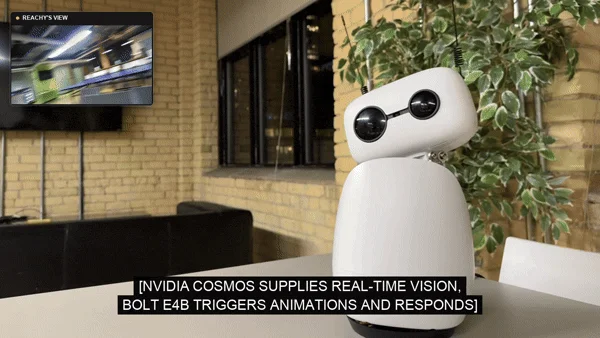
Nemotron 3.5 Bolt E4B is the smallest model in NVIDIA's Nemotron 3.5 generation, released on 23 October 2026 after its larger sibling Bolt 74B-A9B. It is not trained from scratch: NVIDIA took Google's Gemma 4 E4B instruction model and post-trained it with multi-environment reinforcement learning (GRPO) on instruction following, multi-step tool use, multi-turn conversation and structured output, using its NeMo RL and NeMo Gym libraries. The target is conversational agents that must answer quickly on small hardware — local voice and device assistants, interactive game characters, and robot or IoT interfaces.
The model has 8 billion parameters, 4 billion of them effective, reads and writes text, and has a 64K-token context window. Reasoning is switched on or off through the chat template, with a runtime thinking budget, and a separate conversational mode makes replies short and lightly formatted for spoken interaction. NVIDIA ships a full-precision BF16 checkpoint, intended mainly for further post-training and research, a 4GB Q4_K_M build quantised with llama.cpp and an importance matrix calibrated on about a million tokens of RL rollouts, and a DFlash drafter for speculative decoding that NVIDIA says gives up to 21% more throughput than Gemma 4 E4B's original MTP drafter.
NVIDIA's measurements put the 4GB build at 3.1–5.0GB of VRAM across its test setups, decoding 133.4 tokens per second on an RTX 5070 and 15.5 on a Jetson Orin Nano 8GB at batch size 1. Named runtimes include Ollama, LM Studio, Unsloth, Canonical, Jetson AI Lab and the NVIDIA In-Game Inferencing SDK, plus vLLM for the BF16 checkpoint.
On NVIDIA's published table the BF16 model leads Gemma 4 E4B-it, Qwen3.5 4B and Nemotron 3 Nano 4B on most conversational and instruction-following rows — MultiChallenge 53.10, RoleMRC 80.63, IHEval 84.79, LongMemEval 72.10 — and NVIDIA reports about 40% higher average quality than Nemotron 3 Nano 4B. Qwen3.5 4B stays ahead on Tau2-Bench (75.06 to 55.10), BFCL-v3, RULER at 64K and LongBench v2.
| Released | 2026-10-23 |
|---|---|
| License | OpenMDW-1.1 |
| Weights | Open weights |
| Parameters | 8B total · 4B effective |
| Context | 64K |
| Architecture | Gemma 4 E4B, further post-trained by NVIDIA with multi-environment GRPO reinforcement learning |
| Knowledge cutoff | May 2026 (post-training data) |
| Modalities | Text |
| Status | Generally available — open weights on Hugging Face (BF16, 4GB Q4_K_M and a DFlash drafter) and on build.nvidia.com |
Benchmarks
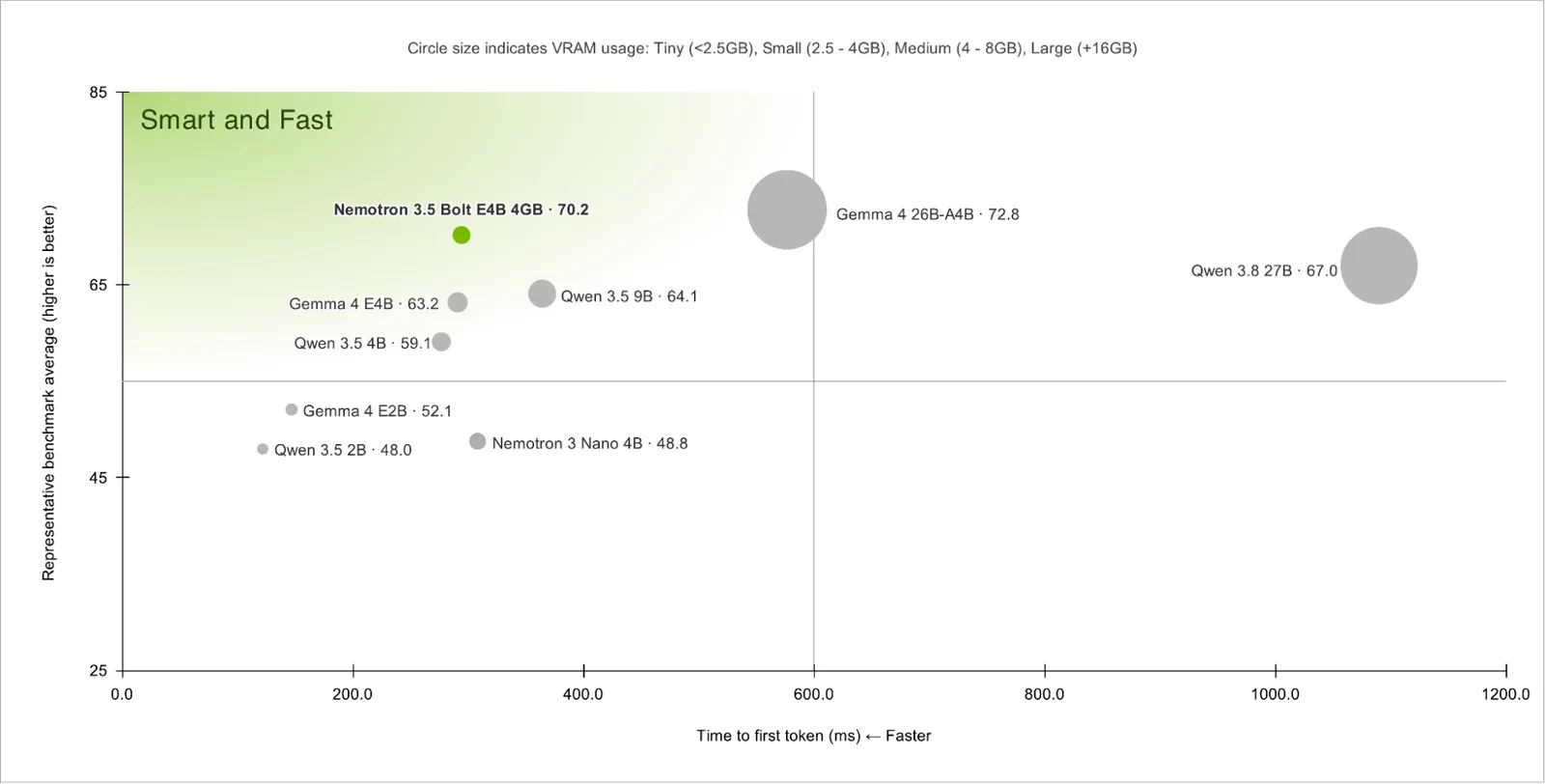
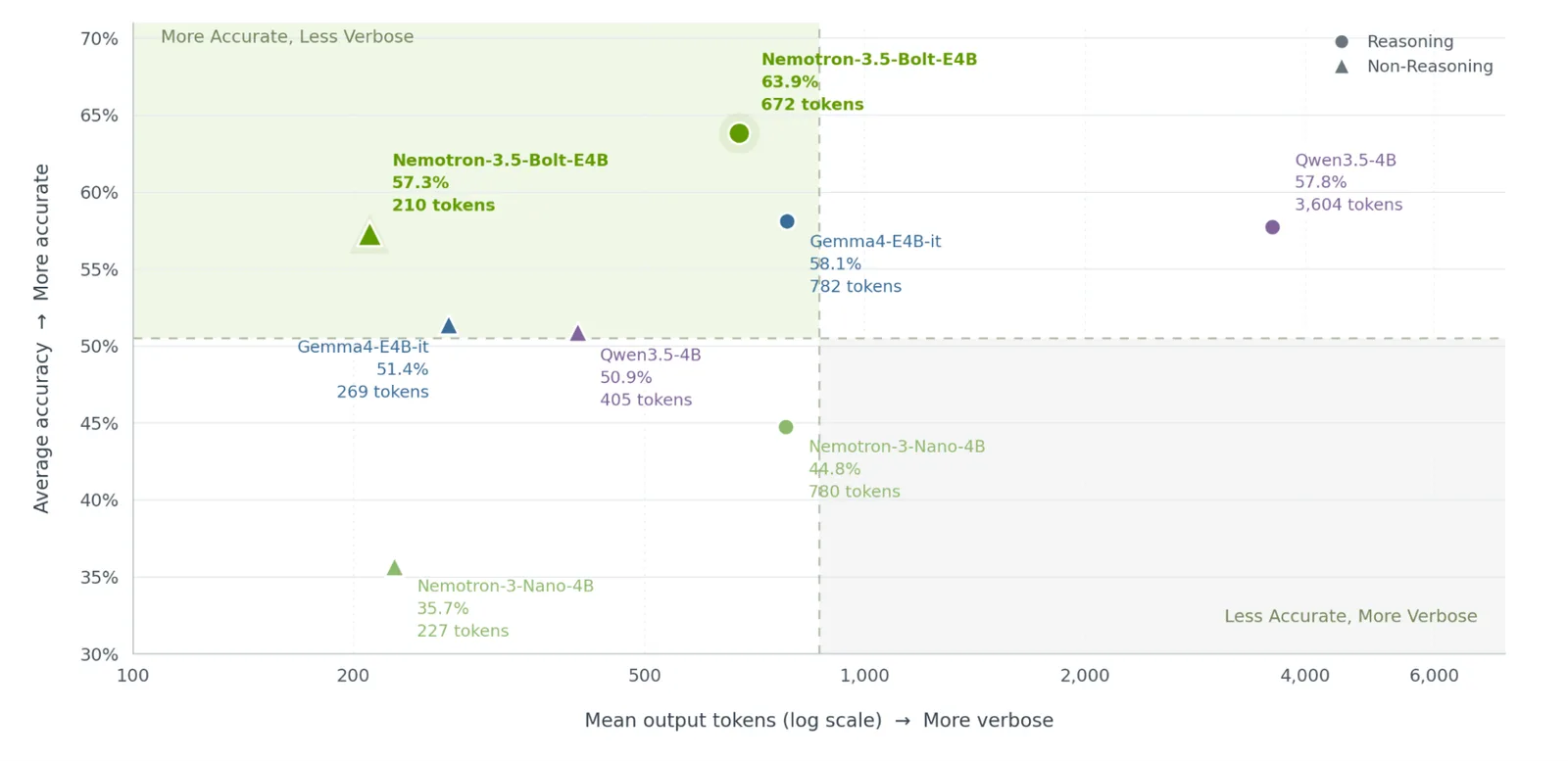
NVIDIA's published comparison from the BF16 model card (23 October 2026). All models in BF16 except the last column, NVIDIA's 4GB Q4_K_M build. Evaluations ran in reasoning mode except RoleBench, EQ-Bench v3 and RULER, on NVIDIA's NeMo Gym harness.
| Benchmark | Nemotron 3.5 Bolt E4B (BF16) | Gemma 4 E4B-it | Qwen3.5 4B | Nemotron 3 Nano 4B | Nemotron 3.5 Bolt E4B 4GB (Q4_K_M) |
|---|---|---|---|---|---|
| MultiChallenge | 53.1 | 42.08 | 51.76 | 35.3 | 55.6 |
| RoleBench | 67.05 | 49.95 | 53.66 | 12.02 | 71.21 |
| RoleMRC | 80.63 | 74.62 | 65.81 | 47 | 79.12 |
| EQ-Bench v3 | 39.4 | 41.17 | 32.92 | 19.31 | 38.15 |
| Brevity Benchmark | 82.52 | 79.99 | 75.35 | 73.6 | 82.84 |
| BFCL-v3 | 68.51 | 66.39 | 70.95 | 61.1 | 67.31 |
| When2Call Multi-Turn | 63.36 | 62.9 | 37.85 | 27.7 | 60.5 |
| ToolSandbox | 68.77 | 65.43 | 69.54 | 57.88 | 74.13 |
| Tau2-Bench | 55.1 | 38.5 | 75.06 | 29.2 | 52.32 |
| IHEval | 84.79 | 67.04 | 60.57 | 51.31 | 82.4 |
| IFBench | 63.79 | 42.84 | 58.91 | 60.1 | 64 |
| RULER (64K) | 86.99 | 86.55 | 95.15 | 91.51 | 85.76 |
| LongMemEval | 72.1 | 70.95 | 66.85 | 25.2 | 69.92 |
| LongBench v2 (48K) | 50.5 | 49.34 | 59.93 | 31.4 | 48.67 |
| GaRAGe | 42.61 | 34.73 | 24.66 | 25.18 | 40.73 |
| RAGTruth | 77.59 | 76.97 | 75.6 | 71.4 | 77.88 |
This model's scores
- IHEval84.79%
- RoleMRC80.63%
- LongMemEval72.1%
- BFCL-v368.51%
- IFBench63.79%
- When2Call Multi-Turn63.36%
- Tau2-Bench55.1%
- MultiChallenge53.1%
Scores on a 0–100 scale (25-point gridlines); higher is better. Each benchmark links to its published source.
Strengths
- Runs in about 4GB of VRAM as a Q4_K_M build, so it fits on GeForce RTX GPUs, Jetson boards, RTX Spark and DGX Spark
- Tuned for multi-turn tool use and instruction following, with a conversational mode for short spoken replies
- Ahead of Gemma 4 E4B-it, Qwen3.5 4B and Nemotron 3 Nano 4B on MultiChallenge, RoleMRC, IHEval and LongMemEval in NVIDIA's table
- Switchable reasoning with a runtime thinking budget to cap latency
- OpenMDW-1.1 license with BF16, 4GB and DFlash speculative-decoding checkpoints
Best for
- Local voice and device assistants that call tools without a cloud round-trip
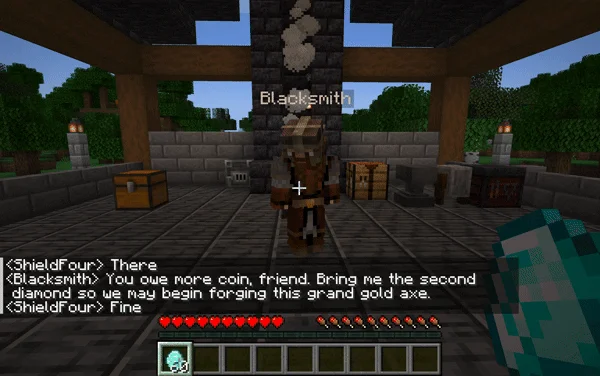
- Non-player characters in games that hold a conversation and act through game functions
- Robot and IoT interfaces on Jetson-class hardware
- Post-training the BF16 checkpoint on domain data before quantising for an edge target
How to access
| Provider | Model ID |
|---|---|
| Hugging Face (BF16 weights) ↗ | nvidia/NVIDIA-Nemotron-3.5-Bolt-E4B-BF16 |
| Hugging Face (4GB Q4_K_M) ↗ | nvidia/NVIDIA-Nemotron-3.5-Bolt-E4B-4GB |
| NVIDIA build.nvidia.com ↗ | nvidia/nemotron-3.5-bolt-e4b |
Nemotron (open-weight) — every version
The full lineage of the Nemotron (open-weight) line, newest first. Every version has its own page — click any to compare specs, benchmarks and pricing.
| Version | Released | Context | License |
|---|---|---|---|
| Nemotron 3.5 Bolt E4Bcurrent | 2026-10-23 | 64K | OpenMDW-1.1 |
| Nemotron 3.5 Super VL | 2026-10-15 | 1M | OpenMDW-1.1 |
| Nemotron 3.5 Bolt 74B-A9B | 2026-10-15 | 256K | OpenMDW-1.1 |
| Nemotron 3.5 Lightning | 2026-08-11 | 1M | OpenMDW-1.1 |
FAQ
Is Bolt E4B a new architecture?
No. It is Google's Gemma 4 E4B instruction model, further post-trained by NVIDIA with reinforcement learning on instruction following, tool use, multi-turn conversation and structured output. Use of the underlying Gemma 4 model is governed by Apache-2.0, and NVIDIA's checkpoint by OpenMDW-1.1.
What does "4GB" refer to?
The Q4_K_M build, quantised with llama.cpp using importance-matrix calibration. NVIDIA measured 3.1 to 5.0GB of VRAM across its RTX and Jetson test setups, depending on hardware and context length.
How fast is it?
On NVIDIA's batch-size-1 llama.cpp runs the 4GB build decoded 133.4 tokens per second on an RTX 5070, 67.0 on RTX Spark, 24.0 on Jetson AGX Orin and 15.5 on Jetson Orin Nano 8GB with a 3K-token prompt.
What is conversational mode?
A chat-template switch (conversational_mode) that makes the model answer concisely with little formatting, for spoken interaction. It combines with reasoning on or off and with tool calling.
Which checkpoint should I use?
The 4GB Q4_K_M build for local inference, with the DFlash drafter for speculative decoding if your runtime supports it; the BF16 checkpoint is intended mainly for post-training, producing your own quantised variants and research.