
What is Agent Starter Pack?
Agent Starter Pack is a Python package from the GoogleCloudPlatform organisation that generates production-ready projects for generative-AI agents on Google Cloud. It sits in the Agent Frameworks & Builders category of the Agents & Automation tools and is open-source, written in Python and licensed Apache-2.0. To get started: create an agent project.
Overview
Agent Starter Pack is a Python package from the GoogleCloudPlatform organisation that generates production-ready projects for generative-AI agents on Google Cloud. One command, `agent-starter-pack create`, asks you to pick an agent template and a deployment target, then writes out a complete project: backend agent code, an optional web frontend, Terraform infrastructure, tests and evaluation notebooks. The pitch is that you focus on agent logic while the template supplies infrastructure, CI/CD, observability and security.
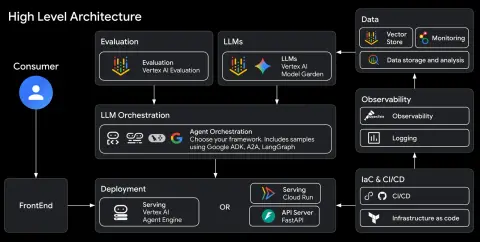
The templates cover the common agent shapes: a base ReAct agent on Google's Agent Development Kit (ADK), an ADK agent speaking the Agent2Agent (A2A) protocol, an agentic RAG agent backed by Vertex AI Search or Vector Search, a LangGraph ReAct agent, an ADK for Java agent, and a real-time multimodal agent on the Gemini Live API; the docs also list Go and TypeScript ADK templates. Generated projects deploy to Cloud Run, GKE or Vertex AI Agent Engine, and an `enhance` command retrofits the same deployment scaffolding onto an agent you already have.
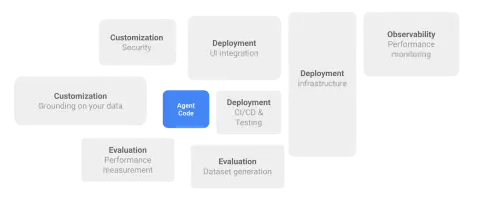
The project's own documentation explains the motivation: its authors found that taking even a dummy agent to production took them three months, with the time going on the "last mile" of evaluation, infrastructure, CI/CD and monitoring rather than on the agent itself. As of September 2026 the README marks Agent Starter Pack as in maintenance mode, receiving critical fixes only, and points new projects to its successor, Google's `agents-cli`, with a migration guide that carries agent code, tests, Terraform and CI/CD across.
What it does
- `create` scaffolds a full agent project from templates for ADK (Python, Java, Go, TypeScript), ADK with A2A, agentic RAG, LangGraph and the Gemini Live API
- Deployment targets on Cloud Run, GKE or Vertex AI Agent Engine, with the infrastructure written as Terraform
- A single `setup-cicd` command wires a complete multi-environment pipeline on Google Cloud Build or GitHub Actions
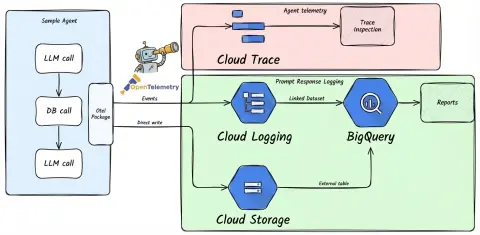
- OpenTelemetry tracing to Cloud Trace out of the box, plus configurable prompt-response logging to Cloud Storage, BigQuery and Cloud Logging
- Vertex AI evaluation, an interactive local playground and an optional RAG data-ingestion pipeline built into generated projects
- Remote templates let teams publish and reuse their own starter packs from any Git repository
Getting started
You need Python 3.10+, the Google Cloud SDK and Terraform (plus Make for the generated project's tasks); `uv` is recommended. The README marks the project as in maintenance mode and recommends `agents-cli` for new projects, but the commands below are the ones Agent Starter Pack documents.

Create an agent project
Run the CLI with uvx — no install needed. It prompts for an agent template and a deployment target, then generates the project.
uvx agent-starter-pack createOr install with pip
python -m venv .venv && source .venv/bin/activate
pip install --upgrade agent-starter-pack
agent-starter-pack create
Pick a template and target up front
Pass the agent template with -a and the deployment target with -d to skip the prompts.
# Python agent with Agent Engine
agent-starter-pack create my-adk-agent -a adk -d agent_engine

# Go agent with Cloud Run
agent-starter-pack create my-go-agent -a adk_go -d cloud_run
Run it locally
Install dependencies and launch the interactive playground with live reload. The generated project's own README has the full local and deployment instructions.
cd <your-project> && make install && make playgroundDeploy and set up CI/CD
Deploy to Google Cloud in one command, then provision the full CI/CD pipeline and infrastructure.
make deploy
uvx agent-starter-pack setup-cicd
Add production scaffolding to an existing agent
Run this in the root of a project you already have to add deployment infrastructure and CI/CD.
uvx agent-starter-pack enhanceCommands and code are distilled from the project's own documentation — always check the official repo for the latest.
When to use it
- Reach for it when you have a working agent prototype and need the Terraform, CI/CD, evaluation and monitoring to run it on Google Cloud without building that plumbing by hand
- Reach for it to start a new ADK, LangGraph, A2A or agentic-RAG agent from a template that already deploys to Cloud Run, GKE or Agent Engine
- Reach for it when you want OpenTelemetry tracing and prompt-response logging into BigQuery set up by default rather than bolted on later
- Reach for it to maintain an existing starter-pack project, or as the documented starting point for migrating to Google's agents-cli
How Agent Starter Pack compares
Agent Starter Pack alongside other open-source agent frameworks & builders tools AI/TLDR tracks, ranked by GitHub stars.
| Tool | Stars | What it does |
|---|---|---|
| DeepSeek Harness | ★ 269k | DeepSeek AI's open-source agent harness (dsh), built on Cordis, where models, tools, skills, sessions, sandboxes, storage and the UI are all plugins composed through profiles. |
| AutoGPT | ★ 188k | One of the earliest autonomous agent projects, now a platform for building and running agents from reusable blocks and workflows. |
| DeerFlow | ★ 84.9k | ByteDance's open-source super agent harness built on LangGraph: skills, sub-agents, sandboxes, a filesystem and long-term memory for long-horizon research, coding and content tasks. |
| nanobot | ★ 49.8k | Lightweight self-hosted personal AI agent framework in Python, with a WebUI, terminal and chat-app channels, tools, long-term memory, MCP and scheduled automations. |
| LangGraph | ★ 44.3k | A library from the LangChain team for building stateful, graph-based agent workflows with explicit control over steps, memory, and human-in-the-loop checkpoints. |
| Agno | ★ 43k | A fast Python framework (formerly Phidata) for building agents with memory, tools, and multimodal inputs, plus a runtime for deploying them in production. |
| AgentGPT | ★ 36.3k | AgentGPT lets you name a custom AI, give it a goal, and watch it plan tasks, run them, and learn from the results, all from a web browser. |
| Agent Starter Pack | ★ 6.6k | A CLI that scaffolds GenAI agents with the Terraform, CI/CD, evaluation and observability needed to run them on Google Cloud |