
What is DS Bot?
DS Bot is a DeepSeek Harness plugin and desktop app that turns the harness into a team of long-lived bots with memory, group chats and bot-to-bot handoffs. It sits in the Multi-Agent Systems category of the Agents & Automation tools and is open-source, written in JavaScript and licensed Apache-2.0. To get started: option A: install the desktop app.
Overview
DS Bot is a bot plugin for DeepSeek Harness (DSH), the plugin-based agent harness from DeepSeek AI. It turns DSH into a set of bots that you create and then talk and work with, each bot running in DSH sessions with the models and tools configured there. It installs as a DSH plugin (`ds-bot` on npm) or as a standalone desktop app for Windows, macOS and Linux that bundles its own DSH, and the repository also carries a Docker image of DSH Web plus DS Bot for a NAS or an always-on server. It is an independent community project, not a DeepSeek product, written in JavaScript and released under Apache 2.0.
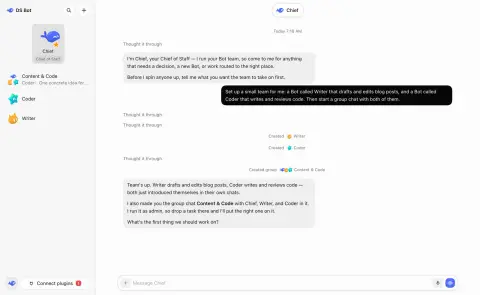
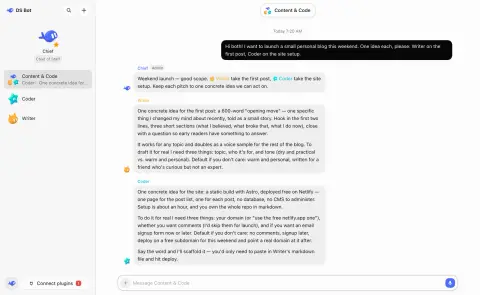
Every bot is long-lived: it keeps one model you pick on its details page, and it has a memory of what you like that it uses in later work, which you can edit there or simply tell the bot about. The first bot, Chief, is the main bot. It has the rights to create and manage the other bots and the group chats, so the README's advice is to set up the rest of the team by talking to it. A group chat has an admin that answers by default and pulls in other members; you can also @ a bot directly, and any bot can hand work to another with @, which then works on its own, posts progress and returns the result to the group. Each group keeps its own memory, separate from your other chats.
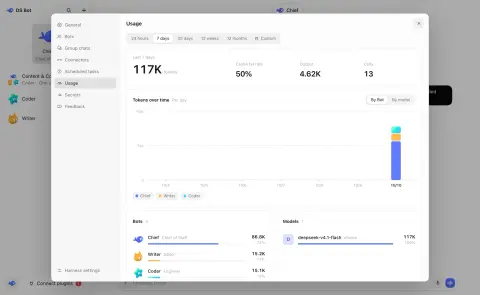
Around the bots sit a shared Capabilities library of MCP servers, skills and packs that you attach per bot (a local MCP command a bot adds needs your approval before it runs), scheduled tasks, and a Usage page with token counts by time, bot and model. All data stays on your machine in the DSH home folder (`~/.dsh` by default) and survives uninstalling the plugin. The README warns that bots use your own model quota and read and write files and run commands when asked, so important actions should be checked.
What it does
- Long-lived bots, each with its own model choice, instructions and editable memory
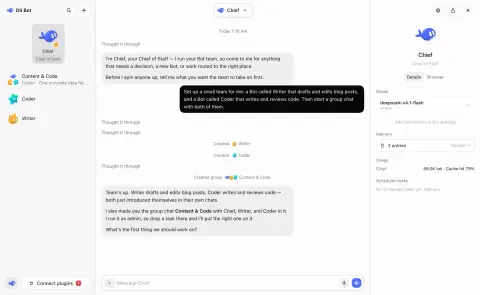
- A main bot (Chief) with rights to create and manage the other bots and the group chats by conversation
- Group chats with an admin bot, direct @ mentions, and bot-to-bot handoffs that report progress and post results back
- Per-group memory that stays inside the group and is invisible to your other chats
- Shared Capabilities library of MCP servers, skills and packs, attached per bot, with approval required for new local MCP commands
- Usage page with tokens over time, cache hit rate and calls, broken down by bot and by model
- Runs as a DSH Desktop or DSH Web plugin, a self-updating desktop app on Windows and the Linux AppImage, or a Docker image for a NAS
- All bots, chats and memory stored locally in the DSH home folder
Getting started
You need DeepSeek Harness with at least one model configured, or the DS Bot desktop app, which brings its own DSH. The DSH Web route needs Node.js 22.19 or later and pnpm. Steps follow the project README.
Option A: install the desktop app
Download the installer for your system from the GitHub Releases page: a `.exe` for Windows x64, a `.zip` for Apple-chip or Intel Macs, or an AppImage or `.deb` for Linux x64. On first start it asks where to keep its data, offers to copy a bot team from an existing DSH (read-only), and lets you set up a model in its settings.
Option B: add the plugin in DSH Desktop
In the DSH Desktop sidebar choose Plugins → Add plugin, enter `ds-bot` as the package name (pick the Mainland China mirror as Registry if you are in mainland China), select Install, then Enable now. If DSH says the change applies at next start, quit it completely and reopen it.
Option C: run it with DSH Web
Add the plugin to the `web` profile with the pinned DSH release, then start the web UI.
npx @deepseek-ai/dsh@0.2.1-rc.2 plugin --profile web add ds-bot
npx @deepseek-ai/dsh@0.2.1-rc.2 web
Build the team by talking to Chief
Open the main bot, Chief, and describe the team you want, for example a Writer bot for blog posts and a Coder bot for code plus a group chat with both. Chief creates the bots and the group, and you then drop tasks into the group or @ a bot directly.
Attach capabilities and watch usage
Under Settings → Capabilities add MCP servers, skills or packs and attach them to a bot from its settings; they apply from that bot's next message. Settings → Usage shows token use by time, bot and model.
Commands and code are distilled from the project's own documentation — always check the official repo for the latest.
When to use it
- Reach for it when you use DeepSeek Harness and want persistent assistants that remember your preferences instead of one-off sessions
- Reach for it when you want several specialised bots, such as a writer and a coder, to split work in a shared group chat
- Reach for it when you want a self-hosted bot team on a NAS or home server through the Docker image
- Reach for it when you need per-bot token accounting across models
How DS Bot compares
DS Bot alongside other open-source multi-agent systems tools AI/TLDR tracks, ranked by GitHub stars.
| Tool | Stars | What it does |
|---|---|---|
| Paperclip | ★ 110k | A self-hosted control plane that runs a team of AI agents like a company, with an org chart, tasks, budgets and approvals. |
| Ruflo | ★ 80.6k | Agent meta-harness that wraps Claude Code and Codex with 100+ specialized agents, swarm coordination, vector memory, background workers and cross-machine agent federation. |
| MetaGPT | ★ 71.1k | A multi-agent framework that models a software company, assigning roles like product manager, architect, and engineer to generate code from a single prompt. |
| AutoGen | ★ 61.7k | Microsoft Research's framework for building applications where multiple agents converse with each other and with tools to solve tasks. |
| CrewAI | ★ 60.4k | A framework for assembling teams ('crews') of role-playing agents that divide tasks and collaborate to complete a goal. |
| AgentScope | ★ 35.2k | A framework for building multi-agent applications with message passing, visual debugging tools, and distributed execution. |
| OpenAI Agents SDK | ★ 30.5k | OpenAI's lightweight Python SDK for building multi-agent workflows using explicit handoffs, tools, and guardrails. |
| DS Bot | ★ 5.1k | A DeepSeek Harness plugin and desktop app that turns the harness into a team of long-lived bots with memory, group chats and bot-to-bot handoffs |