
What is smolmaxxing?
smolmaxxing is a patch for llama.cpp that tries to run the biggest language model possible on the smallest hardware you own. It sits in the Local Runtimes category of the Models & Inference tools and is open-source, written in C and licensed MIT. To get started: connect to the box and build the patched llama.cpp.
Overview

smolmaxxing is a patch for llama.cpp that tries to run the biggest language model possible on the smallest hardware you own. It currently targets two devices with about 1 GB of RAM: a Xiaomi TV Box S (3rd Gen) with four Cortex-A55 cores and about 1 GB usable, running Android 14 without root, and a 2013 iPad Air with a two-core Apple A7 and about 700 MB usable, jailbroken on iOS 12.5.7. The project says every number it publishes was measured on the device itself.
The gains come from several tricks stacked together. Custom kernels are written per chip: a 1-bit lookup-table kernel, repacked 2-bit and ternary formats for the Cortex-A55, and versions for the Apple A7, which has no dot-product instructions. Memory use drops by removing rarely used vocabulary rows, and on the TV box a headless mode stops the launcher and Google services while a model runs. For mixture-of-experts models, popular experts stay in RAM and the rest are read from flash on demand, which lets 8B and 16B MoE models run in about 1 GB; dense models larger than RAM are streamed from flash.
The README reports Qwen3.5-2B at 7.7 tokens/s and the 16B Ling-mini-2.0 MoE at 5.1 tokens/s on the TV box, and the 1-bit Bonsai-1.7B at 24–26 tokens/s and Ling-mini-2.0 at 2.6–4.5 tokens/s on the iPad. Models need the patched llama.cpp; stock llama.cpp cannot load them. The code is MIT-licensed and the model weights keep their own licenses. Phones, single-board computers and routers are listed as planned devices.
What it does
- Per-chip kernels: a 1-bit lookup-table kernel, repacked 2-bit and ternary formats for Cortex-A55, and Apple A7 paths without dot-product instructions
- Mixture-of-experts paging from flash, keeping popular experts in RAM, so 8B and 16B MoE models run in about 1 GB
- Streaming of dense models that are larger than RAM
- Vocabulary pruning that drops rarely used rows of the model's output layer to save memory
- Headless mode on the TV box that stops the launcher and Google services while a model runs
- A browser chat UI served from the TV box with live speed, model and config panels
Getting started
The TV-box path needs network ADB enabled on the box and adb, zig, cmake, ninja, python3 and uv on your computer. Everything on the box lives in /data/local/tmp/llm. The iPad path is in ipad-air/README.md.
Connect to the box and build the patched llama.cpp
Clone llama.cpp at the pinned commit, apply the project's patch and cross-compile it for the box (the full cmake flags and the adb push commands are in docs/tv-box-setup.md).
export ADB_SERIAL=<tv-ip>:5555
adb connect $ADB_SERIAL
git clone https://github.com/ggml-org/llama.cpp third_party/llama.cpp
cd third_party/llama.cpp && git checkout 8642541 && git apply ../../patches/llama.cpp-v0.8.0-tvbox.patch
Get a model
Push a ready-made file from docs/models.md, or rebuild one from its Hugging Face sources directly onto the box.
tools/rebuild-models.sh 2b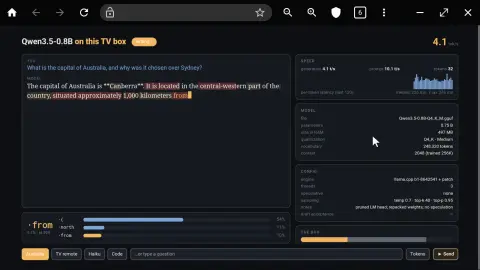
Chat from any device on your network
Start the 2B model and open http://<tv-ip>:8090 in a browser. After MoE models, turn headless mode off on the TV to get the launcher back.
tv-llm-ui/start.sh
tv-llm-ui/start.sh stop
sh /data/local/tmp/llm/tv-llm-mode.sh off
Commands and code are distilled from the project's own documentation — always check the official repo for the latest.
When to use it
- Turn a cheap Android TV box into a small LLM server for your home network
- Give an old iPad a second life as an offline chat device
- Study which memory and kernel tricks matter most when RAM, not compute, is the limit
- Run a 16B mixture-of-experts model on hardware with about 1 GB of usable RAM
How smolmaxxing compares
smolmaxxing alongside other open-source local runtimes tools AI/TLDR tracks, ranked by GitHub stars.
| Tool | Stars | What it does |
|---|---|---|
| Ollama | ★ 187k | A developer-friendly tool that downloads and runs local LLMs from the terminal with a built-in OpenAI-compatible API. |
| llama.cpp | ★ 135k | A C/C++ inference engine that runs LLMs in the GGUF format on CPUs, Apple Silicon, and GPUs with low memory use. |
| GPT4All | ★ 77.4k | GPT4All is a free desktop app and Python client that runs large language models locally on your own computer, with no API calls or GPU required. |
| Colibrì | ★ 50.5k | A pure-C inference engine that keeps a Mixture-of-Experts model's dense trunk resident in RAM and streams its routed experts from disk, so 744B-2.8T models run on consumer hardware. |
| LocalAI | ★ 50.3k | A self-hosted server that exposes an OpenAI-compatible API for running text, vision, voice, and image models on local hardware. |
| Jan | ★ 45.7k | An open-source desktop app that runs LLMs fully offline as a ChatGPT-style assistant on your own computer. |
| Strata | ★ 43.5k | A one-click Windows and Linux engine that splits the 125B Qwen3.8-Flash-Next across GPU, RAM, CPU and SSD so it runs on a 12 GB gaming card, with OpenAI and Anthropic APIs on localhost. |
| smolmaxxing | — | A llama.cpp patch that runs LLMs from 260K to 16B parameters on 1 GB devices: an Android TV box and a 2013 iPad Air |