
What is ToolUniverse?
ToolUniverse is an open-source ecosystem for building AI scientist systems out of any large language model, developed at Marinka Zitnik's lab at Harvard (mims-harvard). It sits in the Scientific Workflow Orchestration category of the Science & Biomedical AI tools and is open-source, written in Python and licensed Apache-2.0. To get started: add it to an MCP client.
Overview
ToolUniverse is an open-source ecosystem for building AI scientist systems out of any large language model, developed at Marinka Zitnik's lab at Harvard (mims-harvard). It standardizes how an LLM identifies and calls tools through what the project calls the AI-Tool Interaction Protocol, and bundles more than 1000 machine learning models, datasets, APIs and scientific packages behind that interface — resources such as UniProt, openFDA, Open Targets, ChEMBL and GTEx — for data analysis, knowledge retrieval and experimental design.
It is reachable three ways. As a Model Context Protocol server it plugs into Claude Desktop, Claude Code, Gemini CLI and other MCP clients, so a chat assistant can answer a question like which kinase target to pursue for a disease by calling the underlying databases. As a Python SDK (`from tooluniverse import ToolUniverse`) it lets developers load tools and run them with a single dictionary call. And the `tu` CLI lets you list, search, inspect, run and test tools straight from the terminal.
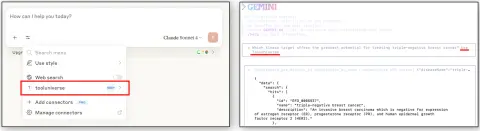
Beyond raw tool access it adds the plumbing an agent needs: a compact mode that collapses the 1000+ tools into 4–5 discovery tools to save context, tool composition for sequential or parallel chains, async execution for long-running jobs such as protein docking, a two-tier result cache (in-memory LRU plus SQLite), unified literature search across PubMed, Semantic Scholar, arXiv, bioRxiv and Europe PMC, and a set of pre-built agent skills for research workflows such as drug discovery, precision oncology and pharmacovigilance. It runs locally with no telemetry; tool arguments go only to the provider that answers them. Projects built on it include TxAgent for therapeutic reasoning and Medea for multi-omics target discovery.
What it does
- More than 1000 scientific tools — ML models, datasets, APIs and packages — behind one standardized AI-Tool Interaction Protocol
- Native MCP server plus a Python SDK and a `tu` CLI with list, grep, find, info, run, test, status, build and serve subcommands
- Works with Claude, GPT, Gemini, Qwen, DeepSeek and open models
- Compact mode reduces the full catalogue to 4–5 core discovery tools to save context window
- Tool composition, async long-running jobs, and a two-tier in-memory + SQLite result cache for speed and reproducibility
- Pre-built agent skills for research workflows including drug discovery, precision oncology, rare disease diagnosis and pharmacovigilance
Getting started
Pick the entry point that matches how you work: an MCP client, Claude Code, the Python SDK or the terminal. The project recommends `uv` rather than system `pip`.

Add it to an MCP client
Add ToolUniverse to your MCP config file; `uvx` fetches and runs the package. Agent skills install separately.
{
  "mcpServers": {
    "tooluniverse": {
      "command": "uvx",
      "args": ["--refresh", "tooluniverse"],
      "env": {"PYTHONIOENCODING": "utf-8"}
    }
  }
}
Or install as a Claude Code plugin
Claude Code users can skip the config file and install the plugin from the repo's marketplace.
claude plugin marketplace add mims-harvard/ToolUniverse
claude plugin install tooluniverse@tooluniverse
Install the Python SDK
Create a uv environment and install the package. The base install covers API and database tools; local ML, cheminformatics and plotting tools need extras such as `tooluniverse[all]`, and `tooluniverse-doctor` reports which groups are missing.
curl -LsSf https://astral.sh/uv/install.sh | sh   # if you don't have uv
uv venv --python 3.12 && source .venv/bin/activate
uv pip install tooluniverse
Run a tool from Python
Load the tools and call one with a name plus arguments — here a UniProt lookup of a protein's function.
from tooluniverse import ToolUniverse

tu = ToolUniverse()
tu.load_tools()

result = tu.run({
    "name": "UniProt_get_function_by_accession",
    "arguments": {"accession": "P05067"}
})
print(result)
Explore from the terminal
The `tu` CLI finds tools in natural language, shows a tool's schema, and runs it.
tu find 'protein structure analysis'
tu info UniProt_get_entry_by_accession
tu run UniProt_get_entry_by_accession accession=P12345
Commands and code are distilled from the project's own documentation — always check the official repo for the latest.
When to use it
- Reach for it when you want Claude, Gemini or another assistant to answer biomedical questions by querying real databases instead of relying on memory
- Reach for it to build a domain agent — drug discovery, target identification, pharmacovigilance — on top of a ready catalogue of scientific tools
- Reach for it when an agent needs hundreds of tools but you cannot afford to put every schema in the context window
- Reach for it to script scientific database lookups from Python or the shell through one consistent interface
How ToolUniverse compares
ToolUniverse alongside other open-source scientific workflow orchestration tools AI/TLDR tracks, ranked by GitHub stars.
| Tool | Stars | What it does |
|---|---|---|
| PaperOrchestra | ★ 6.5k | Google Cloud AI Research's multi-agent pipeline that turns an idea summary and an experimental log into a submission-ready LaTeX paper, with literature review, plots and refinement agents. |
| Nextflow | ★ 3.5k | Workflow language and engine for scalable, reproducible, portable data-driven computational pipelines, widely used in genomics. |
| FAROS | ★ 3.1k | A blueprint-driven AutoResearch runtime that carries a study from research interest to reviewed paper, passing a typed PlanPackage between ideation, planning, code, experiments and the ReviewX claim-evidence audit. |
| Snakemake | ★ 2.9k | Workflow management system for creating reproducible and scalable data-analysis pipelines with a Python-based rule syntax. |
| ToolUniverse | ★ 1.8k | Give any LLM or agent 1000+ scientific tools — databases, ML models and packages — over one protocol |
| NanoResearch | ★ 1.3k | An autonomous research pipeline that turns a topic into generated experiment code, runs it on local GPUs or SLURM, and writes a LaTeX paper from the measured results. |
| Cromwell | ★ 1.1k | Scientific workflow engine from the Broad Institute for running WDL and CWL pipelines from a laptop to cloud scale. |
| nf-core | ★ 334 | Community-curated collection of standardized, peer-reviewed bioinformatics pipelines built with Nextflow, plus tooling to build and lint them. |