
What is NanoResearch?
NanoResearch is an open-source Python pipeline that automates the whole paper-production loop. It sits in the Scientific Workflow Orchestration category of the Science & Biomedical AI tools and is open-source, written in Python and licensed MIT. To get started: install.
Overview
NanoResearch is an open-source Python pipeline that automates the whole paper-production loop. You give it a research topic; it searches and synthesises the literature, proposes an experiment blueprint, generates a runnable experiment project, executes it, analyses the outputs, draws figures, writes a LaTeX paper and then reviews and revises it. The nine stages — IDEATION, PLANNING, SETUP, CODING, EXECUTION, ANALYSIS, FIGURE_GEN, WRITING, REVIEW — end in an exported bundle with `paper.pdf`, `paper.tex`, `references.bib`, figures, code and data.
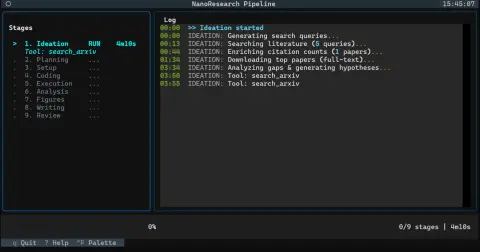
What separates it from AI writing tools that stop at an outline is the EXECUTION stage. It detects local GPUs or generates sbatch scripts and submits them to a SLURM cluster, monitors the jobs and training logs, and when a run fails it reads the error log, fixes the code and re-executes. The ANALYSIS stage parses the real training logs and metrics into structured evidence, and the writing stage consumes that evidence; the README states that when a class of experiment produced no real artifact, the system narrows its claims or records a limitation rather than filling in synthetic numbers.
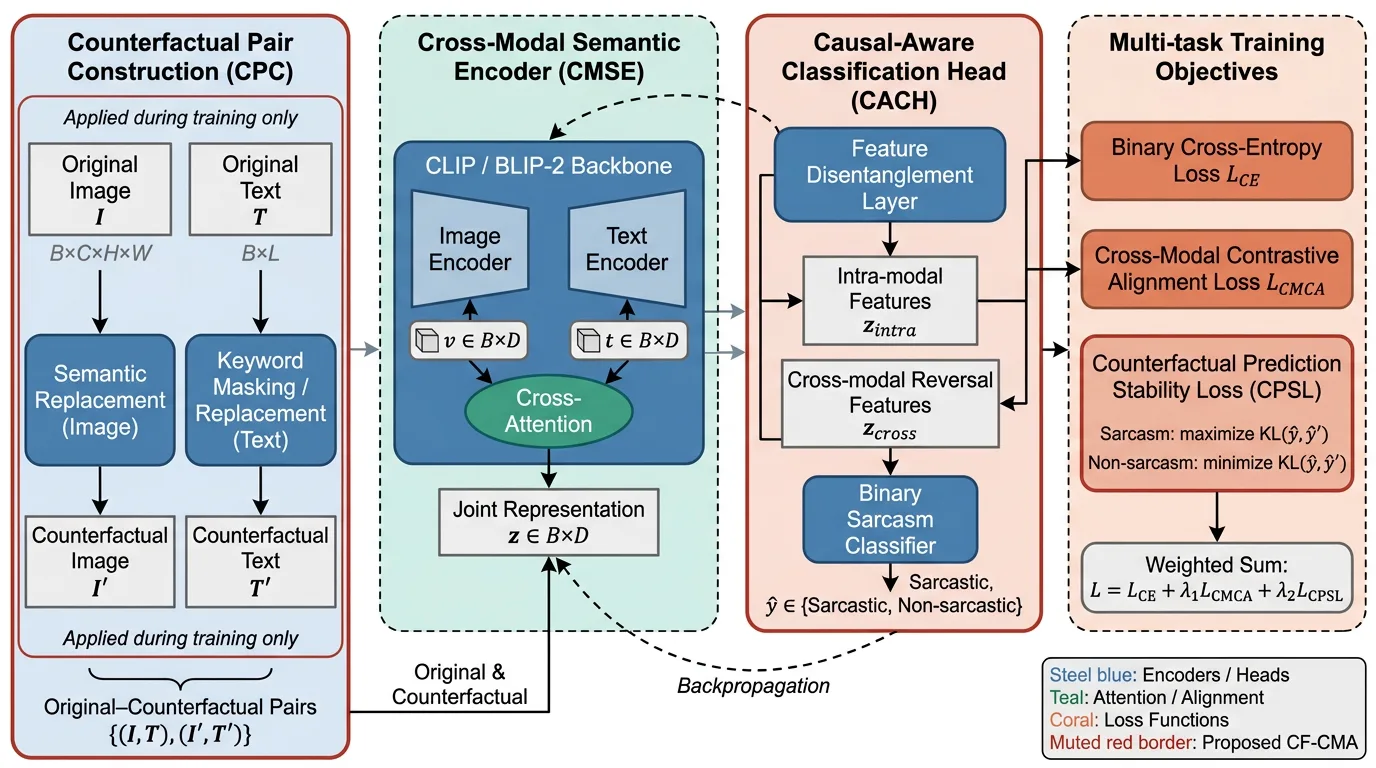
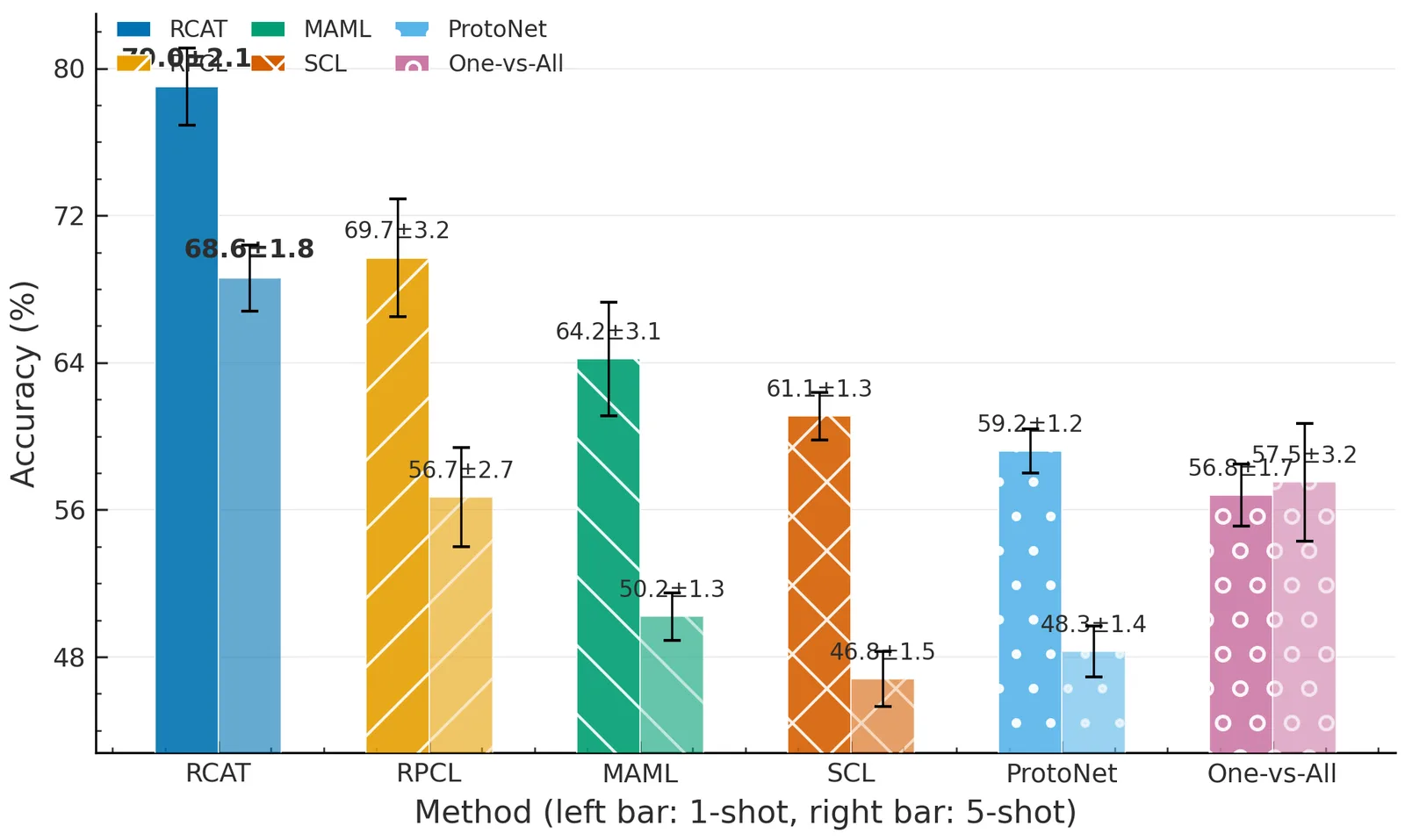
Every run lives in a resumable workspace under `~/.nanoresearch/workspace/research/<session_id>/` with a `manifest.json` that tracks stage state, so a failed stage can be resumed without starting over and every intermediate artifact stays inspectable. Models are routed per stage through OpenAI-compatible endpoints, so ideation, coding, writing and review can each use a different model. Beyond the CLI (with a full-screen TUI or plain streaming logs), the same pipeline can be driven from Claude Code slash commands, from Codex via the repository's `AGENTS.md`, or from a built-in Feishu (Lark) chat bot. An `evo` pipeline adds skill, memory and feedback-driven adaptation across repeated research runs.
What it does
- A nine-stage, checkpointed pipeline from topic to exported LaTeX paper, resumable from any failed stage with `nanoresearch resume`
- Real experiment execution on local GPUs or SLURM clusters, with sbatch generation, job monitoring, and automatic debug-and-retry on failure
- Evidence-grounded writing: figures, tables and numbers come from parsed training logs and metrics, and literature comes from OpenAlex and Semantic Scholar
- Per-stage model routing over OpenAI-compatible endpoints, plus execution profiles (`fast_draft`, `local_quick`, `cluster_full`) and NeurIPS / ICML / arXiv templates
- Several front ends over one workspace format: CLI with TUI, Claude Code `/project:*` commands, Codex via `AGENTS.md`, and a Feishu bot that sends back the finished PDF
- An `evo` self-evolving pipeline that reuses skills and project memory across runs, with optional SDPO LoRA adapter training on the collected feedback
Getting started
NanoResearch needs Python 3.10+, an OpenAI-compatible API endpoint for the text-model stages, and `tectonic` or `pdflatex` to compile the PDF (the project recommends `tectonic`). Image-model access is optional and only used for some figures. Literature search works anonymously; free OpenAlex and Semantic Scholar keys raise the rate limits.
Install
git clone https://github.com/OpenRaiser/NanoResearch.git
cd NanoResearch
pip install -e ".[dev]"
Point it at your model endpoint
Create `~/.nanoresearch/config.json` with your own `base_url` and `api_key`. Each stage (`ideation`, `planning`, `code_gen`, `writing`, `review`, the figure stages) can name its own model; the README's full example sets all of them. `NANORESEARCH_BASE_URL`, `NANORESEARCH_API_KEY` and `NANORESEARCH_TIMEOUT` override the file.
{
  "research": {
    "base_url": "https://your-openai-compatible-endpoint/v1/",
    "api_key": "your-api-key",
    "template_format": "neurips2025",
    "execution_profile": "local_quick",
    "writing_mode": "hybrid",
    "max_retries": 2,
    "ideation": { "model": "your-model", "temperature": 0.5, "max_tokens": 16384, "timeout": 600.0 },
    "writing": { "model": "your-model", "temperature": 0.4, "max_tokens": 16384, "timeout": 600.0 }
  }
}
Validate, then run the full pipeline
A dry run checks the configuration before anything expensive starts.
nanoresearch run --topic "Adaptive Sparse Attention Mechanisms" --dry-run

nanoresearch run --topic "Adaptive Sparse Attention Mechanisms" --format neurips2025 --verbose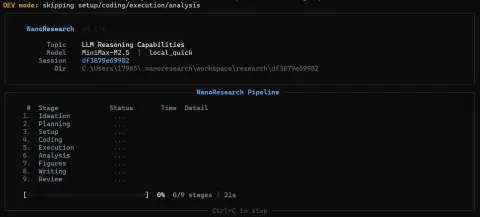
Resume a failed stage and export the paper
`nanoresearch status` and `nanoresearch inspect` show each stage's state and artifacts for a workspace.
nanoresearch resume --workspace ~/.nanoresearch/workspace/research/{session_id} --verbose

nanoresearch export --workspace ~/.nanoresearch/workspace/research/{session_id} --output ./my_paper
Or drive it from Claude Code
In Claude Code mode no API key is configured: Claude Code does the literature search, runs the experiments and compiles the LaTeX. Individual stages are available as `/project:ideation`, `/project:planning`, `/project:experiment`, `/project:analysis`, `/project:writing` and `/project:review`, and the workspaces are compatible with the Python CLI.
git clone https://github.com/OpenRaiser/NanoResearch.git
cd NanoResearch
claude
/project:research "your research topic"
Commands and code are distilled from the project's own documentation — always check the official repo for the latest.
When to use it
- Turning a research idea into a complete experiment-and-paper workspace quickly, to see whether it holds up before investing weeks by hand
- Letting a GPU box or SLURM allocation run generated experiments unattended, with automatic retries, while the results feed straight into analysis and figures
- Producing a LaTeX first draft grounded in real experiment artifacts — the project itself describes the output as a high-quality draft that still needs human review and revision
- Keeping an auditable research log, since every run leaves its plans, code, results, figures, drafts and logs in one inspectable workspace
How NanoResearch compares
NanoResearch alongside other open-source scientific workflow orchestration tools AI/TLDR tracks, ranked by GitHub stars.
| Tool | Stars | What it does |
|---|---|---|
| PaperOrchestra | ★ 6.5k | Google Cloud AI Research's multi-agent pipeline that turns an idea summary and an experimental log into a submission-ready LaTeX paper, with literature review, plots and refinement agents. |
| Nextflow | ★ 3.5k | Workflow language and engine for scalable, reproducible, portable data-driven computational pipelines, widely used in genomics. |
| FAROS | ★ 3.1k | A blueprint-driven AutoResearch runtime that carries a study from research interest to reviewed paper, passing a typed PlanPackage between ideation, planning, code, experiments and the ReviewX claim-evidence audit. |
| Snakemake | ★ 2.9k | Workflow management system for creating reproducible and scalable data-analysis pipelines with a Python-based rule syntax. |
| ToolUniverse | ★ 1.8k | An open-source ecosystem from Harvard's Zitnik Lab that gives any LLM or agent 1000+ scientific tools, databases and ML models through one protocol, via an MCP server, a Python SDK and the tu CLI. |
| NanoResearch | ★ 1.3k | An autonomous research pipeline that takes a topic through literature search, experiment code, real GPU or SLURM runs, figures and review to a LaTeX paper built on the measured results |
| Cromwell | ★ 1.1k | Scientific workflow engine from the Broad Institute for running WDL and CWL pipelines from a laptop to cloud scale. |
| nf-core | ★ 334 | Community-curated collection of standardized, peer-reviewed bioinformatics pipelines built with Nextflow, plus tooling to build and lint them. |