
What is PaperOrchestra?
PaperOrchestra is a multi-agent framework for writing AI research papers. It sits in the Scientific Workflow Orchestration category of the Science & Biomedical AI tools and is open-source, written in Python and licensed Apache-2.0. To get started: clone and install.
Overview
PaperOrchestra is a multi-agent framework for writing AI research papers. It starts from unstructured pre-writing material — an idea summary and an experimental log — plus a conference LaTeX template and its guidelines, and produces a full LaTeX manuscript with a literature review, citations and generated figures. The code comes from Google Cloud AI Research, accompanies the arXiv preprint 2604.05018, and is released under Apache-2.0; the README notes it is not an officially supported Google product.
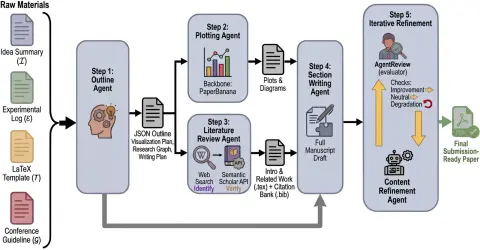
The work is split across specialised agents. An Outline agent reads the raw materials and writes a JSON outline containing a visualization plan, a research graph and a writing plan. Two branches then run from that outline: a Plotting agent (built on PaperBanana) generates plots and diagrams, while a Literature Review agent finds related work through web search and verifies each candidate with the Semantic Scholar API, emitting the introduction and related-work sections plus a citation bank in `.bib`. A Section Writing agent assembles the full draft, and a Content Refinement agent iterates on it against an AgentReview evaluator, keeping a revision when the reviewer score rises (or holds with its sub-scores no worse) and reverting to the previous draft and stopping when it drops.
Everything is driven from one Python CLI, `paper_writing_cli.py`, which takes a raw-materials folder, a template folder and an output folder; the writer, reflection, plotting and image models are each selectable by flag, with Gemini models as the defaults and OpenAI models supported through their API key. The repository ships CVPR 2025 and ICLR 2025 templates (add your own as a new folder under `templates/`), automated raters for literature-review and paper quality under `autoraters/`, and a Streamlit front end that launches the pipeline in the background.
The project page reports a side-by-side human evaluation on PaperWritingBench — raw materials reverse-engineered from 100 CVPR 2025 and 100 ICLR 2025 papers — in which eleven AI researchers preferred PaperOrchestra over a single-agent pipeline and AI Scientist-v2 by an absolute win-rate margin of 50–68% on literature review quality and 14–38% on overall manuscript quality, while a gap to the human-written papers remained. The benchmark dataset is not in the code repository; the README says it will be released separately.
What it does
- Five cooperating agents — Outline, Plotting, Literature Review, Section Writing and Content Refinement — run end to end from raw materials to a LaTeX manuscript
- Literature review that discovers papers by web search and verifies them against the Semantic Scholar API before they enter the citation bank
- Optional plotting workflow (`--use_plotting true`) that generates figures from code, with a critic loop capped by `--plotting_max_critic_rounds`
- Iterative refinement against an AgentReview evaluator: a revision that lowers the score is reverted and the loop stops
- Conference templates for CVPR 2025 and ICLR 2025, extendable by adding a folder under `templates/`
- Separately configurable writer, reflection, plotting and image models, plus a `--research_cutoff` month for the literature search
- Bundled autoraters for citation F1, literature-review quality and side-by-side paper quality
- A Streamlit demo that starts and monitors the writing pipeline from the browser
Getting started
PaperOrchestra runs from source in a Python 3.11 environment. You need an API key for the models you plan to use (Gemini through GEMINI_API_KEY or Vertex AI, or OpenAI) and a Semantic Scholar API key for the literature review, plus a folder holding your idea and experimental log.
Clone and install
git clone https://github.com/google-research/paper-orchestra.git
cd paper-orchestra

conda create -n paper_orchestra python=3.11
conda activate paper_orchestra
pip install -r requirements.txt
Add your API keys
Create a .env file in the project root. Fill in only the providers you use — for Gemini, either VERTEX_AI_PROJECT and VERTEX_AI_LOCATION or GEMINI_API_KEY; for OpenAI models, OPENAI_API_KEY.
SEMANTIC_SCHOLAR_API_KEY=your_semantic_scholar_api_key
OPENAI_API_KEY=your_openai_api_key
VERTEX_AI_PROJECT=your_vertex_ai_project
VERTEX_AI_LOCATION=your_vertex_ai_location
GEMINI_API_KEY=your_gemini_api_key
Prepare your raw materials
Put the idea document and the experimental log in one folder. By default the CLI looks for idea_sparse.md and experimental_log.md; --idea_filename and --experimental_log_filename override those names. Pick a template folder such as templates/cvpr2025 or templates/iclr2025.
Write the paper
--use_plotting true turns on the plotting agent; --writer_model_name and --reflection_model_name choose the LLMs. If --output_dir is omitted, a timestamped folder is created.
python paper_writing_cli.py \
  --raw_materials_dir /path_to_your_raw_materials/ \
  --latex_template_dir templates/cvpr2025 \
  --output_dir /path_to_your_output_folder/ \
  --use_plotting true
Or drive it from the browser
The Streamlit demo launches paper_writing_cli.py as a background process; open the URL it prints (usually http://localhost:8501). Ctrl+C in the terminal stops the pipeline on Linux; otherwise pkill -f paper_writing_cli.py cleans up.
streamlit run frontend/app.pyCommands and code are distilled from the project's own documentation — always check the official repo for the latest.
When to use it
- Reach for it when the experiments are done and you want a first full LaTeX draft in a conference template, generated from your notes and logs
- Reach for it when you want a related-work section whose citations are checked against Semantic Scholar rather than taken on an LLM's word
- Reach for it when you are studying automated paper writing and need a multi-agent baseline with its own quality autoraters
- Reach for it when your figures still need plotting and you want an agent to produce them from the experimental log
How PaperOrchestra compares
PaperOrchestra alongside other open-source scientific workflow orchestration tools AI/TLDR tracks, ranked by GitHub stars.
| Tool | Stars | What it does |
|---|---|---|
| PaperOrchestra | ★ 6.5k | A multi-agent pipeline from Google Cloud AI Research that turns an idea summary and an experimental log into a submission-ready LaTeX paper |
| Nextflow | ★ 3.5k | Workflow language and engine for scalable, reproducible, portable data-driven computational pipelines, widely used in genomics. |
| FAROS | ★ 3.1k | A blueprint-driven AutoResearch runtime that carries a study from research interest to reviewed paper, passing a typed PlanPackage between ideation, planning, code, experiments and the ReviewX claim-evidence audit. |
| Snakemake | ★ 2.9k | Workflow management system for creating reproducible and scalable data-analysis pipelines with a Python-based rule syntax. |
| ToolUniverse | ★ 1.8k | An open-source ecosystem from Harvard's Zitnik Lab that gives any LLM or agent 1000+ scientific tools, databases and ML models through one protocol, via an MCP server, a Python SDK and the tu CLI. |
| NanoResearch | ★ 1.3k | An autonomous research pipeline that turns a topic into generated experiment code, runs it on local GPUs or SLURM, and writes a LaTeX paper from the measured results. |
| Cromwell | ★ 1.1k | Scientific workflow engine from the Broad Institute for running WDL and CWL pipelines from a laptop to cloud scale. |
| nf-core | ★ 334 | Community-curated collection of standardized, peer-reviewed bioinformatics pipelines built with Nextflow, plus tooling to build and lint them. |