In plain English
Three companies dominate the hosted LLM API market: Anthropic (Claude), OpenAI (GPT), and Google (Gemini). All three let you send a message over HTTP and get a smart reply back — the same basic mechanic — but they differ meaningfully in pricing tiers, context-window limits, SDK design, built-in tools, and the tasks where they genuinely outperform each other.
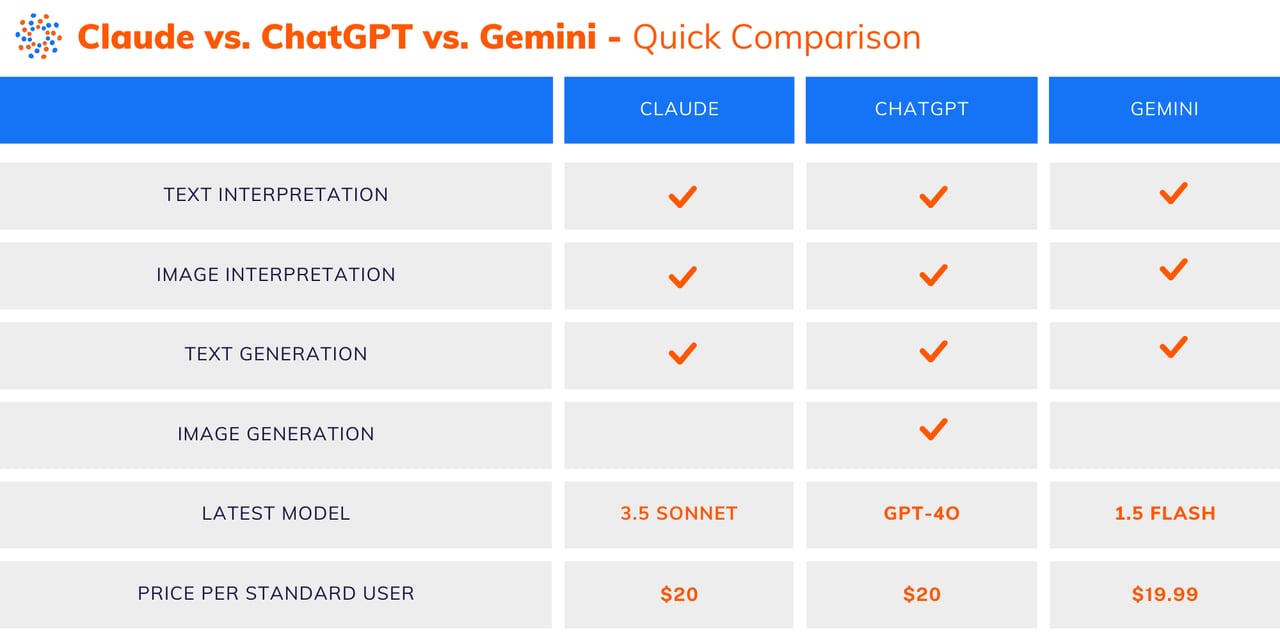
Think of them like three airlines flying the same routes. They all get you to the destination — a text completion — but they differ on legroom (context window), price (token rates), punctuality (latency and reliability), baggage policy (which modalities are native), and the lounge access you get (ecosystem integrations). Picking the wrong carrier for your route is annoying. Picking the wrong AI provider halfway through a production build is expensive.
The goal of this article is not to declare a winner. In mid-2026, frontier models from all three labs are within a few benchmark points of each other on most tasks. The goal is to give you a clear decision framework: which provider should be your default, and when should you reach for an alternative.
Why the choice matters
Switching providers mid-project is painful. The SDKs use different method signatures, the message formats differ in subtle ways, prompt phrasing that works perfectly for one model often needs re-tuning for another, and your eval harness has to be rebuilt from scratch. A 2026 migration between providers means rewriting the agent loop, re-running evals, and re-prompting every tool call. It is weeks of work, not hours.
Picking a provider affects five things that are hard to change later:
- Cost structure — token pricing, batch discounts, and caching savings compound over millions of calls. The cheapest model at a small scale is not always cheapest at production scale.
- Context window — if your use case involves long documents, large codebases, or multi-turn sessions that accumulate history, the effective context limit shapes your architecture from day one.
- Ecosystem lock-in — Google's Gemini slots naturally into Vertex AI, Firebase, and Android. OpenAI has the widest third-party integration surface. Anthropic has MCP and Claude Code for agentic workflows.
- Rate limits and reliability — each provider has different tier structures, burst limits, and SLA guarantees. Enterprise contracts differ significantly.
- Model roadmap — your app will need to upgrade models. Each lab has its own release cadence and deprecation policy.
Getting this decision right once — with a clear upgrade path — saves significant rework later.
How the three providers are structured
Each provider offers a tiered model family rather than a single model. The tiers follow the same pattern: a large flagship for hard tasks, a mid-tier workhorse for everyday production traffic, and a small/fast/cheap model for high-volume simple requests.
- Flagship: Claude Opus 4.8 — $5/$25 per 1M tokens
- Workhorse: Claude Sonnet 4.6 — $3/$15 per 1M tokens
- Fast/cheap: Claude Haiku 4.5 — $1/$5 per 1M tokens
- 1M token context window (Opus, Sonnet)
- 128K max output tokens
- Flagship: GPT-5.5 — $5/$30 per 1M tokens
- Workhorse: GPT-5.4 — $2.50/$15 per 1M tokens
- Fast/cheap: GPT-5.4 nano — lowest-cost tier
- 1M+ token context window (GPT-5.x)
- 128K max output tokens
- Flagship: Gemini 3.1 Pro — most advanced reasoning
- Fast: Gemini 3.5 Flash — agentic/coding workhorse
- Budget: Gemini 3.1 Flash-Lite — cheapest tier
- 1M token context window (2M on some models)
- Pricing varies by tier — check the pricing page
All three providers also offer batch processing at roughly 50% off standard rates for asynchronous, non-real-time jobs, and prompt caching that cuts the cost of re-sending the same large context on repeat calls by 80–90%. These two levers matter enormously for production cost planning.
API shape and SDK design
OpenAI set the de-facto standard for LLM API design. Its messages array with role and content fields became the template that many third-party tools and frameworks (LangChain, LlamaIndex, litellm) speak natively. The OpenAI Python and TypeScript SDKs are the most widely documented and have the deepest tutorial ecosystem.
Anthropic's API is similar in shape but makes one notable ergonomic choice: the system prompt is a top-level parameter, not another message in the array. This enforces a clean separation between static instructions and the live conversation, which many developers find cleaner for structured prompting. Anthropic's SDK exports richer response types (ToolUseBlock, ThinkingBlock, BashCodeExecutionOutputBlock) that reflect Claude's extended capabilities.
Google's Gemini API uses contents rather than messages, with parts arrays inside each turn that can hold text, images, audio, video, or file references natively. The Google Gen AI SDK provides a single interface that runs unchanged on both Google AI Studio (free tier, easy start) and Vertex AI (enterprise, with data residency and IAM).
# All three providers follow a similar call pattern
# — but the SDK method names and field names differ.

# Anthropic (Claude)
import anthropic
client = anthropic.Anthropic(api_key="...")
msg = client.messages.create(
    model="claude-sonnet-4-6",
    max_tokens=1024,
    system="You are a helpful assistant.",  # top-level param
    messages=[{"role": "user", "content": "Explain caching."}]
)
print(msg.content[0].text)

# OpenAI (GPT)
from openai import OpenAI
client = OpenAI(api_key="...")
resp = client.chat.completions.create(
    model="gpt-5.4",
    messages=[
        {"role": "system", "content": "You are a helpful assistant."},
        {"role": "user", "content": "Explain caching."}
    ]
)
print(resp.choices[0].message.content)

# Google (Gemini)
from google import genai
client = genai.Client(api_key="...")
response = client.models.generate_content(
    model="gemini-3-pro",
    contents="Explain caching."
)
print(response.text)Where each provider leads
Benchmarks across the three labs are now tightly clustered — no single provider dominates across the board. But real-world developer experience points to clear per-task advantages.
Claude: coding and long-context coherence
Claude Sonnet 4.6 holds the highest SWE-Bench Verified score of any publicly available model — roughly 72.7% — meaning it autonomously resolves nearly three-quarters of sampled real GitHub issues. Cursor and Windsurf, the two most-used AI code editors, both default to Claude for this reason. Claude is also consistently praised for maintaining coherence across very long contexts: where some models lose the thread deep in a 500K-token prompt, Claude tends to stay on task.
Claude's extended thinking mode (available on Opus and Sonnet) lets the model reason step-by-step before answering, which improves accuracy on complex architectural decisions and multi-file refactors. Anthropic has also built out MCP (Model Context Protocol) and agentic tooling (Claude Code) directly into its offering, making it the strongest choice for autonomous coding agents.
GPT: ecosystem breadth and production tooling
OpenAI's primary advantage is not a single capability — it is the ecosystem. More third-party tools, frameworks, tutorials, and StackOverflow answers are written for OpenAI than for any other provider. LangChain, LlamaIndex, AutoGen, and most agent frameworks treat OpenAI as the first-class default. If you are adopting an off-the-shelf AI framework, it will work with OpenAI out of the box.
OpenAI also has the most mature function calling and structured output APIs, and its Assistants / Agents SDK offers built-in primitives for handoffs, guardrails, and persistent threads that are production-ready. For enterprise applications that need robust tool use, fine-tuning, and a large support community, GPT is the safe default.
Gemini: multimodal depth and Google ecosystem
Gemini's native advantage is multimodal input handling: text, images, audio, video, and PDFs are all first-class input types in the same API call, without needing separate preprocessing. Gemini's Flash models can also natively generate images interleaved with text in a single response — a unique capability among the three providers.
For teams already in the Google ecosystem, Gemini integrates directly into Vertex AI (with enterprise IAM, data residency, and compliance), Firebase AI Logic (for mobile apps), Android development, and Google Cloud's data stack. Some Gemini Pro tiers also use a two-tier pricing model with a hard token threshold — prompts under the limit bill at the lower rate, and prompts above it bill the higher rate across the entire prompt (not just the excess tokens), so check the current pricing page and plan your batch sizes accordingly.
| Dimension | Claude (Anthropic) | GPT (OpenAI) | Gemini (Google) |
|---|---|---|---|
| Coding tasks | Best (SWE-Bench leader) | Strong | Good |
| Long-context coherence | Best | Strong | Strong |
| Ecosystem / third-party integrations | Growing (MCP) | Best | Strong (Google stack) |
| Multimodal (text+image+audio+video) | Text + image input only | Text + image input | All modalities, native generation |
| Flagship API price (input / output, 1M tokens) | $5 / $25 | $5 / $30 | Lowest of the three (see pricing page) |
| Workhorse price (input / output, 1M tokens) | $3 / $15 | $2.50 / $15 | Competitive (see pricing page) |
| Context window | 1M tokens | 1M+ tokens | 1M tokens (2M some models) |
| Prompt caching | Yes (90% savings) | Yes (automatic prefix) | Yes |
| Batch processing discount | 50% off | 50% off | 50% off |
| Agentic tooling | Claude Code, MCP | Agents SDK, function calling | ADK, A2A, native search |
A framework for picking your provider
Rather than picking the 'best' provider in the abstract, walk through these four questions in order. Your answers usually converge on an obvious default.
- What is the primary task? Coding or long-context document work → Claude. General-purpose production app with heavy tool use → GPT. Multimodal content, video/audio analysis, or a Google Cloud deployment → Gemini.
- What is the cost sensitivity at scale? Run your expected monthly token volume through each provider's pricing. At high output volumes, Gemini's flagship tier is often the cheapest. For mid-tier workhorses, GPT-5.4 and Claude Sonnet 4.6 are close. Always model batch + caching savings — they can cut your bill by 50–90%.
- What is your existing ecosystem? Heavily on Google Cloud? Gemini's Vertex integration avoids data egress headaches. Using an off-the-shelf agent framework (LangChain, AutoGen, CrewAI)? It likely expects OpenAI-compatible endpoints. Building an autonomous coding agent? Anthropic's MCP and Claude Code ecosystem is the most mature.
- What are your compliance and data-residency requirements? All three offer enterprise agreements with zero data retention for API calls. Vertex AI (Gemini) and Azure OpenAI (GPT) both have mature regional processing with formal data-residency SLAs. Anthropic's enterprise tier is newer but includes comparable guarantees.
Recommended starting stack
For most new projects with no strong constraints, a sensible starting point in mid-2026 is: Claude Sonnet 4.6 as your default workhorse (strong at coding and instruction following, predictable output quality), Haiku 4.5 or Gemini Flash-Lite for high-volume cheap calls (classification, routing, simple extraction), and Claude Opus 4.8 or GPT-5.5 on standby for the rare task that genuinely needs maximum capability.
Abstract your provider behind a thin wrapper from the start — a function like callLLM(prompt, options) — so that switching models or providers in future is a one-line change rather than a grep-and-replace across your codebase.
Going deeper
Once you have a working default provider, the next layer of optimization is model routing: automatically sending each request to the cheapest or fastest model that can handle it, rather than sending everything to the same model. A routing layer inspects the request — length, task type, required capabilities — and dispatches to a small model for simple queries and a large model only when necessary. This can cut average cost by 40–70% with no user-visible quality change.
Prompt caching is the single biggest cost lever most production apps leave on the table. All three providers support some form of it. With Anthropic, you explicitly mark the cacheable prefix of your prompt with a cache_control header; the first call writes the cache and subsequent calls pay ~10% of the normal input price for that prefix. With OpenAI, caching is automatic for prompts longer than 1,024 tokens that share the same prefix. With Gemini, you create a named cachedContent resource explicitly. The mechanics differ, so read each provider's caching docs before deploying.
Evals are the most underrated part of the provider decision. Before committing to a provider at scale, build a small eval set — 50 to 200 real inputs with expected outputs or human ratings — and run every candidate model against it. Benchmark scores on academic datasets do not always predict which model performs best on your task distribution. A model that scores 5% lower on SWE-Bench might outscore the leader on your specific domain, or vice versa.
For agentic applications that run long multi-step tasks, the provider's tool-calling reliability and error recovery matter more than raw benchmark scores. In 2026, all three labs shipped dedicated agent SDKs: Anthropic's MCP + Claude Code for filesystem-aware coding agents, OpenAI's Agents SDK with handoffs and guardrails primitives, and Google's ADK (Agent Development Kit) plus A2A protocol for multi-agent orchestration. Evaluate tool-call accuracy and retry behavior on your specific tool set, not just general reasoning.
FAQ
Is Claude really better than GPT for coding?
On the SWE-Bench Verified benchmark — which tests models on real GitHub issues — Claude Sonnet 4.6 scores around 72.7%, the highest of any publicly available model as of mid-2026. The two most popular AI code editors (Cursor and Windsurf) both default to Claude. That said, benchmarks measure a particular slice of coding tasks; run your own eval on the kinds of code changes your app requires before committing.
Why is Gemini so much cheaper than Claude and GPT at the flagship tier?
Gemini's flagship tier often undercuts Claude Opus and GPT-5.5 on input price. Google can price aggressively because it runs inference on its own custom TPU hardware and uses Gemini to drive broader Google Cloud adoption. The catch on some tiers is a split-pricing threshold: prompts over a token limit jump to a higher rate, and that higher rate can apply to the entire prompt, not just the excess tokens — so check the current pricing page before sizing your prompts.
Can I use multiple providers in the same app?
Yes, and many production apps do. A common pattern is: Gemini Flash-Lite or a GPT nano tier for cheap, high-volume classification; Claude Sonnet for core reasoning; a frontier model on standby for hard escalations. Wrapping calls behind a thin abstraction layer (or a library like litellm) makes multi-provider routing straightforward. The main cost is maintaining separate prompt sets if the models respond differently to the same instructions.
Do all three providers support prompt caching and batch processing?
Yes. All three offer batch processing at roughly 50% off standard rates. All three support prompt caching that cuts repeat-context costs by 80–90%. The mechanics differ: Anthropic uses explicit cache_control markers, OpenAI caches automatically for long shared prefixes, and Google requires creating a named cachedContent resource. Read each provider's caching docs carefully — the savings are substantial but the implementation varies.
Which provider is best for multimodal applications that involve video and audio?
Gemini. Claude and GPT handle text and image inputs, but Gemini accepts text, images, audio, video, and PDFs natively in the same API call. Gemini's Flash models can also generate images interleaved with text output. If your app needs to reason about video or audio directly — not just transcribe it first — Gemini is the only choice among the three.
How do I avoid being locked into one provider?
Wrap every provider call behind a thin abstraction in your own code (e.g., a callLLM function) rather than scattering SDK calls throughout your codebase. Use an OpenAI-compatible proxy or a library like litellm if you want to swap providers without changing call sites. Build an eval harness from day one so you can empirically test a new provider before switching, rather than guessing. This prep work costs a day upfront and saves weeks later.