

Overview
LFM3-1.7B is the text model of LFM3, the third generation of Liquid Foundation Models, announced on the Liquid AI blog on October 27, 2026. It has 1.73B parameters, a 256K-token context window (input plus output) and a 128,000-token vocabulary, and it supports 16 languages including English, Chinese, Arabic, Hindi, Japanese and Russian. Liquid describes it as a model for local agents, tool calling, structured outputs and domain fine-tuning: at 4-bit precision it takes about 1 GB of memory. Reasoning is on by default and can be switched off with enable_thinking=False.
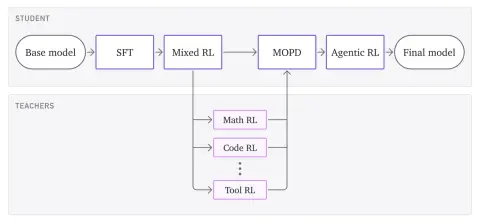
LFM3 introduces a tri-hybrid architecture. Of its 24 layers, 13 are gated short convolutions (kernel size 7, up from 3 in LFM2), 5 are sliding-window attention layers with a 256-token window and 6 are global attention layers. Pre-training covers 22T tokens; the last 3.5T are curated mid-training data with more agentic traces and tool calls, which also extends the context to 256K. Post-training runs 1.75T tokens of supervised fine-tuning, mixed reinforcement learning across many domains, multi-domain on-policy distillation from six specialist RL teachers (code, math, tool use, long context, agentic work and enterprise workflows), and agentic RL inside real agent harnesses. The same LFM3-1.7B-Base also branches into LFM3-VL-2B (vision), LFM3-Audio-2B, LFM3-Omni-2B and two decision models.
On Liquid's 29-benchmark comparison it averages 49.37, ahead of Qwen3.5 9B (47.24), Qwen3.5 4B (39.27), MiniCPM5 2B (39.19), Gemma 4 E4B (31.74) and LFM2.5-2.6B (31.55). Its leads are in agents and tool use — AutomationBench 41.29 against 15.10 for Qwen3.5 9B, WebArena-Verified 38.42 against 28.94, BFCL V4 71.39 against 62.83 — and in instruction following (IFEval 96.66, IFBench 73.03). Liquid is explicit that larger models still win on knowledge and agentic coding: Qwen3.5 9B scores 80.40 on GPQA Diamond to its 63.37 and 51.20 on SWE-bench Verified (OpenCode) to its 43.40, and the model card advises retrieval or search for knowledge-heavy tasks and does not recommend it for agentic coding.
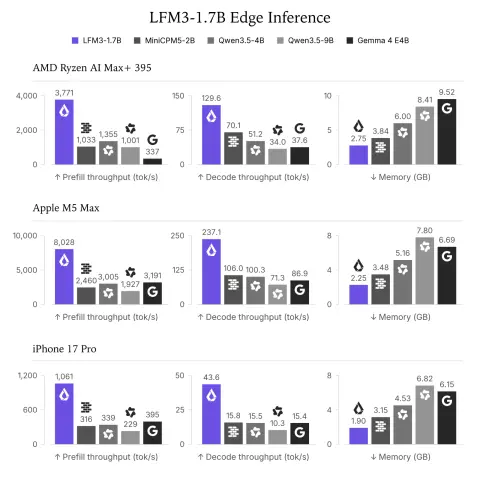
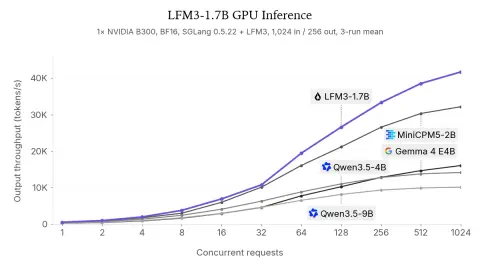
On Liquid's edge benchmarks (llama.cpp, Q4_0, 32K context) it decodes 237.1 tokens/s on an Apple M5 Max, 129.6 on an AMD Ryzen AI Max+ 395 and 43.6 on an iPhone 17 Pro, using the least memory of the compared models (2.25 GB on the M5 Max); a full 128K-token context needs 1.6 GB of KV cache. On one NVIDIA B300 with SGLang it can produce 3.6 billion tokens per day at 1,024 concurrent requests. Weights ship under the LFM Open License v1.0, with support in Transformers, vLLM, SGLang, llama.cpp, Ollama, LM Studio, MLX and ONNX Runtime.
| Released | 2026-10-27 |
|---|---|
| License | LFM Open License v1.0 |
| Weights | Open weights |
| Parameters | 1.73B |
| Context | 256K |
| Architecture | Tri-hybrid, 24 layers: 13 gated short convolutions (kernel size 7), 5 sliding-window attention layers (256-token window) and 6 global attention layers, with head-wise gated attention, partial RoPE and sandwich norm; 128K-token vocabulary |
| Modalities | Text |
| Status | Open weights on Hugging Face (BF16, FP8, NVFP4, GGUF, MLX and ONNX packings, plus a base model); also on the Liquid Playground and Liquid API |
Benchmarks
Liquid AI's published comparison: LFM3-1.7B against five small models on 29 benchmarks
| Benchmark | LFM3-1.7B | LFM2.5-2.6B | MiniCPM5 2B | Gemma 4 E4B | Qwen3.5 4B | Qwen3.5 9B |
|---|---|---|---|---|---|---|
| LiveClaw | 45.6 | 14.7 | 30.37 | 20.36 | 19.94 | 35.77 |
| Claw-Eval General (EN), average | 68.64 | 62.63 | 60.74 | 56.14 | 61.96 | 66.53 |
| Claw-Eval General (EN), pass^3 | 51.4 | 37.52 | 34.58 | 22.43 | 42.99 | 51.87 |
| BrowseComp-Plus (OpenClaw subset) | 37 | 26.33 | 16.83 | 21 | 24.67 | 38 |
| WebArena-Verified | 38.42 | 3.02 | 9.11 | 17.06 | 21.92 | 28.94 |
| EnterpriseOps-Gym | 28.2 | 7.94 | 13.41 | 9.86 | 25.96 | 28.97 |
| AutomationBench (public) | 41.29 | 0.94 | 4.71 | 1.92 | 8.67 | 15.1 |
| BFCL V4 | 71.39 | 55.89 | 62.65 | 48.25 | 55.12 | 62.83 |
| ToolSandbox | 80.36 | 78.04 | 68.16 | 69.27 | 75.4 | 76.41 |
| MCP-Atlas | 32.57 | 16.45 | 26.38 | 6.19 | 41.37 | 42.67 |
| τ³-bench | 68.01 | 56.77 | 69.44 | 33.53 | 65.98 | 67.11 |
| SWE-bench Verified (OpenCode) | 43.4 | 18 | 34.8 | 0.5 | 41.2 | 51.2 |
| SWE-bench Multilingual (OpenCode) | 23 | 8 | 15.67 | 0.67 | 23.33 | 35 |
| Terminal-Bench 2.1 (OpenCode) | 12.92 | 0 | 5.62 | 0 | 13.48 | 17.98 |
| LiveCodeBench v6 | 73.46 | 60.57 | 70.52 | 71 | 61.99 | 69.86 |
| LiveCodeBench Pro 25Q2 | 31.74 | 19.16 | 29.34 | 29.94 | 24.25 | 34.43 |
| SciCode | 28.47 | 16.32 | 27.78 | 25 | 23.02 | 31.6 |
| IFEval | 96.66 | 95.39 | 87.83 | 90.02 | 92.52 | 92.08 |
| IFBench | 73.03 | 60.48 | 62.08 | 44.56 | 38.16 | 48.84 |
| IFStruct | 93.72 | 82.18 | 72.65 | 78.45 | 87.05 | 89.2 |
| Multi-IF | 89.1 | 84.8 | 73.19 | 81.03 | 80.32 | 84.44 |
| GPQA Diamond | 63.37 | 57.78 | 65.15 | 57.88 | 75.76 | 80.4 |
| Humanity's Last Exam (no tools) | 7.17 | 5.88 | 8.2 | 4.77 | 12.84 | 16.41 |
| Humanity's Last Exam (with tools) | 13.9 | 9.6 | 11.5 | 6 | 11.6 | 17.5 |
| AA-Omniscience (public) | 0.5 | -33.17 | -5 | -15.33 | -57.17 | -28 |
| AA-Omniscience accuracy (public) | 7.07 | 8.75 | 9.13 | 9.83 | 15.67 | 13.17 |
| AA-Omniscience non-hallucination (public) | 92.93 | 53.69 | 84.44 | 72.09 | 13.64 | 52.59 |
| AA-LCR | 52.83 | 6 | 49.34 | 39.33 | 52.67 | 62 |
| RULER 128K | 65.56 | 1.15 | 37.96 | 18.82 | 84.63 | 87.11 |
| Average | 49.37 | 31.55 | 39.19 | 31.74 | 39.27 | 47.24 |
This model's scores
- IFEval96.66%
- IFStruct93.72%
- ToolSandbox80.36%
- LiveCodeBench v673.46%
- BFCL V471.39%
- τ³-bench68.01%
- RULER 128K65.56%
- GPQA Diamond63.37%
- LiveClaw45.6%
- SWE-bench Verified (OpenCode)43.4%
- AutomationBench (public)41.29%
- WebArena-Verified38.42%
Scores on a 0–100 scale (25-point gridlines); higher is better. Each benchmark links to its published source.
Strengths
- Highest average on Liquid's 29-benchmark comparison (49.37), above Qwen3.5 9B (47.24) at under a fifth of the parameters
- Agentic and tool-use leads: AutomationBench 41.29, WebArena-Verified 38.42, LiveClaw 45.60, BFCL V4 71.39, ToolSandbox 80.36
- Strong instruction following: IFEval 96.66, IFBench 73.03, IFStruct 93.72, Multi-IF 89.10
- 256K-token context, with 1.6 GB of KV cache for a full 128K context
- Fast on phones and laptops: 237.1 tokens/s decode on an Apple M5 Max and 43.6 on an iPhone 17 Pro (llama.cpp, Q4_0, 32K context)
- Supports deferred tools and tool search through its chat template, and is built to be fine-tuned on a single GPU
Best for
- Running a local agent on a phone or laptop inside a harness such as Hermes Agent, Pi or OpenClaw
- Tool calling and structured-output extraction where instruction following matters more than stored knowledge
- Retrieval- or search-augmented assistants, the pairing Liquid recommends for knowledge-heavy tasks
- Single-GPU fine-tuning (SFT, DPO, GRPO or continued pre-training with TRL) for a narrow domain, format or toolset
- Very high-throughput batch agents on a GPU, such as Liquid's run of more than 300,000 parallel agents over the Enron email archive
How to access
| Provider | Model ID |
|---|---|
| Liquid API ↗ | — |
LFM (Liquid Foundation Models) — every version
The full lineage of the LFM (Liquid Foundation Models) line, newest first. Every version has its own page — click any to compare specs, benchmarks and pricing.
| Version | Released | Context | License |
|---|---|---|---|
| LFM3-1.7Bcurrent | 2026-10-27 | 256K | LFM Open License v1.0 |
| LFM3-VL-2B | 2026-10-27 | 128K | LFM Open License v1.0 |
| LFM2.5-24B-A2B | 2026-10-13 | 128K | LFM Open License v1.0 |
FAQ
What is new in LFM3 compared with LFM2.5?
A tri-hybrid architecture: 24 layers mixing 13 gated short convolutions (kernel size 7, up from 3), 5 sliding-window attention layers and 6 global attention layers, plus a 256K-token context window. Liquid reports that LFM3-1.7B outperforms LFM2.5-2.6B while using 35% fewer parameters — 49.37 against 31.55 on its benchmark average.
How much memory does it need?
About 1 GB at 4-bit precision, according to the model card. In Liquid's llama.cpp tests at Q4_0 with a 32K context, peak memory was 2.25 GB on an Apple M5 Max and 1.90 GB on an iPhone 17 Pro; a full 128K-token context needs 1.6 GB of KV cache.
What is it good and bad at?
It leads Liquid's comparison on agentic and tool-use benchmarks (AutomationBench, WebArena-Verified, LiveClaw, BFCL V4) and on instruction following. Larger models such as Qwen3.5 9B beat it on knowledge tests like GPQA Diamond and on agentic coding like SWE-bench Verified, so Liquid recommends retrieval or search for knowledge-heavy tasks and does not recommend it for agentic coding or complex multi-step reasoning.
Which other models are in the LFM3 family?
Six 2B-class models branched from LFM3-1.7B-Base: the text model LFM3-1.7B, LFM3-VL-2B (vision), LFM3-Audio-2B, LFM3-Omni-2B, and two decision models specialized from the vision and omni models.
Does it think before answering?
Reasoning is enabled by default. Setting enable_thinking=False in the chat template turns thinking traces off, though the model card notes this can be inconsistent on reasoning-heavy tasks.