

Overview
LFM3-VL-2B is the vision-language model of Liquid AI's LFM3 family, announced on the Liquid AI blog on October 27, 2026. It has 1.92B parameters — the 1.73B LFM3 language model, a new 164M in-house vision encoder and a 25M projector — and takes text, images at native resolution and video sampled at 2 fps, with a 128K-token context window and support for 16 languages. It is the first LFM vision model to accept video, and the first to think step by step before answering, which the model card says helps most on math, charts and multi-step visual questions.
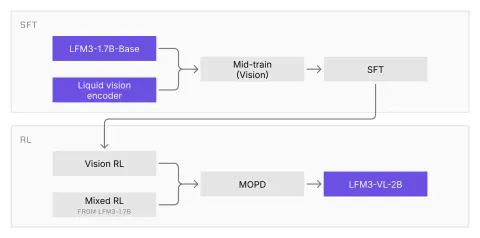
Liquid built it for on-device visual tasks: questions about recorded video, reading documents, charts and app screens, finding objects in an image and spatial reasoning for robots. Training starts from LFM3-1.7B-Base and the Liquid vision encoder, runs vision mid-training and supervised fine-tuning, then vision reinforcement learning; multi-domain on-policy distillation then merges the vision RL model with the mixed-RL model from LFM3-1.7B. The model card does not recommend it for coding, multi-turn conversations or complex reasoning.
Across Liquid's 62 vision benchmarks, grouped into ten categories, it averages 71.4 with thinking (62.1 without). Liquid's card puts it at least 8 points ahead of models of similar size — Qwen3.5 2B averages 64.0, LFM2.5-VL-3B 57.6, MiniCPM-V 4.7 1B 57.5 and Gemma 4 E2B 53.6 — level with Gemma 4 12B (71.7), within 2 points of GPT-5.6 Luna and Qwen3.5 4B (73.4 each) and above Gemini 3.5 Flash Lite (70.0). Its strongest categories are document, OCR and chart (83.9), GUI understanding (83.1) and visual grounding (77.3); the agentic category (42.5) is where the hosted models lead, with 56.1 for GPT-5.6 Luna and 62.4 for Gemini 3.5 Flash Lite.
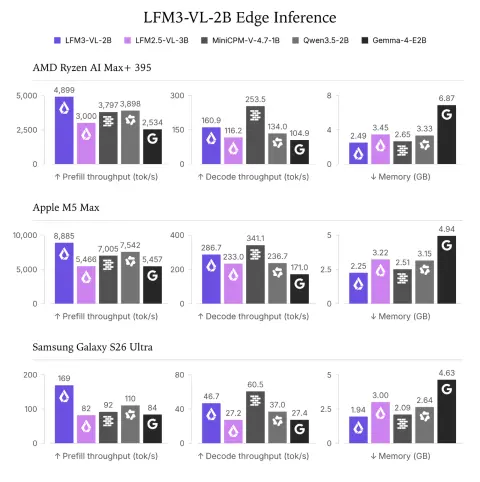
On Liquid's edge benchmarks it prefills fastest and uses the least memory of the five compared models on an AMD Ryzen AI Max+ 395, an Apple M5 Max and a Samsung Galaxy S26 Ultra — for example 8,885 tokens/s prefill and 2.25 GB on the M5 Max — while MiniCPM-V 4.7 1B decodes faster on all three. Weights ship on Hugging Face under the LFM Open License v1.0 with Transformers support (5.21.0 or later); at release the model card lists llama.cpp, SGLang and vLLM support as in review or in progress, with llama.cpp lacking video input for now.
| Released | 2026-10-27 |
|---|---|
| License | LFM Open License v1.0 |
| Weights | Open weights |
| Parameters | 1.92B (1.73B language model + 164M vision encoder + 25M projector) |
| Context | 128K |
| Architecture | LFM3 tri-hybrid language model (24 layers: 13 gated short convolutions, 5 sliding-window attention, 6 global attention) plus a new 14-layer Liquid vision encoder (8 gated depthwise 2D convolutions, 6 bidirectional attention layers, 16×16 patches with 2D rotary embeddings); native-resolution images, video sampled at 2 fps |
| Modalities | Text, Image, Video |
| Status | Open weights on Hugging Face (BF16, FP8, NVFP4, GGUF, MLX and ONNX packings); also on the Liquid Playground and Liquid API |
Benchmarks
Liquid AI's published comparison: category averages over 62 vision benchmarks
| Benchmark | LFM3-VL-2B | LFM3-VL-2B (no think) | LFM2.5-VL-3B | MiniCPM-V 4.7 1B | Qwen3.5 2B | Qwen3.5 4B | InternVL3.5 4B | Gemma 4 E2B | Gemma 4 12B | GPT-5.6 Luna | Gemini 3.5 Flash Lite |
|---|---|---|---|---|---|---|---|---|---|---|---|
| General | 66 | 56.4 | 57.6 | 59.8 | 64 | 73 | 61.2 | 56.9 | 74 | 72.2 | 74.1 |
| Perception | 75.6 | 68.9 | 67.9 | 65.5 | 71.2 | 77.1 | 63.2 | 59.1 | 73.5 | 71 | 73 |
| Document, OCR & Chart | 83.9 | 71.6 | 71.2 | 73 | 79.1 | 84.3 | 72.1 | 72.3 | 85.7 | 84.4 | 82.3 |
| Math & logical reasoning | 68.8 | 41 | 40.6 | 51.8 | 61 | 78.4 | 46.4 | 51.8 | 79.3 | 77.3 | 66.7 |
| Visual grounding | 77.3 | 72.6 | 68.3 | 51.1 | 61.2 | 67 | 63.6 | 41.2 | 74.1 | 72.7 | 63.5 |
| Embodied reasoning | 64.4 | 57.9 | 48 | 45.3 | 51.2 | 63.2 | 48.9 | 41.5 | 59.1 | 61.5 | 50.3 |
| GUI understanding | 83.1 | 81.5 | 66 | 45.3 | 67.2 | 81.1 | 68.5 | 44.3 | 76.1 | 82.5 | 71 |
| Video | 61.2 | 54 | 41.3 | 53.7 | 57 | 67.5 | 59.7 | 46.6 | 58.9 | 72.8 | 70 |
| Multilingual | 84.4 | 76.2 | 81.2 | 77.4 | 78.6 | 83.9 | 79 | 73.4 | 86.1 | 82.1 | 85.8 |
| Agentic | 42.5 | 32.9 | 21.1 | 16.9 | 15.2 | 31.3 | — | 23.8 | 43.6 | 56.1 | 62.4 |
| Average | 71.4 | 62.1 | 57.6 | 57.5 | 64 | 73.4 | 61.1 | 53.6 | 71.7 | 73.4 | 70 |
This model's scores
- Multilingual (category average)84.4%
- Document, OCR & Chart (category average)83.9%
- GUI understanding (category average)83.1%
- Visual grounding (category average)77.3%
- Perception (category average)75.6%
- MMStar74.4%
- Math & logical reasoning (category average)68.8%
- Embodied reasoning (category average)64.4%
- Video (category average)61.2%
- Agentic (category average)42.5%
Scores on a 0–100 scale (25-point gridlines); higher is better. Each benchmark links to its published source.
Strengths
- Category average of 71.4 across 62 vision benchmarks, level with Gemma 4 12B (71.7) at about a sixth of the parameters
- Document, OCR and chart reading (83.9) and GUI understanding (83.1), ahead of GPT-5.6 Luna's 82.5 on GUI
- Visual grounding (77.3) and embodied reasoning (64.4), the top scores in its comparison — a basis for robotics applications
- First LFM vision model with video input (sampled at 2 fps) and step-by-step thinking
- Fastest prefill and lowest memory of its edge comparison on laptop and phone hardware (2.25 GB on an Apple M5 Max, 1.94 GB on a Galaxy S26 Ultra)
- Shares LFM3's tool-calling format and deferred tool search, and can be fine-tuned with TRL
Best for
- Answering questions about recorded lectures, phone walkthroughs or camera clips on the device
- Reading receipts, documents, charts and app screens — for example extracting structured JSON from receipt photos, one of Liquid's fine-tuning notebooks
- Locating objects in an image and reasoning about their spatial layout for robots
- On-device GUI agents that need to understand screenshots
- Transcribing images of equations to LaTeX after GRPO fine-tuning, another of Liquid's notebooks
How to access
| Provider | Model ID |
|---|---|
| Liquid API ↗ | — |
LFM (Liquid Foundation Models) — every version
The full lineage of the LFM (Liquid Foundation Models) line, newest first. Every version has its own page — click any to compare specs, benchmarks and pricing.
| Version | Released | Context | License |
|---|---|---|---|
| LFM3-1.7Bcurrent | 2026-10-27 | 256K | LFM Open License v1.0 |
| LFM3-VL-2B | 2026-10-27 | 128K | LFM Open License v1.0 |
| LFM2.5-24B-A2B | 2026-10-13 | 128K | LFM Open License v1.0 |
FAQ
What inputs does LFM3-VL-2B accept?
Text, images at native resolution and video sampled at 2 frames per second. It is the first LFM vision model with video input; each 2×2 block of image patches becomes one language token.
How does it compare with larger models?
On Liquid's 62-benchmark comparison it averages 71.4, against 71.7 for Gemma 4 12B, 73.4 for GPT-5.6 Luna and Qwen3.5 4B, and 70.0 for Gemini 3.5 Flash Lite. Models of similar size score at least 8 points lower, such as Qwen3.5 2B at 64.0.
Can I run it with llama.cpp?
GGUF checkpoints are published, but at release the model card says LFM3-VL support in llama.cpp is in review (ggml-org/llama.cpp#31252) and does not cover video input yet. Transformers 5.21.0 or later runs it today; SGLang support is in review and vLLM support is in progress.
Does thinking matter?
Yes. With thinking the model averages 71.4 across Liquid's categories; without it, 62.1. The largest gap is in math and logical reasoning, 68.8 against 41.0.