In plain English
There are two fundamentally different strategies AI labs use to generate images from text. Diffusion models start with a canvas of pure random noise and sculpt it into a coherent picture by running many small denoising steps in parallel across the whole image. Autoregressive models work more like a language model writing a sentence — they break the image into a grid of small tokens and predict each one sequentially, left-to-right, top-to-bottom, one token at a time.
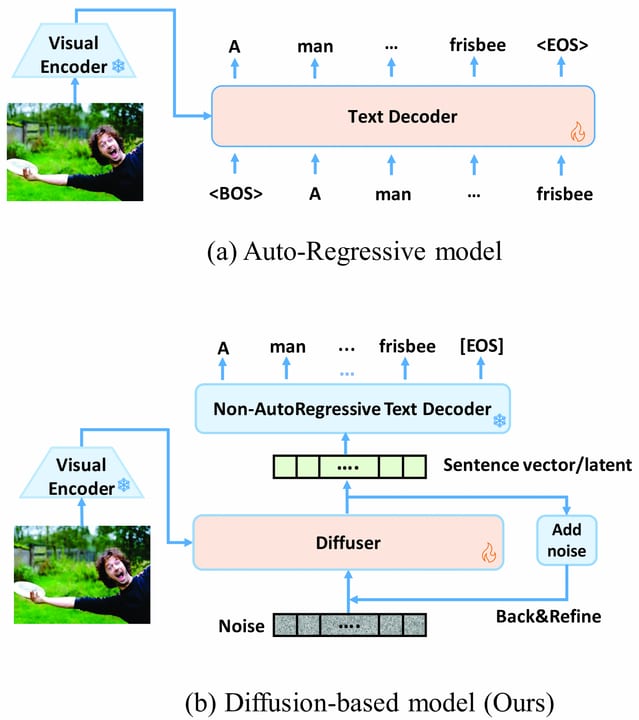
A good analogy: think of a diffusion model as developing a Polaroid photo — the whole image appears at once, gradually sharpening out of a grey haze. An autoregressive model is more like a printer head sweeping across a page, laying down each strip of dots in order until the picture is complete. The Polaroid approach is fast and holistic; the printer approach is methodical, which makes it easier to get fine details (like text) exactly right.
Both approaches are in production at frontier labs right now. Stable Diffusion, Flux, Midjourney, and Google Imagen are all diffusion-based. OpenAI's GPT Image generation (the one in ChatGPT) switched from the diffusion-based DALL-E series to a native autoregressive architecture integrated directly into the GPT transformer — a significant architectural shift that was announced in early 2025.
Why it matters
For most of the 2020s, diffusion models were the clear default for image generation. But they have a persistent blind spot: text rendering. Ask a diffusion model to produce an image with words in it — a product label, a slide, a billboard — and the letters often come out garbled, misspelled, or nonsensical. This happens because diffusion models work over pixels globally; they have no concept of the sequential, character-by-character structure of written language.
Autoregressive models sidestep this by treating image generation the same way they treat text generation — as a next-token prediction problem. Because the model already knows how to predict sequences of characters in text, integrating image generation into the same token stream gives it a natural advantage for tasks that blend language and visuals. OpenAI reported substantially better text-in-image fidelity with its native GPT image model compared to the earlier diffusion-based DALL-E series.
As a builder, the architecture choice downstream of you affects: latency (autoregressive is slower at high resolution), prompt adherence (autoregressive is generally stronger), ecosystem (far more open-source tooling exists for diffusion), fine-tuning (diffusion has a richer ecosystem of LoRAs and ControlNets), and multimodal integration (autoregressive fits naturally into a unified text-and-image model).
- Choosing an API: GPT Image vs Flux vs Stable Diffusion — understanding the underlying architecture explains why their failure modes differ.
- Text-in-image use cases: Autoregressive models are currently the safer bet for accurate text rendering inside generated images.
- Fine-tuning and customization: Diffusion's LoRA/ControlNet ecosystem is far more mature for style transfer and subject consistency.
- Cost and latency: Diffusion models generate all tokens in parallel across denoising steps; autoregressive models do sequential forward passes, making high-res generation slower.
- Multimodal pipelines: If you are already using a GPT-class model for reasoning, using its native image generation avoids a round-trip to a separate diffusion API.
How it works
Diffusion: sculpting from noise
A diffusion model is trained in two phases. In the forward process, real training images have Gaussian noise added to them step by step — typically around 1,000 steps — until the image is indistinguishable from pure static. The model never sees this process; it is just data preparation. In the reverse process, a neural network (originally a U-Net, now typically a Diffusion Transformer or DiT) is trained to predict what the slightly-less-noisy version of its input should look like. Repeat that denoising prediction enough times, starting from pure noise, and you reconstruct a fresh image.
Modern latent diffusion models (Stable Diffusion, Flux, Imagen) work in a compressed latent space rather than on raw pixels. A variational autoencoder (VAE) first compresses the image down 8x or more. The denoising transformer then operates on this smaller latent grid, which dramatically reduces compute. At generation time the finished latent is decoded back to pixels by the VAE decoder.
Autoregressive: painting token by token
An autoregressive image model first needs a way to turn continuous pixel data into discrete tokens. A VQ-VAE (vector-quantized variational autoencoder) compresses the image into a grid of integers — for example, a model might use a 32x32 token grid for a 256x256 image, where each token corresponds to an 8x8 pixel patch. These integer tokens are then concatenated with the text tokens and fed into a standard transformer decoder.
At inference time, the model predicts image tokens one by one from left to right, top to bottom — exactly like predicting the next word in a sentence. Because each prediction is conditioned on all previous tokens, the model can maintain global context throughout: if the top-left of the image shows a sunset sky, the model can make the bottom-right water reflect it correctly, because those early tokens are in its context window when it generates the later ones.
Key tradeoffs side by side
Neither architecture dominates across every dimension. The table below summarizes where each approach wins based on empirical results from 2024-2025 frontier models.
| Dimension | Diffusion models | Autoregressive models |
|---|---|---|
| Text rendering in images | Poor to mediocre — letters often garbled | Strong — benefits from LLM's text knowledge |
| Photorealism and texture | Excellent — Flux and Midjourney lead here | Good but historically trails diffusion |
| Inference latency (high-res) | Fast — parallel denoising steps | Slow — sequential token generation |
| Prompt adherence | Good with CFG guidance | Generally stronger for complex, multi-clause prompts |
| Fine-tuning ecosystem | Mature — LoRA, ControlNet, IP-Adapter | Early-stage, less tooling available |
| Multimodal unification | Requires separate model | Native — same weights as the LLM |
| Open-source availability | Excellent — Stable Diffusion, Flux | Limited — most are proprietary |
| Error accumulation | Low — holistic denoising | Higher — early token errors affect the whole image |
Which labs use which approach
The landscape as of mid-2026 is a clear split: the open-source and Midjourney camp is firmly diffusion, while OpenAI has made a decisive bet on autoregressive unification.
- Stable Diffusion / Flux (Black Forest Labs)
- Midjourney v7+
- Google Imagen 4
- Adobe Firefly
- Amazon Titan Image
- GPT native image generation (OpenAI)
- LlamaGen (Meta, research)
- Emu3 (Meta, research)
- Chameleon (Meta, research)
- Lumina-mGPT (research)
OpenAI's pivot is the most commercially significant: DALL-E 3 (diffusion) was deprecated with support ending in May 2026, replaced entirely by the autoregressive GPT Image series. The reasoning was straightforward — integrating image generation natively into the GPT transformer allowed the model to use its language understanding during generation, not just as a prompt encoder. The result was a substantial jump in text-rendering accuracy and prompt adherence.
Google has taken a different approach, keeping Imagen as a standalone diffusion system. Research papers like LlamaGen and Emu3 have demonstrated that autoregressive models can match diffusion quality, but the open-source community has been slow to adopt the paradigm — partly because the tooling around diffusion (LoRAs, ComfyUI, Automatic1111) is far more mature. Flux 2 from Black Forest Labs remains the quality leader for diffusion-based open-weight generation as of 2026.
Going deeper
Architectural variants worth knowing
Within diffusion, the main architectural shift of 2023-2025 was the move from U-Net backbones to Diffusion Transformers (DiT). U-Nets use convolutional layers that naturally respect spatial locality; DiTs replace them with transformer blocks that process latent patches as a sequence (like a ViT). DiTs scale better — as you add parameters and training compute, a DiT improves more predictably than a U-Net. Flux 2 and Stable Diffusion 3.5 both use DiT-based architectures.
Within autoregressive image generation, the standard approach uses next-token prediction on a rasterized (left-to-right) sequence. Newer architectures like VAR (Visual AutoRegressive modeling) propose generating image tokens at increasing resolutions — coarse to fine — rather than raster order. This can be more efficient because coarse tokens set up the global structure before fine tokens fill in the details, reducing error propagation.
Why text rendering is structurally better in autoregressive models
The text rendering advantage is not accidental — it is architectural. A diffusion model uses a text encoder (CLIP or T5) to produce a fixed-length embedding that conditions the denoising U-Net or DiT. The text is encoded before generation starts and influences the image holistically through cross-attention. The model never thinks about letters character-by-character.
In an autoregressive model, the text prompt and the image tokens are in the same token stream. The model that learned to predict H, e, l, l, o in sequence during language training applies the same machinery when it needs to render the word "Hello" as an image token sequence. The tokenization structures align, and the model can leverage its deep knowledge of character-level and word-level patterns to produce legible output.
Speculative decoding and inference acceleration
The main engineering problem with autoregressive image generation at high resolution is inference speed. A 1024x1024 image with 8x spatial compression requires predicting 128x128 = 16,384 tokens sequentially. Several techniques are being developed to address this: speculative decoding (a smaller draft model proposes many tokens at once; the main model verifies them in parallel), parallelized autoregression (predict multiple independent tokens simultaneously), and Mamba-based sequence models that avoid the quadratic attention cost for long sequences. These are active research fronts as of 2025-2026.
Classifier-free guidance in diffusion vs. autoregressive
Diffusion models use classifier-free guidance (CFG) — a technique where each denoising step blends two predictions: one conditioned on the text prompt and one unconditioned. A guidance scale parameter (typically 7.5 in Stable Diffusion) controls how strongly the model steers toward the prompt. Higher CFG values improve prompt adherence but can introduce artifacts and reduce diversity. Autoregressive models naturally have strong prompt conditioning through the shared token stream, so they do not need CFG in the same form — though temperature and top-k/top-p sampling serve an analogous role in controlling output diversity.
FAQ
Does GPT image generation use diffusion?
No. OpenAI's native GPT image generation is autoregressive, not diffusion-based. OpenAI deprecated DALL-E 3 (which was diffusion-based) in May 2026 and replaced it with native autoregressive generation integrated directly into the GPT transformer. This is why native GPT image generation is notably better at rendering text inside images than DALL-E 3 was.
Why are diffusion models better at photorealism than autoregressive models?
Diffusion models denoise the entire image holistically across many steps, which naturally produces coherent textures, lighting, and global composition. Autoregressive models predict tokens one at a time and can accumulate errors — a mistake in an early token affects all subsequent ones. The diffusion process has no equivalent exposure bias because all denoising steps see the whole latent simultaneously. However, the quality gap has been narrowing steadily since 2024.
Why is autoregressive image generation slower than diffusion?
An autoregressive model needs one transformer forward pass per image token, and tokens must be predicted in sequence. A 512x512 image with 8x compression produces a 64x64 = 4,096-token grid — requiring 4,096 sequential passes. Diffusion models run 20-50 denoising steps, but each step processes the entire latent grid in one forward pass, making it far more parallelizable on modern GPUs.
Can I fine-tune an autoregressive image model like I would fine-tune Stable Diffusion?
In principle yes, but in practice the ecosystem is much less mature. Stable Diffusion and Flux have extensive community tooling (LoRA, ControlNet, DreamBooth, Textual Inversion). Autoregressive image models — especially the frontier ones like GPT Image — are largely proprietary and do not expose fine-tuning APIs. Open-source autoregressive models like LlamaGen exist but have far fewer community adapters and workflows.
What is the difference between DALL-E and GPT Image generation?
DALL-E 3 used a diffusion architecture — a separate model that received text embeddings and denoised an image latent. GPT Image (the generation built into the GPT model) uses a native autoregressive architecture where image tokens are generated by the same transformer weights that handle text. The practical differences are: GPT Image is better at rendering text, follows complex multi-clause prompts more reliably, and can natively interleave text and image understanding in the same context.
Is Midjourney diffusion or autoregressive?
Midjourney has not published detailed technical documentation, but based on its generation characteristics — parallel generation, style-over-accuracy tradeoffs, and traditional text rendering weaknesses — it is widely understood to be diffusion-based. Its strength is aesthetic quality and artistic coherence rather than precise instruction following.