
What is chinese-novelist?
chinese-novelist is an Agent Skill for long-form Chinese fiction. It sits in the Writing & Marketing category of the AI Productivity & Writing tools and is open-source, written in Python and licensed MIT. To get started: install the skill.
Overview
chinese-novelist is an Agent Skill for long-form Chinese fiction. Installed into Claude Code or another coding agent that reads `SKILL.md`, it turns "使用 chinese-novelist 帮我写一部小说" ("use chinese-novelist to write me a novel") into a staged project: a short interview about genre, protagonists and core conflict, a planning pass that produces an outline, character files and a machine-readable writing plan, and then an unattended run that writes every chapter to its own Markdown file. The repository describes the target as a complete 10–50 chapter novel, with 3,000–5,000 characters per chapter.
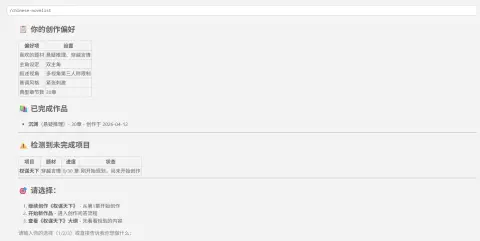
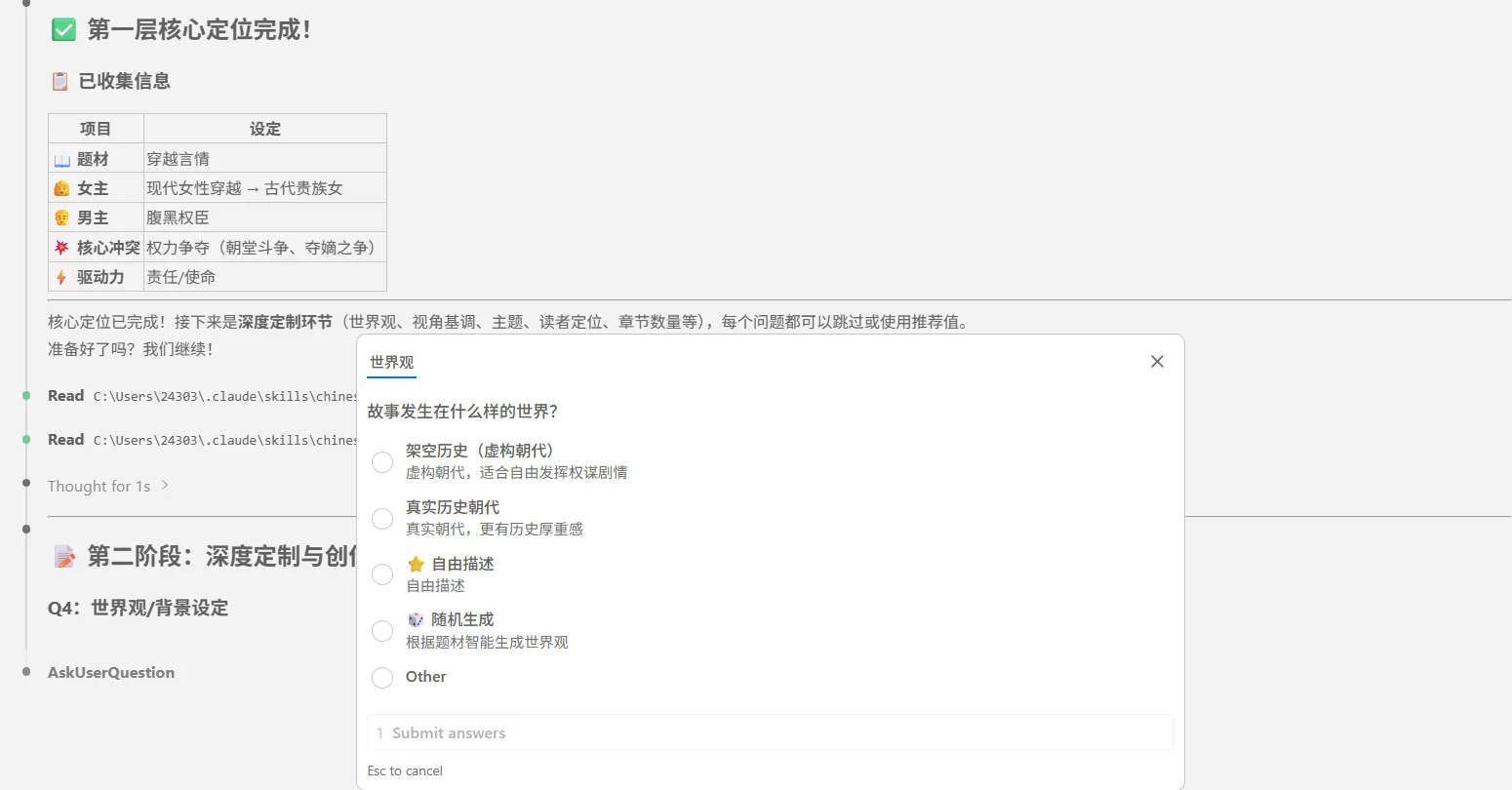
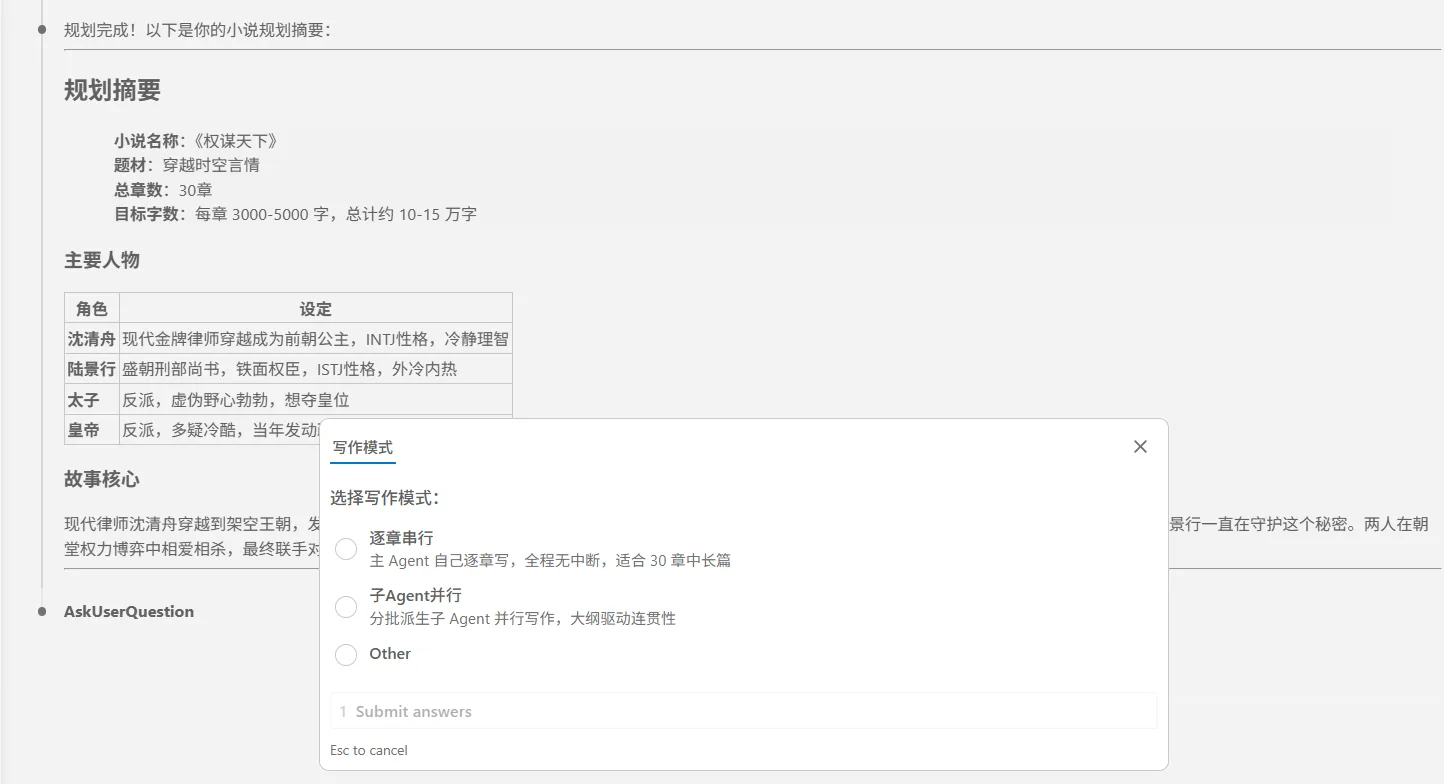
The work is split into numbered phases, each with its own instruction file under `references/flows/`. Phase 0 loads the writer's saved preferences and checks for an unfinished project to resume. Phase 1 asks three required questions, then optional deeper ones (world, point of view, theme, audience, chapter count) and proposes a title; every question can be skipped or randomised. Phase 2 shows the plan for confirmation, and the writer picks a mode: one agent writing chapter after chapter, parallel sub-agents writing in batches, or Claude Code Agent Teams for longer books.
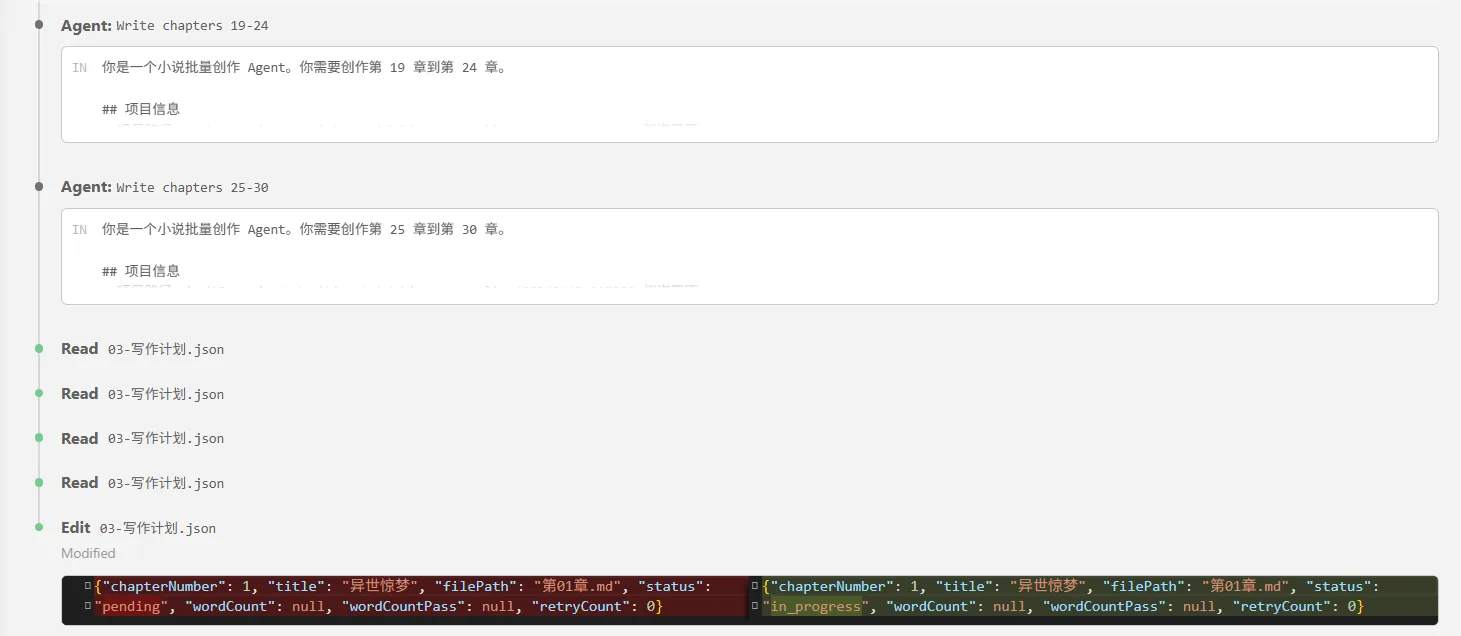
Phase 3 writes without further prompts. For each chapter the skill analyses what the chapter needs, drafts it, runs a polishing pass meant to strip stock "AI-flavoured" phrasing, checks the length and appends a summary to a running chapter digest that later chapters read for continuity. Phase 4 then checks the whole manuscript for word count and coherence and rewrites failing chapters, up to three rounds. Version 2.3 added a style-baseline file (a style fingerprint, reference paragraphs and a list of phrasings to avoid) and a glossary to stop names and terms drifting between chapters; v2.3.1 added a fact-ledger rule and a quantified AI-flavour check.
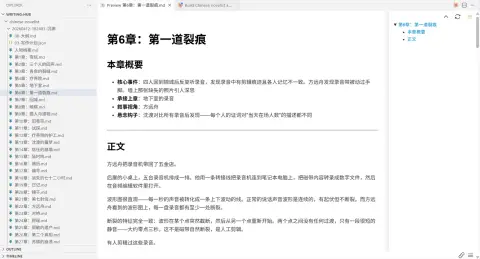
Everything the skill produces is plain files in a dated project folder (outline, character profiles, writing plan JSON, style baseline, chapter summaries and one file per chapter), so a draft can be read, edited or continued in any editor. A small Python script, `scripts/check_chapter_wordcount.py`, does the length checks. The README and prompts are in Simplified Chinese, and the skill writes Chinese fiction only.
What it does
- Layered interview: three required questions (genre, protagonists, core conflict), optional deeper customisation and a generated title, with skip or random answers at every step
- Planning artefacts before any prose: a seven-column chapter outline, character profiles and a JSON writing plan that tracks each chapter's status, word count and retries
- Three writing modes: one agent writing chapter after chapter, batched parallel sub-agents coordinated through the plan file, or Claude Code Agent Teams
- Per-chapter loop of pre-writing analysis, a 3,000–5,000 character draft, a de-"AI-flavour" polish, a length check and a running summary for continuity
- Automatic final validation of length and coherence, rewriting failing chapters for up to three rounds
- Cross-session memory of your preferred genres, viewpoint, tone and chapter count, plus detection and resumption of unfinished projects
Getting started
chinese-novelist is a skill folder, not an app: it runs inside a coding agent that reads `SKILL.md` (the README targets Claude Code). Prompts and output are Simplified Chinese.
Install the skill
The skills CLI fetches the repository and asks which agents to add it to.
npx skills add PenglongHuang/chinese-novelist-skillOr copy it into Claude Code's skills directory
The README's manual route is to place the folder at `~/.claude/skills/chinese-novelist/`.
git clone https://github.com/PenglongHuang/chinese-novelist-skill ~/.claude/skills/chinese-novelistAsk for a novel
In a new session, give the trigger sentence from the README ("use chinese-novelist to write me a novel"). The skill loads your saved preferences and offers to resume any unfinished project.
使用 chinese-novelist 帮我写一部小说Answer the interview
Pick a genre, protagonist set-up and core conflict, then continue to the optional questions or say "跳过" (skip) or "都用默认" (use the defaults).
Confirm the plan and choose a writing mode
Reply "确认" (confirm) to the outline and character summary, then choose serial, parallel sub-agent or Agent Teams writing. From here the skill writes without asking again.
Read the manuscript
Output lands in a dated project folder next to a shared `user-preferences.json`: `00-人物档案.md` (characters), `01-大纲.md` (outline), `02-写作计划.json` (plan), `03-文风基准.md` (style baseline), `99-章节摘要.md` (chapter digest) and one `第NN章-<title>.md` per chapter.
Commands and code are distilled from the project's own documentation — always check the official repo for the latest.
When to use it
- Drafting a complete Chinese web novel (mystery, romance, fantasy, sci-fi, wuxia, historical) from a one-line idea
- Producing an outline, cast and chapter plan to revise by hand before any prose is written
- Running a long serial unattended with parallel sub-agents, then resuming it in a later session
- Studying how a multi-phase writing workflow can be encoded as a skill with plain Markdown and JSON state
How chinese-novelist compares
chinese-novelist alongside other open-source writing & marketing tools AI/TLDR tracks, ranked by GitHub stars.
| Tool | Stars | What it does |
|---|---|---|
| AiToEarn | ★ 27.6k | An AI content-marketing agent that creates, schedules and publishes posts to 14+ Chinese and global social platforms, with an MCP server, an agent skill bundle and a self-hosted Docker stack. |
| InkOS | ★ 11.1k | Story-creation agent for long novels, short fiction, scripts, storyboards, interactive film and translation, sharing one tool loop across a Studio web app, a TUI and a CLI while it keeps story state on disk. |
| xiaobei | ★ 8.7k | A self-hosted team of AI agents, built on openclaw, that small businesses control from WeChat to write, publish and track social-media content and win customers. |
| chinese-novelist | ★ 4.8k | A coding-agent skill that plans and writes a complete Chinese novel, chapter by chapter |
| GEOFlow | ★ 4.1k | An open-source, self-hosted platform for generative engine optimization that runs knowledge-grounded AI content through quality checks, human review and multi-site publishing. |
| md2wechat | ★ 3.8k | Command-line tool that AI agents can drive to turn Markdown into WeChat Official Account articles, generate covers and infographics, check readiness and create drafts. |
| AI Novel Writer | ★ 2.6k | Local-first Windows and macOS desktop app that takes a novel from premise, characters and worldbuilding through chapter blueprints, drafts, AI review and revision, using local Ollama or cloud models. |
| Jasper | — | AI platform for marketing teams that runs brand-aware content workflows, campaigns and copy at scale using specialized agents. |