
What is GEOFlow?
GEOFlow is an open-source platform for GEO (generative engine optimization) operations on company websites. It sits in the Writing & Marketing category of the AI Productivity & Writing tools and is open-source, written in PHP and licensed AGPL-3.0. To get started: start a local instance with Docker.
Overview
GEOFlow is an open-source platform for GEO (generative engine optimization) operations on company websites. It connects trusted knowledge, AI content production, quality gates, human review, multi-site delivery and analytics in one admin system, so brand, growth and content teams can run an enterprise website, a GEO sub-channel, an industry source site or an internal content operations platform while keeping source material, review decisions, publishing results and operating data together.
The workflow runs as a loop: knowledge and assets feed AI content production, an AI quality gate checks each article, a human reviews it, and it is published to the main website, to hosted channel sites, or through a manual publishing desk assisted by a Chrome extension. Traffic and AI visibility analytics then feed back into the knowledge base. The knowledge base supports structured chunking, optional semantic planning and vector recall, and the quality gate scores articles against knowledge evidence, data and citations, advertising rules and publishing context, keeping articles that are pending, blocked or expired in draft.
It is a Laravel application backed by PostgreSQL (pgvector recommended) and Redis, deployed with Docker Compose. Published sites automatically serve `robots.txt`, `sitemap.xml`, `sitemap.txt` and `llms.txt`, alongside SEO metadata, Open Graph and Schema output. Distribution channels include hosted sites, a generated GEOFlow Agent PHP package for target sites, WordPress REST and a generic HTTP API. A separate Updater handles signed updates, full backups and restore-point rollback, and an API v1, the `bin/geoflow` CLI and a bundled Agent Skill cover automation. The README is written in Chinese with English, Japanese, Spanish, Russian and Brazilian Portuguese translations, and the admin UI supports six languages. The project is licensed AGPL-3.0 (earlier versions were released under Apache-2.0) and is free for commercial use under those terms; the copyright holder offers a separate commercial license for closed-source integrations that need an exemption from AGPL obligations.
What it does
- Central libraries for knowledge, titles, keywords, images, authors, prompts and AI models, with structured knowledge chunking and vector recall
- AI quality gate that checks articles against knowledge evidence, citations, advertising rules and publishing context, recording scores, source locations and suggested fixes
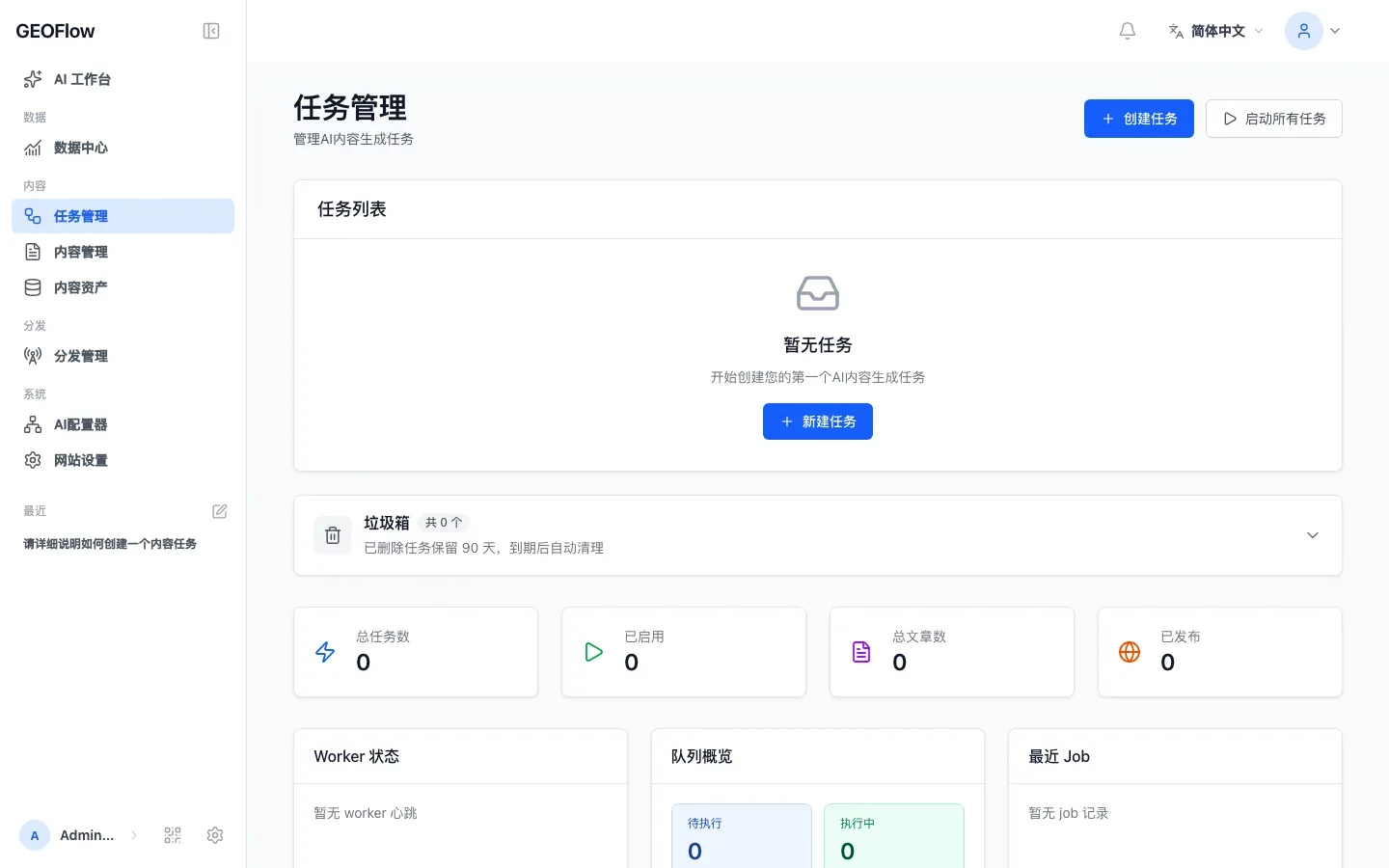
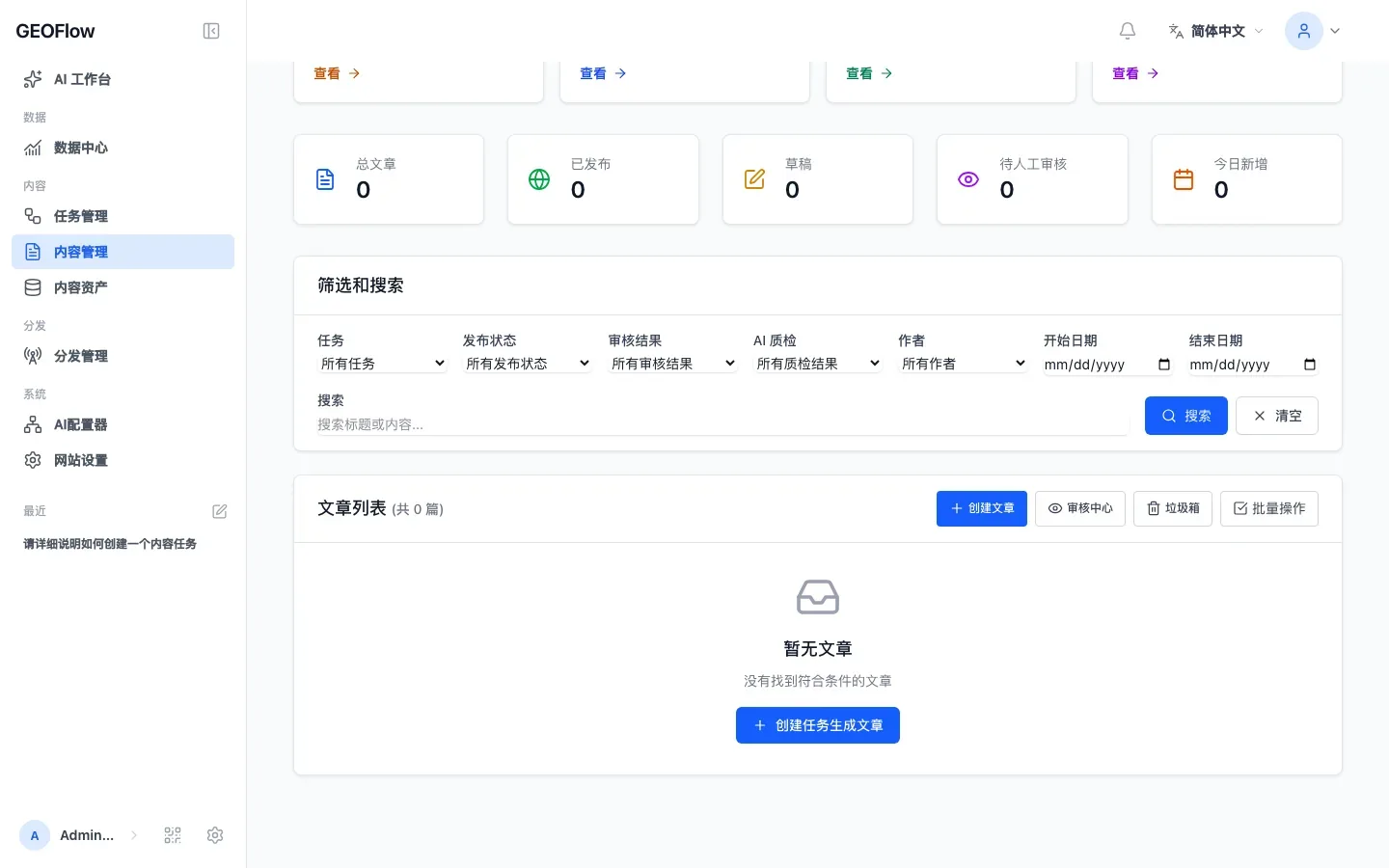
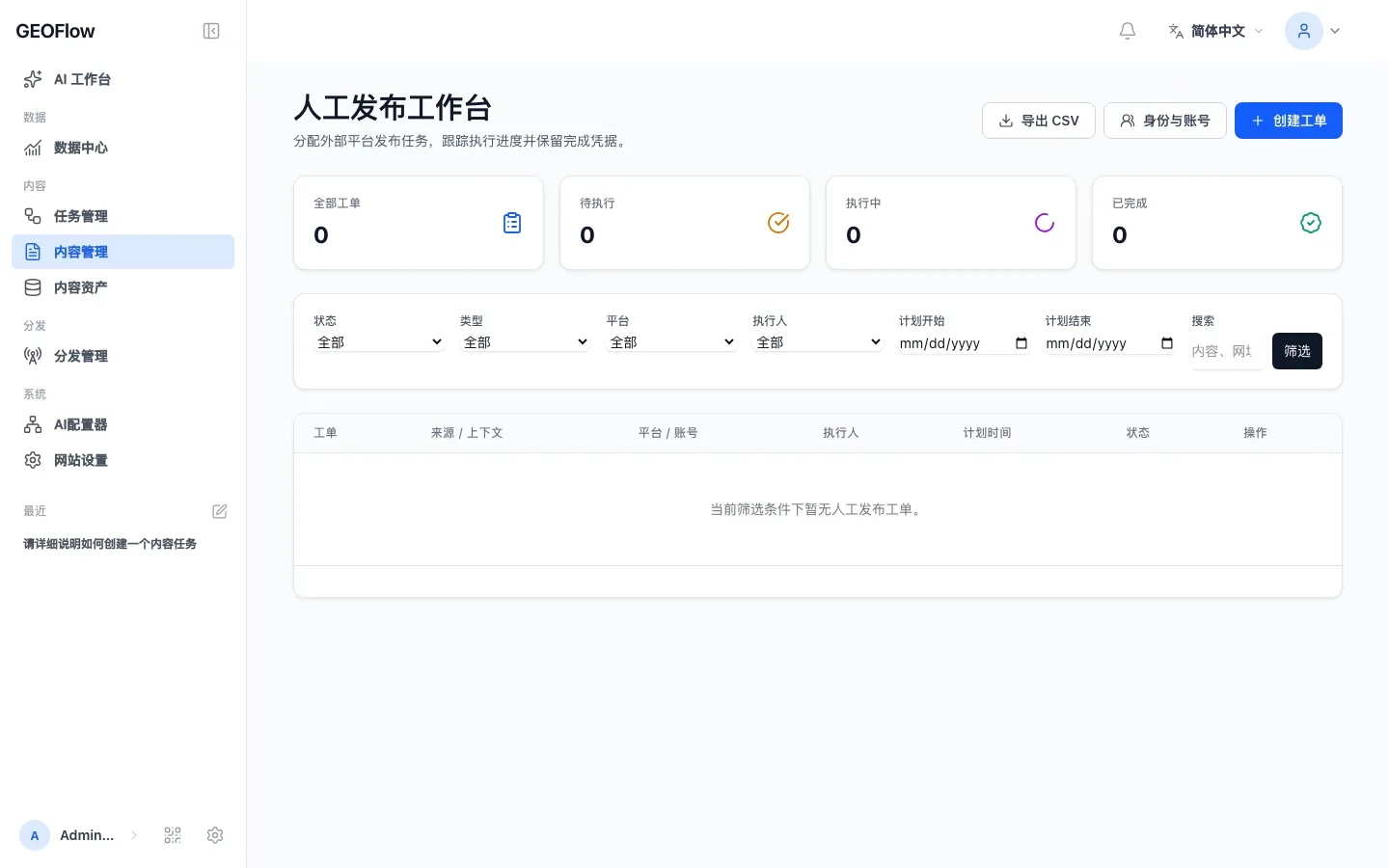
- Review workflow for drafts, approval, publishing, trash and batch Markdown export, plus a manual publishing desk that records accounts, assignees, schedules and receipts
- Multi-site delivery to hosted channel sites, GEOFlow Agent target sites, WordPress REST and generic HTTP APIs, with automatic sitemaps and `llms.txt`
- Data center covering content, distribution, visits, top content, AI crawlers and AI visibility (brand mentions and competitor sources)
- Developer entry points: API v1, the `bin/geoflow` CLI and a built-in GEOFlow Agent Skill
Getting started
GEOFlow needs PHP 8.3+, PostgreSQL (pgvector recommended), Redis and Node.js for front-end builds; the quickest route is Docker Compose. For production the project recommends a stable release or a pinned, reviewed commit.
Start a local instance with Docker
The `init` service runs database migrations and the empty-database install on first start.
git clone https://github.com/yaojingang/GEOFlow.git
cd GEOFlow
cp .env.example .env
docker compose build
docker compose up -d --remove-orphans
Open the site and the admin
The front end defaults to `http://localhost:18080` and the admin to `http://localhost:18080/geo_admin/login`. `APP_PORT` controls the port and `ADMIN_BASE_PATH` the admin prefix; default development admin credentials are in the deployment guide.
Deploy for production
Production uses `docker-compose.prod.yml` with Nginx and php-fpm. Set an explicit admin password, HTTPS, cookie security and reverse proxy settings first; the full procedure is in `docs/deployment/DEPLOYMENT.md`.
cp .env.prod.example .env.prod
docker compose --env-file .env.prod -f docker-compose.prod.yml build
docker compose --env-file .env.prod -f docker-compose.prod.yml up -d postgres redis
docker compose --env-file .env.prod -f docker-compose.prod.yml up -d init
docker compose --env-file .env.prod -f docker-compose.prod.yml up -d --remove-orphans app web queue ai-quality-queue ai-quality-backfill-queue ai-optimization-queue knowledge-queue scheduler reverb
Build and test from source
For development work on GEOFlow itself.
composer install
npm ci
npm run build
composer test
Commands and code are distilled from the project's own documentation — always check the official repo for the latest.
When to use it
- Run a company website's GEO program, continuously publishing product, case, FAQ and industry content grounded in a knowledge base
- Spin up GEO sub-channels or an industry source site on subdomains with SEO metadata, sitemaps and `llms.txt` generated automatically
- Give an agency or content team one back office to produce, quality-check, review and distribute content across several brands and sites
- Track how often AI answers mention a brand and which sources and competitors they cite
Version history
Every verified update to GEOFlow that AI/TLDR tracked, newest first — each links to our coverage and the official changeset.
- 2026-09-16v3.2.0-beta.1
Beta for development and isolated testing: a standalone remote CLI for named instances, remote theme drafts with live preview, and recovery safeguards coordinated with the Updater.
- 2026-09-09v3.1.0
Pairs with Updater 0.4.0 to add blue/green deployment, automatic migrations and full recovery, plus conversational task creation, site theme packages and AI visibility analysis.
- 2026-09-04v3.0.0
Unifies the product in Admin UI V3 and adds article AI quality checks, hosted channel sites, the Chrome operations assistant and a standalone Updater for signed updates, backups and rollback.
How GEOFlow compares
GEOFlow alongside other open-source writing & marketing tools AI/TLDR tracks, ranked by GitHub stars.
| Tool | Stars | What it does |
|---|---|---|
| AiToEarn | ★ 27.6k | An AI content-marketing agent that creates, schedules and publishes posts to 14+ Chinese and global social platforms, with an MCP server, an agent skill bundle and a self-hosted Docker stack. |
| InkOS | ★ 11.1k | Story-creation agent for long novels, short fiction, scripts, storyboards, interactive film and translation, sharing one tool loop across a Studio web app, a TUI and a CLI while it keeps story state on disk. |
| xiaobei | ★ 8.7k | A self-hosted team of AI agents, built on openclaw, that small businesses control from WeChat to write, publish and track social-media content and win customers. |
| chinese-novelist | ★ 4.8k | An agent skill that interviews you, plans an outline, cast and chapter plan, then writes, polishes and checks a complete 10–50 chapter Chinese novel, one Markdown file per chapter. |
| GEOFlow | ★ 4.1k | Self-hosted GEO content operations: knowledge, AI writing, quality gates and multi-site publishing |
| md2wechat | ★ 3.8k | Command-line tool that AI agents can drive to turn Markdown into WeChat Official Account articles, generate covers and infographics, check readiness and create drafts. |
| AI Novel Writer | ★ 2.6k | Local-first Windows and macOS desktop app that takes a novel from premise, characters and worldbuilding through chapter blueprints, drafts, AI review and revision, using local Ollama or cloud models. |
| Jasper | — | AI platform for marketing teams that runs brand-aware content workflows, campaigns and copy at scale using specialized agents. |