
What is InkOS?
InkOS is an agent system for story creation and multilingual translation. The same workbench handles long-form serialised novels, standalone short fiction, scripts, storyboards, fan fiction and continuations, branching interactive film and games, open worlds, and long-document translation. It sits in the Writing & Marketing category of the AI Productivity & Writing tools and is open-source, written in TypeScript and licensed AGPL-3.0.
Overview
InkOS is an agent system for story creation and multilingual translation. The same workbench handles long-form serialised novels, standalone short fiction, scripts, storyboards, fan fiction and continuations, branching interactive film and games, open worlds, and long-document translation. Three surfaces — a Studio web app, a terminal UI, and an `inkos` CLI — share one action layer, so a session can move between them without losing state.
The design premise is that the hard part of a long book is not generating prose but keeping the book coherent over hundreds of thousands of words. So InkOS, not the model, owns confirmation, context, state, atomic persistence and what counts as the canonical artefact. Characters, worldbuilding, plot threads and chapter state live in files on disk; retrieval runs over a rebuildable SQLite FTS5/BM25 projection of story memory, archived material and skill references, with source files staying authoritative and retrieved evidence keeping its source location. Prose, state, hooks and run snapshots are validated in a chapter workspace and committed atomically, so state cannot advance when the prose fails to persist.
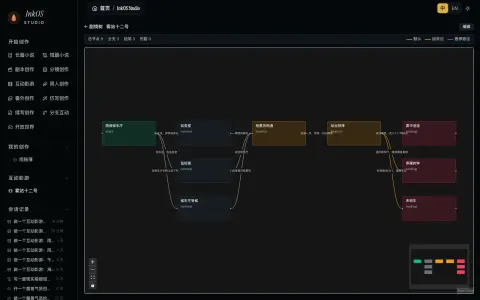
Work is organised into named modes rather than one catch-all prompt. Long-form writing runs a `plan → compose → draft → audit → revise` chain per chapter. A narrative-forecast mode generates isolated future branches from current canon and compares their beats, character decisions and risks before you commit to one — selecting a branch writes only a plan file and leaves prose, outlines and canon untouched. InkOS Short produces a complete standalone package (manuscript, outline and review records, synopsis, selling points, cover prompt). InkOS Play builds open worlds or branching interactive fiction from a natural-language world contract covering time flow, character agents, inventory, evidence, relationships and scene state.
It is model-agnostic: Studio carries provider settings, model routing, aggregator entries and custom OpenAI-compatible endpoints, and LM Studio is supported for local models. Fifteen built-in professional skills ship as standard `SKILL.md` packages covering long-form writing and review, commercial shorts, Play, scripts, storyboards, interactive film, translation, analysis, market research, import, covers and semantic de-slopping — and because the format is the standard one, an external coding agent can drive InkOS through the same entry point. The project is AGPL-3.0 and published to npm as `@actalk/inkos`.
What it does
- One tool loop across three surfaces — the Studio web app, a TUI, and the `inkos` CLI — sharing the same typed action and result boundary
- Atomic, composable commands (`plan chapter`, `compose chapter`, `draft`, `audit`, `revise`, `write next`) that each do one thing and accept `--json`, so external agents can call them
- Story state on disk: characters, worldbuilding, plot threads and canon are files, with chapter workspaces committed atomically so prose and state cannot drift apart
- Local retrieval over one rebuildable SQLite FTS5 / BM25 projection, with imported material bindable to a specific book and retrieved by task instead of injected wholesale
- Narrative forecast — generate 2–5 isolated future branches from current canon and compare their beats, decisions and risks before writing the next chapter
- Modes for short fiction, scripts, storyboards, interactive film and open-world Play, each with its own craft method on shared execution and recovery infrastructure
- Fifteen built-in skills in the standard `SKILL.md` format, plus imports from the usual `skills/`, `.agents/skills/` and `~/.agents/skills/` locations
- Provider-agnostic model configuration in Studio, including custom OpenAI-compatible endpoints and LM Studio for local models
Getting started
InkOS installs from npm as a global CLI. Node.js 22 or later is required.
Install
npm i -g @actalk/inkosInitialise a project and create a book
`init` sets up the project directory; `book create` takes the genre, chapter length and target length, and can read a brief from a file.
inkos init my-project
inkos book create --genre litrpg --chapter-words 2500 --target-chapters 120 --lang en
inkos book list
Write a chapter with the full pipeline
`write next` runs the governance chain end to end — plan the chapter intent, compose its inputs, draft, audit and auto-revise — and can run several chapters in sequence as one recoverable task.
inkos write next my-book
inkos write next my-book --count 5
Or drive the steps one at a time
Every stage is also a standalone command. `plan` and `compose` govern the inputs; `draft`, `audit` and `revise` handle prose and quality. `--json` makes each one machine-readable, which is how an external agent drives InkOS.
inkos plan chapter my-book --context "Focus on the mentor conflict first" --json
inkos compose chapter my-book --json
inkos draft my-book --context "The dungeon boss encounter and party dynamics" --json
inkos audit my-book 31 --json
inkos revise my-book 31 --json
Talk to it instead
Agent mode exposes only the tools that make sense for the current session kind. The shared interaction entry point is what a coding agent should prefer, since it routes through the same executor as the TUI and Studio.
inkos agent "Write a LitRPG novel where the MC is a healer class in a dungeon world"

# the entry an external agent should call
inkos interact --json --message "continue the current book, but keep the pacing tighter"
Commands and code are distilled from the project's own documentation — always check the official repo for the latest.
When to use it
- Reach for it when a book is long enough that the model can no longer hold its own canon, and you need characters, worldbuilding and plot threads kept in files the tool re-reads
- Reach for it to build branching interactive fiction or an open world where scene state, inventory, evidence and relationships have to persist between turns
- Reach for it to produce a complete short-fiction package — manuscript, synopsis, selling points and cover — from one brief
- Reach for it when you want a coding agent such as Claude Code or OpenClaw to do the writing, but want the story state managed by something other than the chat log
How InkOS compares
InkOS alongside other open-source writing & marketing tools AI/TLDR tracks, ranked by GitHub stars.
| Tool | Stars | What it does |
|---|---|---|
| AiToEarn | ★ 27.6k | An AI content-marketing agent that creates, schedules and publishes posts to 14+ Chinese and global social platforms, with an MCP server, an agent skill bundle and a self-hosted Docker stack. |
| InkOS | ★ 11.1k | A story-creation agent that owns the state a long book needs — characters, worldbuilding, plot threads and canon — instead of re-prompting for it |
| xiaobei | ★ 8.7k | A self-hosted team of AI agents, built on openclaw, that small businesses control from WeChat to write, publish and track social-media content and win customers. |
| chinese-novelist | ★ 4.8k | An agent skill that interviews you, plans an outline, cast and chapter plan, then writes, polishes and checks a complete 10–50 chapter Chinese novel, one Markdown file per chapter. |
| GEOFlow | ★ 4.1k | An open-source, self-hosted platform for generative engine optimization that runs knowledge-grounded AI content through quality checks, human review and multi-site publishing. |
| md2wechat | ★ 3.8k | Command-line tool that AI agents can drive to turn Markdown into WeChat Official Account articles, generate covers and infographics, check readiness and create drafts. |
| AI Novel Writer | ★ 2.6k | Local-first Windows and macOS desktop app that takes a novel from premise, characters and worldbuilding through chapter blueprints, drafts, AI review and revision, using local Ollama or cloud models. |
| Jasper | — | AI platform for marketing teams that runs brand-aware content workflows, campaigns and copy at scale using specialized agents. |