Overview
OpenRig describes itself in one line: a harness wraps a model, and a rig wraps your harnesses. It turns AI coding agents from a pile of terminal sessions into a persistent, organized team. You define the team in YAML, boot it with one command, and Claude Code and Codex run in the same rig, managed as one system. The idea is that you talk to a lead agent about the outcome you want, and it coordinates specialists and brings back results and the decisions that need your attention.
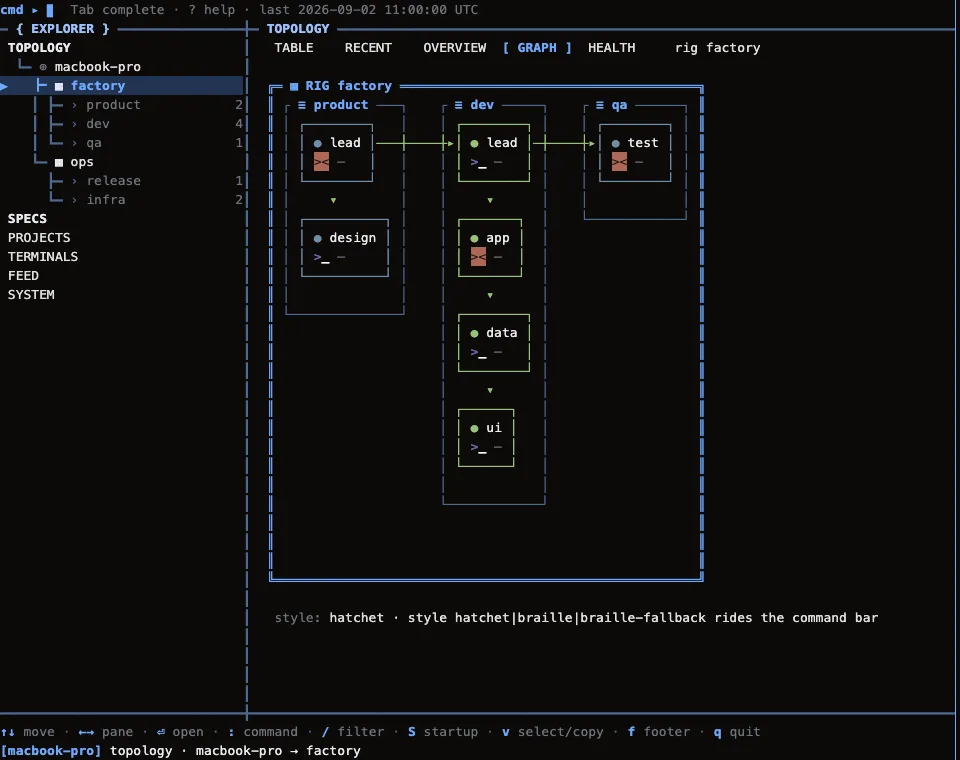
Under the hood it is a local daemon, a CLI, a terminal UI and an MCP server, built on tmux. A RigSpec declares the topology — pods of related seats, the edges between them, and continuity policies — and every seat gets a stable address such as dev-owner@first-project. `rig up` starts the tmux sessions, harnesses and startup files and runs readiness checks; `rig send`, `rig broadcast` and `rig chatroom` carry messages between agents; `rig down --snapshot` captures the whole topology so it can be restored by name after a reboot. Agents can also manage their own topology through MCP tools such as rig_up, rig_ps and rig_send.
It runs on macOS or Linux with Node.js 20, 22 or 24 and tmux (native Windows is not supported). Setup writes to real configuration files — ~/.tmux.conf, ~/.claude.json and the Codex config — so the project asks you to review the dry run and back those files up first. The code is TypeScript under the Apache-2.0 license.
What it does
- RigSpec: a declarative YAML definition of the team, with pods, members, edges, continuity policies and a CULTURE.md that sets coordination norms
- One command boots the team: `rig up` starts tmux sessions, native Claude Code and Codex harnesses, startup files and readiness checks
- A terminal UI that shows rigs, pods and seats as a topology graph or a table with runtime, model, context and state, plus per-seat detail
- Agent-to-agent messaging with `rig send`, `rig broadcast` and `rig chatroom`
- Snapshot a running topology with `rig down --snapshot` and restore it by name with `rig up <name>`
- Discovery: `rig discover` fingerprints existing Claude Code and Codex sessions and `rig adopt` brings them under management
- An MCP server so agents can inspect and change their own topology, plus reusable AgentSpecs and portable RigBundles with SHA-256 integrity
- Starter rigs including first-project, product-team, conveyor, implementation-pair, adversarial-review and research-team
Getting started
You need Node.js 20, 22 or 24 and tmux on macOS or Linux (the release notes recommend Node.js 22 on Apple silicon). Setup changes your tmux, Claude Code and Codex configuration, so read the dry run first and back up those files.
Install the CLI
Install the rig command globally with npm. Since v0.5.17 it also installs with Bun.
npm install -g @openrig/cli
# or
bun add -g @openrig/cli
Preview setup
Setup checks the native harnesses and tmux, and writes OpenRig configuration to ~/.tmux.conf plus the Claude Code and Codex trust settings. The dry run shows what it would change; Codex needs to be signed in.
rig setup --dry-runBoot the first-project starter
From your repository, bring up the default two-seat starter rig against the current directory.
cd /path/to/your/repository
rig up first-project --cwd .
Watch the team in the TUI
Open the terminal UI to see the rig as a graph or a table of seats, then send the team a bounded task and track the work through the shared queue.
rig tui --shared
Explore other rigs and terminals
List every shipped starter spec, or open the agents' terminals side by side in a herdr or cmux workspace.
rig specs ls
rig terminal open first-project --provider herdr
Commands and code are distilled from the project's own documentation — always check the official repo for the latest.
When to use it
- Run Claude Code and Codex together on one repository as a single managed team instead of juggling separate terminal windows
- Give a lead agent an outcome and let it coordinate implementation, QA and review seats, surfacing only the decisions that need you
- Recover a multi-agent setup after a reboot by restoring a named snapshot rather than rebuilding every session by hand
- Bring agent sessions you already have running under management with discovery and adoption
How OpenRig compares
OpenRig alongside other open-source multi-agent systems tools AI/TLDR tracks, ranked by GitHub stars.
| Tool | Stars | What it does |
|---|---|---|
| Ruflo | ★ 73.4k | Agent meta-harness that wraps Claude Code and Codex with 100+ specialized agents, swarm coordination, vector memory, background workers and cross-machine agent federation. |
| MetaGPT | ★ 70.7k | A multi-agent framework that models a software company, assigning roles like product manager, architect, and engineer to generate code from a single prompt. |
| AutoGen | ★ 61.2k | Microsoft Research's framework for building applications where multiple agents converse with each other and with tools to solve tasks. |
| CrewAI | ★ 59.1k | A framework for assembling teams ('crews') of role-playing agents that divide tasks and collaborate to complete a goal. |
| AgentScope | ★ 32.5k | A framework for building multi-agent applications with message passing, visual debugging tools, and distributed execution. |
| OpenAI Agents SDK | ★ 29.7k | OpenAI's lightweight Python SDK for building multi-agent workflows using explicit handoffs, tools, and guardrails. |
| A2A | ★ 26k | Open Agent2Agent protocol from Google (now in the Linux Foundation) that lets agents from different frameworks discover each other and collaborate over JSON-RPC. |
| OpenRig | — | A harness for your harnesses: define a team of Claude Code and Codex agents in YAML and boot it with one command |